


Page 1350 - Hall et al (2015) Principles of Critical Care-McGraw-Hill
P. 1350
CHAPTER 97: Acute Kidney Injury  923


                         120                                                independent of GFR in studies to date. 77-79  It undergoes purely renal
                                   Surgery, MI, sepsis                    excretion. Serum cystatin C levels increase before serum creatinine
                         100                                              levels in patients with progressive chronic kidney disease. 77,79  Emerging
                        GFR (mL/min)  80      Reversal of ischemia        data suggest that plasma cystatin C levels similarly increase 1 to 2 days
                          60
                                                                          before serum creatinine in patients developing AKI in a variety of
                                                                          settings,  including radio-contrast nephropathy,  renal transplantation,
                                                                                                           80
                                                                                                                           81,82
                                                                               79
                          40
                                                                                               84
                                                                                    83
                          20                                              cirrhotic AKI,  malarial AKI,  and AKI in the ICU. 85,86  In the latter study
                                                                          of 85 critically ill patients, Herget-Rosenthal and colleagues showed that
                           0 7 6                                          AKI defined by elevation of cystatin C occurred 1 to 2 days before serum
                        Serum creatinine (mg%)  5 4 3 2                   analysis was 0.82 and 0.97 on the 2 days prior to creatinine-defined AKI. 86
                                                                          creatinine elevation; the area under the curve in receiver operating curve
                                                                           In patients with azotemia and/or oliguria, traditional urine chemistry
                                                                          markers may provide useful information, interpreted in combination with
                                                                          other clinical and laboratory parameters (see below), including micro-
                                                                          hypoperfusion and injury will  prove  clinically useful  in the  future.
                                                                                                                           88,89
                           0 1                                            scopic urinalysis. 72,87  Hopefully, more sensitive markers of early renal
                                 0        7      14       21      28      Meanwhile, all clinically available renal function indices should be used
                                             Time, days                   in combination for assessment of renal perfusion and function in the ICU.
                    FIGURE 97-3.  Dynamic relationship between serum creatinine and GFR in AKI. Moran and     ■  DIAGNOSTIC APPROACH TO ACUTE RENAL FAILURE
                    Myers demonstrated that elevation of serum creatinine lags significantly behind GFR decre-
                    ments in AKI. In this example, an acute decrement in GFR to <10 mL/min (commonly a dialysis-  The diagnostic approach to AKI involves assignment of the cause to
                    requiring level) after a major ischemic insult is associated with a subsequent slow, daily rise of   prerenal, renal, or postrenal categories, with further refinement of the
                    serum creatinine. The daily serum creatinine increment is determined by creatinine generation   diagnosis based on additional laboratory testing.
                    (muscle mass and catabolic state), volume status (volume of distribution of creatinine), and the   History and Physical Examination in Acute Renal Failure:  Any decrease in
                    new GFR level. Serum creatinine continues to rise until creatinine generation equals creatinine   effective perfusion of the kidneys can result in the syndrome of prer-
                    excretion at steady state. Only after a week is it fully apparent from the serum creatinine level   enal AKI. This may be the result of an absolute decrease in the extra-
                    how low the GFR is in this patient with AKI; this could have been inferred from the progressive   cellular fluid (ECF) volume, redistribution of ECF from vascular to
                    daily serum creatinine increments, and measured by urine collection for an abbreviated creati-  interstitial locations (third-spacing), or impaired delivery of blood
                    nine clearance. (Reproduced with permission from Moran SM, Myers BD. Course of acute renal   to the kidneys such as can occur in patients with renal arterial ste-
                    failure studied by a model of creatinine kinetics. Kidney Int. June 1985;27(6):928-937.)  nosis, vasculitis, or depressed cardiac function. Third-space losses
                                                                          should be suspected in the presence of severe burns, pancreatitis,
                    estimate of GFR than serum creatinine alone, and are more timely than   peritonitis, or recent abdominal surgery. Absolute decreases in the
                    24-hour urine collections.  Emerging data suggest that serial monitoring   ECF volume are most common in the setting of gastrointestinal fluid
                                      76
                    of serum cystatin C levels may provide a more sensitive index of early   losses or in patients receiving excessive doses of diuretics.
                    AKI than serum creatinine or BUN. Cystatin C is a nonglycosylated   Decreases  in  weight, if  known,  can  provide  some  information
                    13-kDa basic protein that is a member of the cystatin super-family of   about the degree of ECF loss. However, weight changes are subject to
                    cysteine protease inhibitors. It is produced by all nucleated cells, and   misinterpretation if the nature of fluid loss is not taken into account
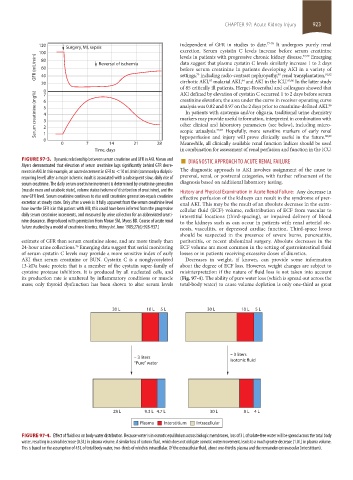
                    its production rate is unaltered by inflammatory conditions or muscle   (Fig. 97-4). The ability of pure water loss (which is spread out across the
                    mass; only thyroid dysfunction has been shown to alter serum levels   total-body water) to cause volume depletion is only one-third as great


                                                  30 L        10 L  5 L            30 L       10 L  5 L


                                                                                           – 3 liters
                                                          – 3 liters                       isotonic fluid
                                                          “Pure” water


                                                   28 L       9.3 L 4.7 L           30 L       8 L  4 L
                                                            Plasma  Interstitium  Intracellular

                    FIGURE 97-4.  Effect of fluid loss on body water distribution. Because water is in osmotic equilibrium across biologic membranes, loss of 3 L of solute-free water will be spread across the total body
                    water, resulting in a small decrease (0.3 L) in plasma volume. A similar loss of isotonic fluid, which does not obligate osmotic water movement, leads to a much greater decrease (1.0 L) in plasma  volume.
                    This is based on the assumption of 45 L of total body water, two-thirds of which is intracellular. Of the extracellular fluid, about one-third is plasma and the remainder extravascular (interstitium).


            section08.indd   923                                                                                       1/14/2015   8:27:55 AM

