


Page 1371 - Hall et al (2015) Principles of Critical Care-McGraw-Hill
P. 1371
944     PART 8: Renal and Metabolic Disorders


                                                                         2.  The collecting duct must be permeable to water, allowing water
                     • Total body phosphate stores may be significantly reduced and pro-  to osmotically flow out of the collecting ducts into the medullary
                    duce organ dysfunction even in the face of normal or minimally   interstitium, concentrating the urine. This is affected by ADH. Thus
                    decreased serum levels; if suspicion for a depleted state exists, treat-  ADH is required for production of concentrated urine.
                    ment should be given.
                     • Severe hypomagnesemia may have significant consequences itself,   Antidiuretic Hormone:  ADH plays a crucial role in the concentrating and
                    including cardiac arrhythmias and muscle weakness; lesser degrees   diluting process. ADH, or vasopressin, is a six-peptide amino acid pro-
                                                                       duced in the hypothalamus and stored in the posterior pituitary gland.
                    of hypomagnesemia often accompany hypokalemia and hypocal-
                    cemia and correction of the magnesium deficit facilitates correc-  Release of ADH follows increases in osmolality or dramatic drops in blood
                    tion of the other electrolyte abnormalities.       pressure or EABV. An increase in serum osmolality of 1% (2 mOsm/kg)
                                                                       will stimulate ADH, while a similar decrease inhibits release. ADH
                                                                       is less sensitive to changes in blood volume; a loss of 7% to 10% of
                                                                       blood volume is required to release ADH.  When osmolality sup-
                                                                                                        1
                 SODIUM                                                presses and volume depletion stimulates ADH release, volume effects
                     ■  METABOLISM                                     predominate and ADH is released. Osmolality is a more sensitive ADH
                                                                       stimulus, while volume is a more potent ADH stimulus. ADH is also
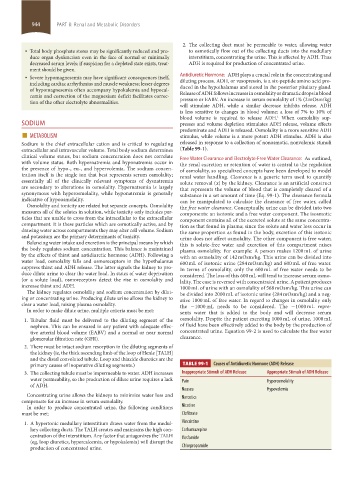
                 Sodium is the chief extracellular cation and is critical to regulating   released in response to a collection of nonosmotic, nonvolemic stimuli
                 extracellular and intravascular volume. Total body sodium determines   (Table 99-1).
                 clinical volume status, but sodium concentration does not correlate   Free Water Clearance and Electrolyte-Free Water Clearance:  As outlined,
                 with volume status. Both hypernatremia and hyponatremia occur in   the renal excretion or retention of water is central to the regulation
                 the presence of hypo-, eu-, and hypervolemia.  The sodium  concen-  of osmolality, so specialized concepts have been developed to model
                 tration itself is the single ion that best represents serum osmolality;   renal water handling. Clearance is a generic term used to quantify
                 essentially all of the clinically relevant symptoms of dysnatremia   solute removal (x) by the kidney. Clearance is an artificial construct
                 are secondary to alterations in osmolality. Hypernatremia is largely   that represents the volume of blood that is completely cleared of a
                 synonymous with hyperosmolality, while hyponatremia is generally   substance in a set amount of time (Eq. 99-1). The clearance formula
                 indicative of hypoosmolality.                         can be manipulated to calculate the clearance of free water, called
                   Osmolality and tonicity are related but separate concepts. Osmolality   the free water clearance. Conceptually, urine can be divided into two
                 measures all of the solutes in solution, while tonicity only includes par-  components: an isotonic and a free water component. The isosmotic
                 ticles that are unable to cross from the intracellular to the extracellular   component contains all of the excreted solute at the same concentra-
                 compartment. It is these particles which are osmotically active, and by   tion as that found in plasma; since the solute and water loss occur in
                 drawing water across compartments they may alter cell volume. Sodium   the same proportion as found in the body, excretion of this isotonic
                 and potassium are the primary determinants of tonicity.  urine does not affect osmolality. The other component is free water;
                   Balancing water intake and excretion is the principal means by which   this is solute-free water and excretion of this compartment raises
                 the body regulates sodium concentration. This balance is maintained   plasma osmolality. For example: A person makes 1200 mL of urine
                 by the effects of thirst and antidiuretic hormone (ADH). Following a   with an osmolality of 142 mOsm/kg. This urine can be divided into
                 water load, osmolality falls and osmoreceptors in the hypothalamus   600 mL of isotonic urine (284 mOsm/kg) and 600 mL of free water.
                 suppress thirst and ADH release. The latter signals the kidney to pro-  In  terms  of  osmolality,  only  the  600 mL  of free  water  needs  to  be
                 duce dilute urine to clear the water load. In states of water deprivation   considered. The loss of this 600 mL will tend to increase serum osmo-
                 (or a solute load), osmoreceptors detect the rise in osmolality and   lality. The case is reversed with concentrated urine. A patient produces
                 increase thirst and ADH.                              1000 mL of urine with an osmolality of 568 mOsm/kg. This urine can
                   The kidney regulates osmolality and sodium concentration by dilut-  be divided into 2000 mL of isotonic urine (284 mOsm/kg) and a neg-
                 ing or concentrating urine. Producing dilute urine allows the kidney to   ative 1000 mL of free water. In regard to changes in osmolality only
                 clear a water load, raising plasma osmolality.        the  −1000 mL needs to be considered. The  −1000 mL repre-
                   In order to make dilute urine, multiple criteria must be met:  sents water that is added to the body and will decrease serum

                   1.  Tubular fluid must be delivered to the diluting segment of the    osmolality. Despite the patient excreting 1000 mL of urine, 1000 mL
                    nephron. This can be ensured in any patient with adequate effec-  of fluid have been effectively added to the body by the production of
                    tive arterial blood volume (EABV) and a normal or near normal   concentrated urine. Equation 99-2 is used to calculate the free water
                    glomerular filtration rate (GFR).                  clearance.
                   2.  There must be intact sodium resorption in the diluting segments of
                    the kidney (ie, the thick ascending limb of the loop of Henle [TALH]
                    and the distal convoluted tubule. Loop and thiazide diuretics are the
                    primary causes of inoperative diluting segments.)    TABLE 99-1    Causes of Antidiuretic Hormone (ADH) Release
                   3.  The collecting tubule must be impermeable to water. ADH increases   Inappropriate Stimuli of ADH Release  Appropriate Stimuli of ADH Release
                    water permeability, so the production of dilute urine requires a lack   Pain     Hyperosmolality
                    of ADH.
                                                                        Nausea                       Hypovolemia
                   Concentrating urine allows the kidneys to minimize water loss and   Narcotics
                 compensate for an increase in serum osmolality.
                   In order to produce concentrated urine, the following conditions   Nicotine
                 must be met:                                           Clofibrate
                   1.  A hypertonic medullary interstitium draws water from the medul-  Vincristine
                    lary collecting ducts. The TALH creates and maintains the high con-  Carbamazepine
                    centration of the interstitium. Any factor that antagonizes the TALH   Ifosfamide
                    (eg, loop diuretics, hypercalcemia, or hypokalemia) will disrupt the
                    production of concentrated urine.                   Chlorpropamide


            section08.indd   944                                                                                       1/14/2015   8:28:02 AM

