


Page 1372 - Hall et al (2015) Principles of Critical Care-McGraw-Hill
P. 1372
CHAPTER 99: Electrolyte Disorders in Critical Care 945
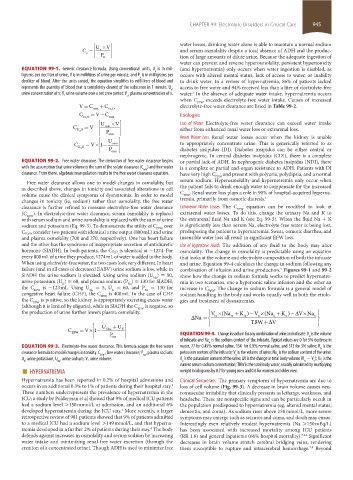
U × V water losses, drinking water alone is able to maintain a normal sodium
C = x and serum osmolality despite a total absence of ADH and the produc-
x P
x tion of large amounts of dilute urine. Because the adequate ingestion of
water can prevent and reverse hyperosmolality, persistent hypertonicity
EqUATIon 99-1. Generic clearance formula. Using conventional units, U is in mil- (and hypernatremia) only occurs when water ingestion is disabled, as
x
ligrams per deciliter of urine, V is in milliliters of urine per minute, and P is in milligrams per occurs with altered mental status, lack of access to water, or inability
x
deciliter of blood. After the units cancel, the equation simplifies to milliliters of blood and to drink water. In a review of hypernatremia, 86% of patients lacked
represents the quantity of blood that is completely cleared of the substance in 1 minute. U , access to free water and 94% received less than a liter of electrolyte-free
x
urine concentration of x; V, urine volume over a set time period; P , plasma concentration of x. water. In the absence of adequate water intake, hypernatremia occurs
2
x
when C EFW exceeds electrolyte-free water intake. Causes of increased
V = C + C electrolyte-free water clearance are listed in Table 99-2.
osm H O
2
V C
C =− Etiologies
HO osm
2
U × V Loss of Water Electrolyte-free water clearance can exceed water intake
V
C HO =− osm either from enhanced renal water loss or extrarenal loss.
2
P osm
U Renal Water Loss Renal water losses occur when the kidney is unable
V 1
C HO =× − ossm to appropriately concentrate urine. This is generically referred to as
2
P osm diabetes insipidus (DI). Diabetes insipidus can be either central or
nephrogenic. In central diabetes insipidus (CDI), there is a complete
EqUATIon 99-2. Free water clearance. The derivation of free water clearance begins or partial lack of ADH. In nephrogenic diabetes insipidus (NDI), there
with the assumption that urine volume is the sum of the solute clearance (C ) and free water is a complete or partial end-organ resistance to ADH. Patients with DI
osm
clearance. From there, algebraic manipulation results in the free water clearance equation. have very high C EFW and present with polyuria, polydipsia, and a normal
Free water clearance allows one to model changes in osmolality, but serum sodium. Hyperosmolality and hypernatremia only occur when
as described above, changes in tonicity and associated alterations in cell the patient fails to drink enough water to compensate for the increased
volume cause the clinical symptoms of dysnatremia. In order to model C EFW . Renal water loss plays a role in 90% of hospital-acquired hyperna-
changes in tonicity (ie, sodium) rather than osmolality, the free water tremia, primarily from osmotic diuresis. 1
clearance is further refined to measure electrolyte-free water clearance Extrarenal Water Losses The C EFW equation can be modified to look at
(C EFW ). In electrolyte-free water clearance, serum osmolality is replaced extrarenal water losses. To do this, change the urinary Na and K to
with serum sodium and urine osmolality is replaced with the sum of urine the extrarenal fluid Na and K (see Eq. 99-3). When the fluid Na + K
sodium and potassium (Eq. 99-3). To demonstrate the utility of C EFW over is significantly less than serum Na, electrolyte-free water is being lost,
C H 2 O, consider two patients with identical urine output (800 mL) and urine predisposing the patient to hypernatremia. Sweat, osmotic diarrhea, and
and plasma osmolality (700 and 270, respectively). One has heart failure insensible water loss all result in significant EFW loss.
and the other has the syndrome of inappropriate secretion of antidiuretic Use of Hypertonic Fluids The addition of any fluid to the body may alter
hormone (SIADH). In both patients, the C H 2 O is identical at −1274. For osmolality. The change in osmolality is predictable using an equation
every 800 mL of urine they produce, 1274 mL of water is added to the body. that looks at the volume and electrolyte composition of both the infusate
When using electrolyte-free water, the two cases look very different. In heart and urine. Equation 99-4 calculates the change in sodium following any
failure (and in all cases of decreased EABV) urine sodium is low, while in combination of infusion and urine production. Figures 99-1 and 99-2
5
SIADH the urine sodium is elevated. Using urine sodium (U ) = 90, show how the change in sodium formula works to predict hypernatre-
Na
urine potassium (U ) = 60, and plasma sodium (P ) = 130 for SIADH, mia in two scenarios, one a hypertonic saline infusion and the other an
K
Na
the C EFW is −123 mL. Using U = 5, U = 60, and P = 130 for increase in C . The change in sodium formula is a general model of
Na
K
Na
EFW
congestive heart failure (CHF), the C EFW is 400 mL. In the case of CHF sodium handling in the body and works equally well in both the etiolo-
the C EFW is positive, so the kidney is appropriately excreting excess water gies and treatment of dysnatremias.
(although it is limited by oliguria), while in SIADH the C EFW is negative, so
the production of urine further lowers plasma osmolality. V ×( Na + K ) − V ×( Na + K − ∆VNa
)
×
s
∆Na = iv iv iv u u u
U + U TBW+ ∆V
V 1
C EFW =× − Na+ K
P Na EqUATIon 99-4. Change in sodium for any combination of urine and infusate. V is the volume
iv
of infusate and Na is the sodium content of the infusate. Typical values are 0 for 5% dextrose in
iv
EqUATIon 99-3. Electrolyte-free water clearance. This formula adapts the free water water, 77 for 0.45% normal saline, 154 for 0.9% normal saline, and 513 for 3% saline; K is the
iv
clearance formula to model changes in tonicity. C , free water clearance; P , plasma sodium; potassium content of the infusate; V is the volume of urine; Na is the sodium content of the urine;
u
u
EFW
Na
U , urine potassium; U , urine sodium; V, urine volume. K is the potassium content of the urine; ∆V is the change in total body volume (V − V ); Na is the
iv
u
s
K Na current serum sodium concentration; TBW is the total body water, usually calculated by multiplying
u
■ HYPERNATREMIA weight in kilograms by 0.7 for young men and 0.6 for women and older men.
Hypernatremia has been reported in 0.2% of hospital admissions and Clinical Sequelae: The primary symptoms of hypernatremia are due to
occurs in an additional 0.3% to 1% of patients during their hospital stay. loss of cell volume (Fig. 99-3). A decrease in brain volume causes neu-
2
These numbers underrepresent the prevalence of hypernatremia in the romuscular irritability that clinically presents as lethargy, weakness, and
ICU; a study by Polderman et al showed that 9% of medical ICU patients headache. These are nonspecific signs and can be particularly occult in
had a sodium level >150 mmol/L at admission, and an additional 6% the population predisposed to hypernatremia (eg, altered mental status,
developed hypernatremia during the ICU stay. More recently, a larger dementia, and coma). As sodium rises above 158 mmol/L, more severe
3
retrospective review of 981 patients showed that 9% of patients admitted symptoms may emerge such as seizures and coma, and death may ensue.
to a medical ICU had a sodium level >149 mmol/L, and that hyperna- Interestingly even relatively modest hypernatremia (Na >150 mEq/L)
tremia developed in a further 2% of patients during their stay. The body has been associated with increased mortality among ICU patients
4
defends against increases in osmolality and serum sodium by increasing (RR 1.6) and general inpatients (66% hospital mortality). 3,4,6 Significant
water intake and minimizing renal-free water excretion (through the decreases in brain volume stretch cerebral bridging veins, rendering
creation of a concentrated urine). Though ADH is used to minimize free them susceptible to rupture and intracerebral hemorrhage. Beyond
7,8
section08.indd 945 1/14/2015 8:28:08 AM

