


Page 1374 - Hall et al (2015) Principles of Critical Care-McGraw-Hill
P. 1374
CHAPTER 99: Electrolyte Disorders in Critical Care   947


                                                                          with pseudohyponatremia have normal sodium and osmolality, no
                          Initial Na = 168 mmol/L
                                                                          specific treatment is needed.
                                                                           With simultaneous hyponatremia and hyperosmolality, an additional
                               V  × (Na  + K ) − V × Na
                           Na =  iv  iv  iv     s                         solute is contributing to the osmolality. Both glucose and mannitol
                                     TBW + V
                                                                          can act as the additional solute. The increased extracellular osmolality
                           Na =  1 × (0 + 0) − 1 × 168                    draws water from the intracellular space, diluting serum sodium. The
                                   42 + 1                                 measured serum sodium falls by a predictable amount; the common
                                                                          cited adjustment is a decrease in sodium of 1.6 mmol/L for every
                           Na = 3.9   4                                   100 mg/dL increase in blood glucose.  However, the only empiric data
                                                                                                     12
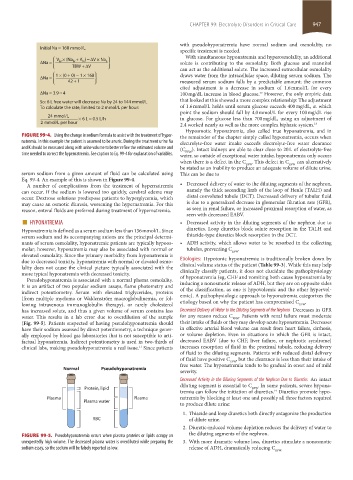
                          So: 6 L free water will decrease Na by 24 to 144 mmol/L  that looked at this showed a more complex relationship: The adjustment
                          To calculate the rate, limited to 2 mmol/L per hour:  of 1.6 mmol/L holds until serum glucose exceeds 400 mg/dL, at which
                                                                          point the sodium should fall by 4.0 mmol/L for every 100 mg/dL rise
                             24 mmol/L  × 6 L = 0.5 L/h                   in glucose. For glucose less than 700 mg/dL, using an adjustment of
                          2 mmol/L per hour
                                                                          2.4 worked nearly as well as the more complex biphasic system. 13
                                                                           Hyposmotic hyponatremia, also called true hyponatremia, and in
                    FIGURE 99-4.  Using the change in sodium formula to assist with the treatment of hyper-  the remainder of the chapter simply called hyponatremia, occurs when
                    natremia. In this example the patient is assumed to be anuric. During the treatment urine Na   electrolyte-free water intake exceeds electrolyte-free water clearance
                    and K should be measured along with urine volume to better refine the estimated volume and   (C  ). Intact kidneys are able to clear close to 20 L of electrolyte-free
                                                                           EFW
                    time needed to correct the hypernatremia. See caption to Eq. 99-4 for explanation of variables.  water, so outside of exceptional water intake, hyponatremia only occurs
                                                                          when there is a defect in the C EFW . This defect in C EFW  can alternatively
                                                                          be stated as an inability to produce an adequate volume of dilute urine.
                    serum sodium from  a  given amount  of  fluid  can be  calculated  using     This can be due to
                    Eq. 99-4. An example of this is shown in Figure 99-4.
                     A  number  of  complications  from  the  treatment  of  hypernatremia     • Decreased delivery of water to the diluting segments of the nephron,
                    can occur. If the sodium is lowered too quickly, cerebral edema may   namely the thick ascending limb of the loop of Henle (TALH) and
                    occur. Dextrose solutions predispose patients to hyperglycemia, which   distal convoluted tubule (DCT). Decreased delivery of tubular fluid
                    may cause an osmotic diuresis, worsening the hypernatremia. For this   is due to a generalized decrease in glomerular filtration rate (GFR),
                    reason, enteral fluids are preferred during treatment of hypernatremia.  as seen in renal failure, or increased proximal resorption of water, as
                        ■  HYPONATREMIA                                     • Decreased activity in the diluting segments of the nephron due to
                                                                            seen with decreased EABV.
                    Hyponatremia is defined as a serum sodium less than 136 mmol/L. Since   diuretics. Loop diuretics block solute resorption in the TALH and
                    serum sodium and its accompanying anions are the principal determi-  thiazide-type diuretics block resorption in the DCT.
                    nants of serum osmolality, hyponatremic patients are typically hypoos-    • ADH activity, which  allows water to be resorbed in the collecting
                    molar; however, hyponatremia may also be associated with normal or   tubules, preventing C EFW .
                    elevated osmolality. Since the primary morbidity from hyponatremia is
                    due to decreased tonicity, hyponatremia with normal or elevated osmo-  Etiologies:  Hypotonic hyponatremia is traditionally broken down by
                                                                          clinical volume status of the patient (Table 99-3). While this may help
                    lality does not cause the clinical picture typically associated with the
                    more typical hyponatremia with decreased tonicity.    clinically classify patients, it does not elucidate the pathophysiology
                                                                          of hyponatremia (eg, CHF and vomiting both cause hyponatremia by
                     Pseudohyponatremia is associated with a normal plasma osmolality.
                    It is an artifact of two popular sodium assays, flame photometry and   inducing a nonosmotic release of ADH, but they are on opposite sides
                                                                          of the classification, as one is hypovolemic and the other hypervol-
                    indirect potentiometry. Serum with elevated triglycerides, proteins
                    (from multiple myeloma or Waldenström macroglobulinemia, or fol-  emic). A pathophysiologic approach to hyponatremia categorizes the
                                                                                                                    .
                                                                          etiology based on why the patient has compromised C
                    lowing  intravenous  immunoglobulin  therapy),  or  rarely  cholesterol                       EFW
                    has increased solute, and thus a given volume of serum contains less   Decreased Delivery of Water to the Diluting Segments of the Nephron  Decreases in GFR
                    water. This results in a lab error due to overdilution of the sample   for any reason reduce C EFW . Patients with renal failure must moderate
                    (Fig. 99-5). Patients suspected of having pseudohyponatremia should   their intake of fluids or they may develop acute hyponatremia. Decreases
                    have their sodium assessed by direct potentiometry, a technique gener-  in effective arterial blood volume can result from heart failure, cirrhosis,
                    ally employed by blood gas laboratories that is not susceptible to arti-  or volume depletion. Even in situations in which the GFR is intact,
                    factual hyponatremia. Indirect potentiometry is used in two-thirds of   decreased EABV (due to CHF, liver failure, or nephrotic syndrome)
                    clinical labs, making pseudohyponatremia a real issue.  Since patients   increases resorption of fluid in the proximal tubule, reducing delivery
                                                            11
                                                                          of fluid to the diluting segments. Patients with reduced distal delivery
                                                                          of fluid have positive C EFW , but the clearance is less than their intake of
                                                                          free water. The hyponatremia tends to be gradual in onset and of mild
                                  Normal       Pseudohyponatremia
                                                                          severity.
                                                                          Decreased Activity in the Diluting Segments of the Nephron Due to Diuretics  An intact
                                                                          diluting segment is essential to C  . In some patients, severe hypona-
                                         Protein, lipid                                           EFW
                                                                          tremia can follow the initiation of diuretics.  Diuretics promote hypo-
                                                                                                          14
                            Plasma                        Plasma          natremia by blocking at least one and possibly all three factors required
                                         Plasma water
                                                                          to produce dilute urine:
                                                                            1.  Thiazide and loop diuretics both directly antagonize the production
                                            RBC                              of dilute urine.
                                                                            2.  Diuretic-induced volume depletion reduces the delivery of water to
                    FIGURE 99-5.  Pseudohyponatremia occurs when plasma proteins or lipids occupy an   the diluting segments of the nephron.
                    unexpectedly high volume. The decreased plasma water is overdiluted while preparing the     3.  With more dramatic volume loss, diuretics stimulate a nonosmotic
                    sodium assay, so the sodium will be falsely reported as low.  release of ADH, dramatically reducing C
                                                                                                          EFW.


            section08.indd   947                                                                                       1/14/2015   8:28:10 AM

