


Page 1375 - Hall et al (2015) Principles of Critical Care-McGraw-Hill
P. 1375
948     PART 8: Renal and Metabolic Disorders


                                                                         3.  Elevated urine sodium
                   TABLE 99-3    Etiologies of Hyponatremia Categorized by Clinical Volume Status
                                                                         4.  No underlying adrenal, thyroid, pituitary, or renal disease
                  Hypovolemic        Euvolemic         Hypervolemic
                  Diarrhea           SIADH             CHF             Unique Clinical Situations Resulting in Hyponatremia
                  Vomiting           Hypothyroidism    Cirrhosis       Cerebral Salt Wasting  Cerebral salt wasting (CSW) is a rare clinical event that
                                                                       typically follows a subarachnoid hemorrhage. Patients have high urinary
                  Pancreatitis       Glucocorticoid deficiency  Nephrotic syndrome
                                                                       flow rates with elevated urine sodium, which ultimately results in severe
                  Burns                                Acute renal failure  volume deficiency and hyponatremia. The pathophysiology behind CSW
                  Diuretic induced                     Chronic renal failure  has not been fully elucidated but it is likely that natriuretic proteins are
                                                                       released in response to the CNS injury. Atrial natriuretic peptide, brain
                  Mineralocorticoid deficiency
                                                                       natriuretic peptide,  and  an  endogenous  ouabain-like  peptide  have  all
                  Salt-wasting nephropathy                             been proposed as possible etiologic agents. The key diagnostic dilemma
                  Cerebral salt wasting                                is differentiating CSW from SIADH, as both can follow CNS insults and
                                                                       are marked by hyponatremia with elevated urine sodium. The principal
                 CHF, congestive heart failure; SIADH, the syndrome of inappropriate secretion of antidiuretic hormone.
                                                                       differences are urine volume (in SIADH it is low, while it is high in CSW)
                                                                       and clinical volume status (it is normal in SIADH, while it is low in
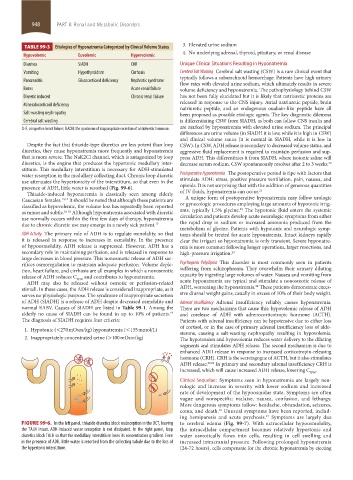
                   Despite the fact that thiazide-type diuretics are less potent than loop   CSW). In CSW, ADH release is secondary to decreased volume status, and
                 diuretics, they cause hyponatremia more frequently and hyponatremia   aggressive fluid replacement is required to maintain perfusion and sup-
                 that is more severe. The NaK2Cl channel, which is antagonized by loop   press ADH. This differentiates it from SIADH, where isotonic saline will
                 diuretics, is the engine that produces the hypertonic medullary inter-  decrease serum sodium. CSW spontaneously resolves after 2 to 3 weeks. 20
                 stitium. This medullary interstitium is necessary for ADH-stimulated
                 water resorption in the medullary collecting duct. Chronic loop diuretic   Postoperative Hyponatremia  The postoperative period is ripe with factors that
                 use attenuates the hypertonicity of the interstitium, so that even in the   stimulate ADH: stress, positive pressure ventilation, pain, nausea, and
                 presence of ADH, little water is resorbed (Fig. 99-6).  opioids. It is not surprising that with the addition of generous quantities
                                                                                                  21
                   Thiazide-induced hyponatremia is classically seen among elderly   of IV fluids, hyponatremia can occur.
                 Caucasian females. 14,15  It should be noted that although these patients are   A unique form of postoperative hyponatremia may follow urologic
                 classified as hypovolemic, the volume loss has repeatedly been reported   or gynecologic procedures employing large amounts of hypotonic irrig-
                                                                                            22
                 as minor and subtle. 16-18  Although hyponatremia associated with diuretic   ants, typically 1.5% glycine.  The hypotonic fluid enters the systemic
                 use normally occurs within the first few days of therapy, hyponatremia   circulation and patients develop acute neurologic symptoms from either
                 due to chronic diuretic use may emerge in a newly sick patient. 17  the rapid drop in sodium or increased ammonia produced from the
                                                                       metabolism of glycine. Patients with hypotonic and neurologic symp-
                 ADH Activity  The primary role of ADH is to regulate osmolality, so that   toms should be treated for acute hyponatremia. Intact kidneys rapidly
                 it is released in response to increases in osmolality. In the presence   clear the irrigant so hyponatremia is only transient. Severe hyponatre-
                 of hypoosmolality, ADH release is suppressed. However, ADH has a   mia is more common following longer operations, larger resections, and
                 secondary role in maintaining perfusion, and is released in response to   high-pressure irrigation. 23
                 large decreases in blood pressure. This nonosmotic release of ADH sac-
                 rifices osmoregulation to maintain adequate perfusion. Volume deple-  Psychogenic Polydipsia  This disorder is most commonly seen in patients
                 tion, heart failure, and cirrhosis are all examples in which a nonosmotic   suffering from schizophrenia. They overwhelm their urinary diluting
                 release of ADH reduces C EFW  and contributes to hyponatremia.  capacity by ingesting large volumes of water. Nausea and vomiting from
                   ADH may also be released without osmotic or perfusion-related   acute hyponatremia are typical and stimulate a nonosmotic release of
                                                                                                 24
                 stimuli. In these cases, the ADH release is considered inappropriate, as it   ADH, worsening the hyponatremia.  These patients demonstrate exces-
                 serves no physiologic purpose. The syndrome of inappropriate secretion   sive diurnal weight gains, usually in excess of 10% of their body weight.
                 of ADH (SIADH) is a release of ADH despite decreased osmolality and   Adrenal Insufficiency  Adrenal insufficiency reliably causes hyponatremia.
                 normal EABV. Causes of SIADH are listed in Table 99-1. Among the     There are two mechanisms that cause this: hypovolemic release of ADH
                                                                    19
                 elderly no cause of SIADH can be found in up to 10% of patients.    and corelease of ADH with adrenocorticotropic hormone (ACTH).
                 The diagnosis of SIADH requires four criteria:        Patients with adrenal insufficiency can be hypotensive due to either loss
                                                                       of cortisol, or in the case of primary adrenal insufficiency loss of aldo-
                   1.  Hypotonic (<270 mOsm/kg) hyponatremia (<135 mmol/L)  sterone, causing a salt-wasting nephropathy resulting in hypovolemia.
                   2.  Inappropriately concentrated urine (>100 mOsm/kg)  The hypotension and hypovolemia reduces water delivery to the diluting
                                                                       segments and stimulates ADH release. The second mechanism is due to
                                                                       enhanced ADH release in response to increased corticotropin-releasing
                                                                       hormone (CRH). CRH is the secretagogue of ACTH, but it also stimulates
                                                                       ADH release. 25,26  In primary and secondary adrenal insufficiency CRH is
                                                                       increased, which will cause increased ADH release, lowering C  .
                                                                                                                   EFW
                                                                       Clinical Sequelae:  Symptoms seen in hyponatremia are largely neu-
                                                                       rologic and increase in severity with lower sodium and increased
                                                                       rate of development of the hypoosmolar state. Symptoms are often
                                                                       vague and nonspecific: malaise, nausea, confusion, and lethargy.
                                                                       More dangerous symptoms follow: headache, obtundation, seizures,
                                                                       coma, and death.  Unusual symptoms have been reported, includ-
                                                                                    16
                                                                       ing hemiparesis and acute psychosis.  Symptoms are largely due
                                                                                                    27
                 FIGURE 99-6.  In the left panel, thiazide diuretics block reabsorption in the DCT, leaving   to  cerebral  edema  (Fig. 99-7).  With  extracellular  hypoosmolality,
                 the TALH intact. ADH-induced water resorption is not dissipated. In the right panel, loop   the intracellular compartment becomes relatively hypertonic and
                 diuretics block TALH so that the medullary interstitium loses its concentration gradient. Even   water osmotically flows into cells, resulting in cell swelling and
                 in the presence of ADH, little water is resorbed from the collecting tubule due to the loss of   increased intracranial pressure. Following prolonged hyponatremia
                 the hypertonic interstitium.                          (24-72 hours), cells compensate for the chronic hyponatremia by ejecting


            section08.indd   948                                                                                       1/14/2015   8:28:11 AM

