


Page 1376 - Hall et al (2015) Principles of Critical Care-McGraw-Hill
P. 1376
CHAPTER 99: Electrolyte Disorders in Critical Care   949


                                                                          sodium has been raised by 4 to 6 mEq/L.  Furthermore, the sodium
                                                                                                         28
                                                                          should be raised no more than 10- 12 mEq/L in the first 24 hours, and
                                                                          by no more than 18 mEq/L in 48 hours. 30-34  The sodium concentration
                                                                          should be assessed frequently to maintain the permitted rate of correction.
                                                                          Aside from volume depletion, hypertonic saline is the best way to raise
                                                                          the sodium concentration to treat acute, symptomatic hyponatremia.
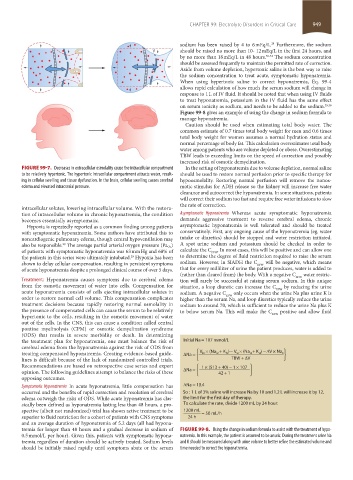
                                                                          When using hypertonic saline to correct hyponatremia, Eq. 99-4
                                                                          allows rapid calculation of how much the serum sodium will change in
                                                                          response to 1 L of IV fluid. It should be noted that when using IV fluids
                                                                          to  treat hyponatremia,  potassium  in  the IV  fluid  has the  same  effect
                                                                          on serum tonicity as sodium, and needs to be added to the sodium. 35,36
                                                                          Figure 99-8 gives an example of using the change in sodium formula to
                                                                          manage hyponatremia.
                                                                           Caution should be used when estimating total body water. The
                                                                          common estimate of 0.7 times total body weight for men and 0.6 times
                                                                          total body weight for women assumes a normal hydration status and
                                                                          normal percentage of body fat. This calculation overestimates total body
                                                                          water among patients who are volume depleted or obese. Overestimating
                                                                          TBW leads to exceeding limits on the speed of correction and possibly
                                                                          increased risk of osmotic demyelination.
                    FIGURE 99-7.  Decreases in extracellular osmolality cause the intracellular compartment   In the setting of hyponatremia due to volume depletion, normal saline
                    to be relatively hypertonic. The hypertonic intracellular compartment attracts water, result-  should be used to restore normal perfusion prior to specific therapy for
                    ing in cellular swelling and tissue dysfunction. In the brain, cellular swelling causes cerebral   hypoosmolality. Restoring normal perfusion will remove the nonos-
                    edema and elevated intracranial pressure.             motic stimulus for ADH release so the kidney will increase free water
                                                                          clearance and autocorrect the hyponatremia. In some situations, patients
                                                                          will correct their sodium too fast and require free water infusions to slow
                                                                          the rate of correction.
                    intracellular solutes, lowering intracellular volume. With the restora-
                    tion of intracellular volume in chronic hyponatremia, the condition   Asymptomatic Hyponatremia  Whereas acute symptomatic hyponatremia
                    becomes essentially asymptomatic.                     demands aggressive treatment to  reverse  cerebral  edema,  chronic
                     Hypoxia is repeatedly reported as a common finding among patients   asymptomatic hyponatremia is well tolerated and should be treated
                    with symptomatic hyponatremia. Some authors have attributed this to   conservatively. First, any ongoing cause of the hyponatremia (eg, water
                    noncardiogenic pulmonary edema, though central hypoventilation may   intake or diuretics) should be stopped and water restriction initiated.
                                  28                                   )   A spot urine sodium and potassium should be checked in order to
                    also be responsible.  The average partial arterial oxygen pressure (Pa O 2
                    of patients with symptomatic hyponatremia was 63 mm Hg and 68% of   calculate the C EFW . In most cases, this will be positive and can allow one
                    the patients in this series were ultimately intubated.  Hypoxia has been   to determine the degree of fluid restriction required to raise the serum
                                                         29
                    shown to delay cellular compensation, resulting in persistent symptoms   sodium. However, in SIADH the C EFW  will be negative, which means
                    of acute hyponatremia despite a prolonged clinical course of over 5 days.  that for every milliliter of urine the patient produces, water is added to
                                                                          (rather than cleared from) the body. With a negative C   water restric-
                                                                                                                 EFW
                    Treatment:  Hyponatremia  causes  symptoms  due  to  cerebral  edema   tion will rarely be successful at raising serum sodium. In this unique
                    from  the osmotic movement of  water into cells.  Compensation for   situation, a loop diuretic can increase the C   by reducing the urine
                                                                                                          EFW
                    acute hyponatremia consists of cells ejecting intracellular solutes in   sodium. A negative C   only occurs when the urine Na plus urine K is
                                                                                         EFW
                    order to restore normal cell volume. This compensation complicates   higher than the serum Na, and loop diuretics typically reduce the urine
                    treatment decisions  because  rapidly restoring normal osmolality in   sodium to around 70, which is sufficient to reduce the urine Na plus K
                    the presence of compensated cells can cause the serum to be relatively   to below serum Na. This will make the C   positive and allow fluid
                    hypertonic to the cells, resulting in the osmotic movement of water                  EFW
                    out of the cells. In the CNS, this can cause a condition called central
                    pontine myelinolysis  (CPM)  or  osmotic  demyelination  syndrome
                    (ODS) that results  in severe morbidity or  death. In  determining
                    the treatment plan for hyponatremia, one must balance the risk of   Initial Na = 107 mmol/L
                    cerebral edema from the hyponatremia against the risk of ODS from
                    treating compensated hyponatremia. Creating evidence-based guide-   Na =  V iv  × (Na  + K ) − V  × (Na  + K ) − V × Na s
                                                                                             u
                                                                                      iv
                                                                                         iv
                                                                                                 u
                                                                                                    u
                    lines is difficult because of the lack of randomized controlled trials.   TBW + V
                    Recommendations are based on retrospective case series and expert   1 × (513 + 40) − 1 × 10⁷
                    opinion. The following guidelines attempt to balance the risks of these    Na =  42 + 1
                    opposing outcomes.
                    Symptomatic Hyponatremia  In acute hyponatremia, little compensation has    Na = 10.4
                    occurred and the benefits of rapid correction and resolution of cerebral   So : 1 L of 3% saline will increase Na by 10 and 1.2 L will increase it by 12,
                    edema outweigh the risks of ODS. While acute hyponatremia has clas-  the limit for the first day of therapy.
                    sically been defined as hyponatremia lasting less than 48 hours, a pro-  To calculate the rate, divide 1200 mL by 24 hour:
                    spective (albeit not randomized) trial has shown active treatment to be   1200 mL
                    superior to fluid restriction for a cohort of patients with CNS symptoms   24 h  = 50 mL/h
                    and an average duration of hyponatremia of 5.2 days (all had hypona-
                    tremia for longer than 48 hours and a gradual decrease in sodium of   FIGURE 99-8.  Using the change in sodium formula to assist with the treatment of hypo-
                    0.5 mmol/L per hour). Given this, patients with symptomatic hypona-  natremia. In this example, the patient is assumed to be anuric. During the treatment urine Na
                    tremia regardless of duration should be actively treated. Sodium levels   and K should be measured along with urine volume to better refine the estimated volume and
                    should be initially raised rapidly until symptoms abate or the serum   time needed to correct the hyponatremia.


            section08.indd   949                                                                                       1/14/2015   8:28:12 AM

