


Page 1409 - Hall et al (2015) Principles of Critical Care-McGraw-Hill
P. 1409
982     PART 8: Renal and Metabolic Disorders


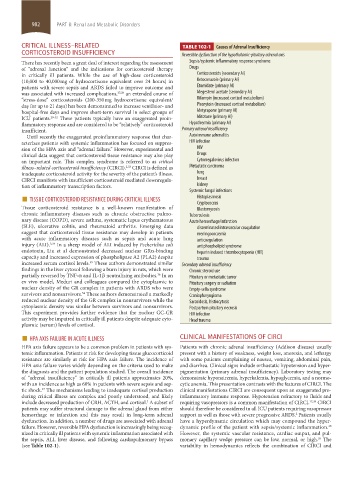
                 CRITICAL ILLNESS–RELATED                                TABLE 102-1    Causes of Adrenal Insufficiency
                 CORTICOSTEROID INSUFFICIENCY                           Reversible dysfunction of the hypothalamic-pituitary adrenal axis
                 There has recently been a great deal of interest regarding the assessment   Sepsis/systemic inflammatory response syndrome
                 of  “adrenal  function”  and  the  indications  for  corticosteroid  therapy   Drugs
                 in critically ill patients. While the use of high-dose corticosteroid   Corticosteroids (secondary AI)
                 (10,000 to 40,000 mg of hydrocortisone equivalent over 24 hours) in   Ketoconazole (primary AI)
                 patients with severe sepsis and ARDS failed to improve outcome and   Etomidate (primary AI)
                 was associated with increased complications, 27,28  an extended course of   Megesterol acetate (secondary AI)
                 “stress-dose” corticosteroids (200-350 mg hydrocortisone equivalent/  Rifampin (increased cortisol metabolism)
                 day for up to 21 days) has been demonstrated to increase ventilator- and   Phenytoin (increased cortisol metabolism)
                 hospital-free days and improve short-term survival in select groups of   Metyrapone (primary AI)
                 ICU patients. 29-32  These patients typically have an exaggerated proin-  Mitotane (primary AI)
                 flammatory response and are considered to be “relatively” corticosteroid   Hypothermia (primary AI)
                 insufficient.                                          Primary adrenal insufficiency
                   Until recently the exaggerated proinflammatory response that char-  Autoimmune adrenalitis
                 acterizes patients with systemic inflammation has focused on suppres-  HIV infection
                 sion of the HPA axis and “adrenal failure.” However, experimental and   HIV
                 clinical data suggest that corticosteroid tissue resistance may also play   Drugs
                 an important role. This complex syndrome is referred to as  critical   Cytomegalovirus infection
                   illness–related corticosteroid insufficiency (CIRCI).  CIRCI is defined as   Metastatic carcinoma
                                                     2,33
                 inadequate corticosteroid activity for the severity of the patient’s illness.   lung
                 CIRCI manifests with insufficient corticosteroid mediated downregula-  breast
                                                                             kidney
                 tion of inflammatory transcription factors.              Systemic fungal infections
                     ■  TISSUE CORTICOSTEROID RESISTANCE DURING CRITICAL ILLNESS  Histoplasmosis
                 Tissue corticosteroid resistance is a well-known manifestation of   Cryptococcus
                                                                             Blastomycosis
                 chronic inflammatory diseases such as chronic obstructive pulmo-  Tuberculosis
                 nary disease (COPD), severe asthma, systematic lupus erythematosus   Acute hemorrhage/infarction
                 (SLE),  ulcerative  colitis,  and  rheumatoid  arthritis.  Emerging  data   disseminated intravascular coagulation
                 suggest that corticosteroid tissue resistance may develop in patients   meningococcemia
                 with acute inflammatory diseases such as sepsis and acute lung   anticoagulation
                 injury (ALI). 2,34  In a sheep model of ALI induced by Escherichia coli   antiphospholipid syndrome
                 endotoxin, Liu et al demonstrated decreased nuclear GRα-binding   heparin induced thrombocytopenia (HIT)
                 capacity and increased expression of phospholipase A2 (PLA2) despite   trauma
                 increased serum cortisol levels.  These authors demonstrated similar   Secondary adrenal insufficiency
                                        35
                 findings in the liver cytosol following a burn injury in rats, which were   Chronic steroid use
                 partially reversed by TNF-α and IL-1β neutralizing antibodies.  In an   Pituitary or metastatic tumor
                                                                36
                 ex vivo model, Meduri and colleagues compared the cytoplasmic to   Pituitary surgery or radiation
                 nuclear density of the GR complex in patients with ARDS who were   Empty-sella syndrome
                 survivors and nonsurvivors.  These authors demonstrated a markedly   Craniopharyngioma
                                      34
                 reduced nuclear density of the GR complex in nonsurvivors while the   Sarcoidosis, histiocytosis
                 cytoplasmic density was similar between survivors and nonsurvivors.   Postpartum pituitary necrosis
                 This experiment provides further evidence that the nuclear GC-GR   HIV infection
                 activity may be impaired in critically ill patients despite adequate cyto-  Head trauma
                 plasmic (serum) levels of cortisol.
                     ■  HPA AXIS FAILURE IN ACUTE ILLNESS              CLINICAL MANIFESTATIONS OF CIRCI


                 HPA axis failure appears to be a common problem in patients with sys-  Patients with chronic adrenal insufficiency (Addison disease) usually
                 temic inflammation. Patients at risk for developing tissue glucocorticoid   present with a history of weakness, weight loss, anorexia, and lethargy
                 resistance are similarly at risk for HPA axis failure. The incidence of   with some patients complaining of nausea, vomiting, abdominal pain,
                 HPA axis failure varies widely depending on the criteria used to make   and diarrhea. Clinical signs include orthostatic hypotension and hyper-
                 the diagnosis and the patient population studied. The overall incidence   pigmentation (primary adrenal insufficiency). Laboratory testing may
                 of “adrenal insufficiency” in critically ill patients approximates 20%,   demonstrate hyponatremia, hyperkalemia, hypoglycemia, and a normo-
                 with an incidence as high as 60% in patients with severe sepsis and sep-  cytic anemia. This presentation contrasts with the features of CIRCI. The
                 tic shock.  The mechanisms leading to inadequate cortisol production   clinical manifestations CIRCI are consequent upon an exaggerated pro-
                        37
                 during critical illness are complex and poorly understood, and likely   inflammatory immune response. Hypotension refractory to fluids and
                 include decreased production of CRH, ACTH, and cortisol.  A subset of   requiring vasopressors is a common manifestation of CIRCI. 17,38  CIRCI
                                                            2
                 patients may suffer structural damage to the adrenal gland from either   should therefore be considered in all ICU patients requiring vasopressor
                   hemorrhage or infarction and this may result in long-term adrenal   support as well as those with severe progressive ARDS.  Patients usually
                                                                                                               2
                 dysfunction. In addition, a number of drugs are associated with adrenal   have a hyperdynamic circulation which may compound the hyper-
                 failure. However, reversible HPA dysfunction is increasingly being recog-  dynamic profile of the patient with sepsis/systemic inflammation.
                                                                                                                          38
                 nized in critically ill patients with systemic inflammation associated with    However, the systemic vascular resistance, cardiac output, and pul-
                 the sepsis, ALI, liver disease, and following cardiopulmonary bypass    monary capillary wedge pressure can be low, normal, or high.  The
                                                                                                                      39
                 (see Table 102-1).                                    variability in hemodynamics  reflects the combination of CIRCI and


            section08.indd   982                                                                                       1/14/2015   8:28:33 AM

