


Page 1580 - Hall et al (2015) Principles of Critical Care-McGraw-Hill
P. 1580
CHAPTER 115: The Transplant Patient  1099


                    donors.  In this procedure, the right hepatic lobe from a donor with   operation, but if the graft is functioning properly they should return
                         68
                    a compatible blood type is implanted into the recipient following   to normal—usually within 1 day. Abrupt changes in any of the func-
                    hepatectomy of the diseased organ. This procedure requires much   tion parameters or the absence of evidence of decline of their original
                    more delicate dissection because the living donor partial liver graft   levels should prompt further investigation into whether the graft is
                    has a much smaller sized hepatic artery, vein, and pulmonary vein.   functioning appropriately with an ultrasound and Doppler study to
                    Given the small size, the reconstruction is technically difficult and   ensure adequate hepatic artery and vein flow. A Doppler study is rou-
                    patients are at higher risk of having postoperative bleeding compli-  tinely performed after living-donor transplants.
                    cations. Biliary reconstructions are completed last and have shifted
                    largely from hepaticojejunostomies to duct-to-duct anastomosis.    Volume Status and Hemodynamics:  A coagulopathy can persist in the
                                                                      68
                    Along with an often substantially reduced waiting time for the proce-  postoperative period and close monitoring of hemoglobin is necessary
                    dure, living-related transplants may also allow for better selection of   to monitor for signs of bleeding. Most centers advocate continuing to
                    healthy donors (and consequently donor organs) and a considerably   maintain a low central venous pressure in attempt to minimize liver con-
                    decreased cold ischemic time. The elective nature of the procedure   gestion and reduce the risk of bleeding. The traditional perspective to
                    also enables potential recipients to be medically stabilized preop-  fluid status intraoperatively and postoperatively was a conservative one
                    eratively. The major disadvantage is the small but significant risk   with some institutions actively aiming for lower central venous pressures
                    of complications for the donor. Biliary complications may occur in   (CVP). This is believed to decrease the potential congestion to the fresh
                                                                                                                          78
                    up to 6% of donors,  and other complications of abdominal surgery   graft in order to maximize graft function and minimize blood loss.  A
                                   75
                    such  as  wound  infection  may  develop;  the  reported  mortality  of   more recent review has demonstrated that maintaining a low CVP is
                    donors following living-donor liver transplant is 0.28%.  One study     not associated with any benefit with respect to immediate postopera-
                                                              76
                                                                                                                 80
                    suggests that in the United States approximately 99% of living donors   tive graft function, graft survival, or patient survival.  Enhancing and
                    are genetically or emotionally related to the recipient,  creating   optimizing oxygen delivery through adequate cardiac output (optimized
                                                               75
                    important ethical and psychosocial challenges.        preload and contractility) should be the primary focus of postoperative
                                                                          fluid and hemodynamic management with caution not to overresusci-
                    Blood Loss:  In  the  late  1980s,  the  average  red  cell  transfusion  was   tate or underresuscitate the unstable posttransplant patient given the
                    20 units per orthotopic liver transplant. This rate of transfusion has   sensitivity of the graft to under perfusion and hepatic congestion. The
                    decreased dramatically to as low as 2 units in 2003 after improvements   hyperdynamic circulatory state that characterizes portal hypertension
                    in transplant technique, changes in patient characteristics, and altera-  will often persist in the postoperative period. The increased cardiac
                    tions in transfusion triggers.  Anesthesiologists attempt to decrease   output and decreased systemic vascular resistance may mimic sepsis
                                         77
                    surgical blood loss by maintaining a low central venous pressure in order   and make the interpretation of hemodynamic measurements difficult.
                    to minimize graft congestion. 78                       The management of the patient with preoperative portopulmonary
                    Hemodynamic Challenges:  Refractory hypotension is a relatively com-  hypertension can be extremely challenging. These patients will often
                    mon event during reperfusion and may require catecholamine   encounter pulmonary hemodynamic instability due to acute right
                    support as well as fluids in addition to correction of acid-base and   ventricular decompensation and may have increased cardiopulmonary
                    electrolyte abnormalities. Vasoplegic syndrome (VS) and postreper-  mortality, especially if the preoperative mean pulmonary artery pressure
                                                                                            81
                    fusion syndrome (PRS) represent the most severe form of refractory   is greater than 35 mm Hg.  If invasive hemodynamic monitoring has not
                    hypotension that can be difficult to treat given its refractory nature   already been established with a pulmonary artery catheter, it should be
                    to standard vasopressors. Initially described in cardiac surgery, VS is   considered to guide therapy in these patients. Specific pulmonary vaso-
                    characterized by profound vasodilation with a low systemic vascular   dilators such as inhaled nitric oxide or nebulized prostaglandins may
                    resistance and high cardiac index. PRS is characterized by severe   be required in the setting of right ventricular dysfunction in order to
                    hypotension after graft reperfusion defined as a greater than 30%   preserve cardiac output. Strategies should also focus on attempts to aug-
                    decrease in systolic pressure during the first 5 minutes after graft   ment contractility, while preserving coronary perfusion and minimizing
                    perfusion that lasts at least 1 minute. The cause of the hypotension is   RV overload (and in-turn hepatic congestion).
                    not completely understood, but is believed to be associated with dys-  A system for classifying patients based on their anticipated need for
                                                                                                               82
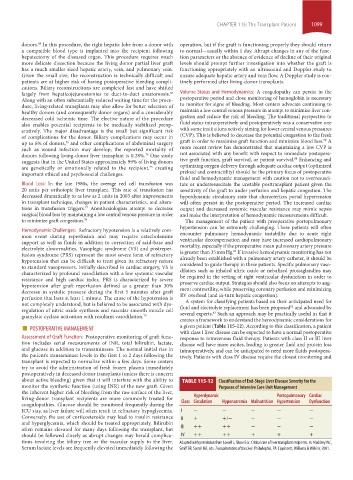
                    regulation of nitric oxide synthesis and vascular smooth muscle cell   fluid and electrolyte replacement has been proposed  and advocated by
                                                                                     83
                    guanylate cyclase activation with resultant vasodilation. 79  several experts.  Such an approach may be practically useful in that it
                                                                          creates a framework to understand the hemodynamic considerations for
                        ■  POSTOPERATIVE MANAGEMENT                       a given patient (Table 115-12). According to this classification, a patient
                    Assessment of Graft Function:  Postoperative monitoring of graft func-  with class I liver disease can be expected to have a normal postoperative
                                                                          response to intravenous fluid therapy. Patients with class II or III liver
                    tion includes serial measurements of INR, total bilirubin, lactate,   disease will have more ascites, leading to greater fluid and protein loss
                    and glucose in addition to transaminases. The normal initial rise in   intraoperatively, and can be anticipated to need more fluids postopera-
                    the patient’s transaminase levels in the first 1 to 2 days following the   tively. Patients with class IV disease require the closest monitoring and
                    transplant is expected to normalize within a few days. Some centers
                    try to avoid the administration of fresh frozen plasma immediately
                    postoperatively in deceased donor transplants (unless there is concern
                    about active bleeding) given that it will interfere with the ability to     TABLE 115-12     Classification of End-Stage Liver Disease Severity for the
                    monitor the synthetic function (using INR) of the new graft. Given   Purposes of intensive Care Unit Management
                    the inherent higher risk of bleeding from the raw surface of the liver,
                    living-donor transplant recipients are more commonly treated for   Hyperdynamic        Portopulmonary  Cardiac
                    coagulopathies. Glucose should be monitored frequently during the   Class Circulation  Hyponatremia Malnutrition Hypertension  Dysfunction
                    ICU stay, as liver failure will often result in refractory hypoglycemia.   I  −  −  −  −          −
                    Conversely, the use of corticosteroids may lead to insulin resistance   II  +  +/−  −  −          −
                    and hyperglycemia, which should be treated appropriately. Bilirubin
                    often remains elevated for many days following the transplant, but   III  ++  ++  −    −          −
                    should be followed closely as abrupt changes may herald complica-  IV  ++  ++  +       +          +
                    tions  involving  the  biliary  tree  or  the  vascular  supply  to  the  liver.   Adapted with permission from Lowell J, Shaw B Jr. Critical care of liver transplant recipients. In: Maddrey WC,
                    Serum lactate levels are frequently elevated immediately following the   Schiff ER, Sorrell MF, eds. Transplantation of the Liver. Philadephia, PA: Lippincott, Williams & Wilkins; 2001.


            section10.indd   1099                                                                                      1/20/2015   9:19:57 AM

