


Page 1758 - Hall et al (2015) Principles of Critical Care-McGraw-Hill
P. 1758
CHAPTER 125: Critical Care Pharmacology  1227


                    Interindividual Response  Variability (Sensitivity):  Another point to note
                    is the variability between individual responses to a given plasma drug   Choice of drug:
                    level; sensitivity to drug action may differ between individuals or groups.        Drug-disease
                                                                                                Drug-patient
                    For example, elderly subjects are more sensitive to the sedative effects        Drug-drug
                    of benzodiazepines (and many other sedatives) than younger subjects ;
                                                                      12
                    American subjects of Chinese descent are twice as sensitive as American
                    white men to the β-blocking effects of propranolol ; black subjects are
                                                         13
                    less sensitive to the vasodilatory effect of isoproterenol than are white
                    Americans.  Recent evidence implicates pharmacogenomics as the      Route of administration
                            14
                                                                                             Bioavailability
                    cause of variability of drug effect between races, and even individuals        Feeding status of patient
                    within races.  Pharmacogenomics is the study of the role of inherited        Convenience
                             15
                    and acquired genetic variation in drug response. It can facilitate the        Titratability
                    identification of biomarkers that can help physicians optimize drug selec-
                    tion, dose, and treatment duration and avert adverse drug reactions.
                                                                      16
                    An example is an association between the presence of HLA-B*5701 and
                    hypersensitivity reactions to Abacavir, a nucleoside analogue used to treat   Loading dose necessary?
                    HIV infection.  This resulted in the FDA modification of the abacavir        Volume of distribution
                              17
                    label  to  include  a  recommendation  that  patients  undergo  genotyping        Urgency in observing desired
                    for HLA-B*5701 before the initiation of therapy. Despite significant        drug effect
                    advances in research relating to pharmacogenomics as well as FDA
                    guidelines, the use of these tests is not widespread due to limitations
                    in the availability of tests, lack of cost-effective analyses, and the need
                    to establish clinical utility. Current information regarding the known   Maintenance dosing
                    specific  drug  gene  interactions  can  be  obtained  through  the  National        Half-life
                    Institute of Health Pharmacogenetics Research Network’s PharmGKB:         Ability to titrate
                    The Pharmacogenomics Knowledge base (www.pharmgkb.org). 18
                    Dose-Dependent Effects:  The predominant drug-receptor complex
                    mediating a drug’s effect may change according to drug concentration,
                    resulting in variable pharmacologic responses at different plasma levels.   Adjustments for
                    For example, dopamine predominantly activates dopaminergic receptors    Drug-drug, drug-patient, and
                    (and causes mesenteric and renal vasodilation) only at infusion rates of   Drug-disease interactions
                    up to 2 µg/kg per minute. β -Adrenergic (inotropic) and α-adrenergic
                                        1
                    (vasoconstrictor) activation occur at doses as low as 2 to 4 µg/kg per
                    minute and 5 to 10 µg/kg per minute, respectively; as a result, the hemo-
                    dynamic effect of dopamine infusion changes with increasing dose.    Therapeutic drug monitoring
                                                                      15
                    Despite such concerns, we expect the attainment of drug levels in the
                    usual therapeutic range to elicit the desired effect in most patients.
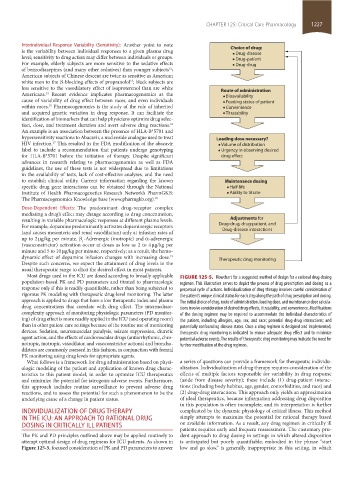
                     Most drugs used in the ICU are dosed according to broadly applicable   FIGURE 125-5.  Flowchart for a suggested method of design for a rational drug dosing
                    population-based PK and PD parameters and titrated to pharmacologic   regimen. This illustration serves to depict the process of drug prescription and dosing as a
                    response only if this is readily quantifiable, rather than being subjected to   perpetual cycle of actions. Individualization of drug therapy involves careful consideration of
                    rigorous PK modeling with therapeutic drug-level monitoring. The latter   the patient’s unique clinical status for each step along the path of drug prescription and dosing.
                    approach is applied to drugs that have a low therapeutic index and plasma   The initial choice of drug, route of administration, loading dose, and maintenance dose calcula-
                    drug concentrations that correlate with drug effect. The intermediate-  tions involve consideration of desired drug effects, titratability, and convenience. Modifications
                    complexity approach of monitoring physiologic parameters (PD monitor-  of  the  dosing  regimen  may  be  required  to  accommodate  the  individual  characteristics  of
                    ing) of drug effect is more readily applied in the ICU (and operating room)   the patient, including allergies, age, sex, and race; potential drug-drug interactions; and
                    than in other patient care settings because of the routine use of monitoring   potentially confounding disease states. Once a drug regimen is designed and implemented,
                    devices. Sedation, neuromuscular paralysis, seizure suppression, diuretic   therapeutic drug monitoring is indicated to ensure adequate drug effect and to minimize
                    agent action, and the effects of cardiovascular drugs (antiarrhythmic, chro-  potential adverse events. The results of therapeutic drug monitoring may indicate the need for
                    notropic, inotropic, vasodilator, and vasoconstrictor actions) and broncho-  further modification of the drug regimen.
                    dilators are commonly assessed in this fashion, in conjunction with formal
                    PK monitoring using drug levels for appropriate agents.
                     What follows is a framework for drug administration based on physi-  a series of questions can provide a framework for therapeutic individu-
                    ologic modeling of the patient and application of known drug charac-  alization. Individualization of drug therapy requires consideration of the
                    teristics to this patient model, in order to optimize ICU therapeutics   effects of multiple factors responsible for variability in drug response
                    and minimize the potential for iatrogenic adverse events. Furthermore,   (aside from disease severity); these include (1) drug-patient interac-
                    this approach includes routine surveillance to prevent adverse drug   tions (including body habitus, age, gender, comorbidities, and race) and
                    reactions, and to assess the potential for such a phenomenon to be the   (2) drug-drug interactions. This approach only yields an approximation
                    underlying cause of a change in patient status.       of ideal therapeutics, because information addressing drug disposition
                                                                          in this population is often incomplete, and its interpretation is further
                    INDIVIDUALIZATION OF DRUG THERAPY                     complicated by the dynamic physiology of critical illness. This method
                    IN THE ICU: AN APPROACH TO RATIONAL DRUG              simply  attempts to maximize  the potential  for rational  therapy  based
                    DOSING IN CRITICALLY ILL PATIENTS                     on available information. As a result, any drug regimen in critically ill
                                                                          patients requires early and frequent reassessment. The customary pru-
                    The PK and PD principles outlined above may be applied routinely to   dent approach to drug dosing in settings in which altered disposition
                    attempt optimal design of drug regimens for ICU patients. As shown in   is anticipated but poorly quantifiable, embodied in the phrase “start
                    Figure 125-5, focused consideration of PK and PD parameters to answer   low and go slow,” is generally inappropriate in this setting, in which


            section11.indd   1227                                                                                      1/19/2015   10:52:08 AM

