


Page 1760 - Hall et al (2015) Principles of Critical Care-McGraw-Hill
P. 1760
CHAPTER 125: Critical Care Pharmacology  1229


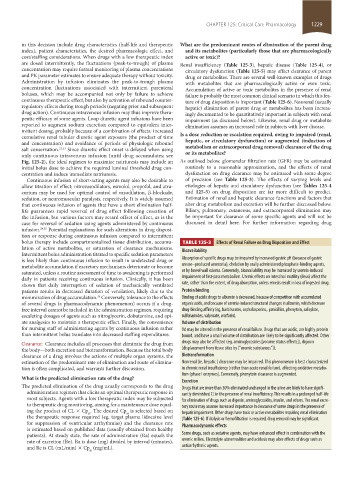
                    in this decision include drug characteristics (half-life and therapeutic   What are the predominant routes of elimination of the parent drug
                    index), patient characteristics, the desired pharmacologic effect, and   and its metabolites (particularly those that are pharmacologically
                    cost/staffing considerations. When drugs with a low therapeutic index   active or toxic)?
                    are dosed intermittently, the fluctuations (peak-to-trough) of plasma   Renal insufficiency  (Table 125-3),  hepatic  disease (Table 125-4),  or
                    concentration may require formal monitoring of plasma concentrations   circulatory dysfunction (Table 125-5) may affect clearance of parent
                    and PK parameter estimates to ensure adequate therapy without toxicity.    drug or metabolites. There are several well-known examples of drugs
                    Administration  by  infusion  eliminates  the  peak-to-trough  plasma     with metabolites that are pharmacologically active or even toxic.
                    concentration  fluctuations  associated  with  intermittent  parenteral   Accumulation of active or toxic metabolites in the presence of renal
                    boluses, which may be accompanied not only by failure to achieve   failure is probably the most common clinical scenario in which this fea-
                    continuous therapeutic effect, but also by activation of rebound counter-  ture of drug disposition is important (Table 125-6). Nonrenal (usually
                    regulatory effects during trough periods (negating prior and subsequent   hepatic) elimination of parent drug or metabolites has been increas-
                    drug action). Continuous intravenous infusion may thus improve thera-  ingly documented to be quantitatively important in subjects with renal
                    peutic efficacy of some agents. Loop diuretic agent infusions have been   impairment (as discussed below). Likewise, renal drug or metabolite
                    reported to augment sodium excretion compared to equivalent inter-  elimination assumes an increased role in subjects with liver disease.
                    mittent dosing, probably because of a combination of effects: increased
                    cumulative renal tubular diuretic agent exposure (the product of time   Is a dose reduction or escalation required, owing to impaired (renal,
                    and concentration) and avoidance of periods of physiologic rebound   hepatic, or circulatory dysfunction) or augmented (induction of
                    salt conservation. 22,23  Since diuretic effect onset is delayed when using   metabolism or extracorporeal drug removal) clearance of the drug
                    only continuous intravenous infusion (until drug accumulates; see     or its metabolites?
                    Fig. 125-2), the ideal regimen to maximize natriuresis may include an   As outlined below, glomerular filtration rate (GFR) may be estimated
                    initial bolus dose to achieve the required luminal threshold drug con-  routinely to a reasonable approximation, and the effects of renal
                    centration and induce immediate natriuresis.           dysfunction on drug clearance may be estimated with some degree
                     Continuous infusion of short-acting agents may also be desirable to   of precision (see  Table 125-3). The effects of varying levels and
                    allow titration of effect; nitrovasodilators, esmolol, propofol, and atra-  etiologies of hepatic and circulatory dysfunction (see Tables 125-4
                    curium may be used for optimal control of vasodilation,  β-blockade,   and  125-5) on drug disposition are far more difficult to predict.
                    sedation, or neuromuscular paralysis, respectively. It is widely assumed   Estimation of renal and hepatic clearance functions and factors that
                    that continuous infusion of agents that have a short elimination half-  alter drug metabolism and excretion will be further discussed below.
                    life guarantees rapid reversal of drug effect following cessation of   Biliary, pulmonary, cutaneous, and extracorporeal elimination may
                    the infusion, but various factors may retard offset of effect, as is the   be important for clearance of some specific agents and will not be
                    case for reversal of sedation using agents administered by continuous     discussed in detail here. For further information regarding drug
                    infusion. 24,25  Potential explanations for such alterations in drug disposi-
                    tion or response during continuous infusion compared to intermittent
                    bolus therapy include compartmentalized tissue distribution, accumu-    TABLE 125-3    Effects of Renal Failure on Drug Disposition and Effect
                    lation of active metabolites, or saturation of clearance mechanisms.   Bioavailability
                    Intermittent bolus administration titrated to specific sedation parameters
                    is less likely than continuous infusion to result in undetected drug or   Absorption of specific drugs may be impaired by increased gastric pH (because of gastric
                    metabolite accumulation if excretory mechanisms deteriorate or become   urease–produced ammonia), chelation by orally administered phosphate-binding agents,
                    saturated, unless a routine assessment of time to awakening is performed   or by bowel wall edema. Conversely, bioavailability may be increased by uremia-induced
                    daily in patients receiving continuous infusion. Clinically, it has been   impairment of first-pass metabolism. Uremic effects on intestinal motility (ileus) affect the
                    shown that daily interruption of sedation of mechanically ventilated   rate, rather than the extent, of drug absorption, unless emesis result in loss of ingested drug.
                    patients results in decreased duration of ventilation, likely due to the   Protein binding
                    minimization of drug accumulation.  Conversely, tolerance to the effects   Binding of acidic drugs to albumin is decreased, because of competition with accumulated
                                             26
                    of several drugs (a pharmacodynamic phenomenon) occurs if a drug-  organic acids, and because of uremia-induced structural changes in albumin, which decrease
                    free interval cannot be included in the administration regimen, requiring   drug-binding affinity (eg, barbiturates, cephalosporins,. penicillins, phenytoin, salicylate,
                    escalating dosages of agents such as nitroglycerin, dobutamine, and opi-    sulfonamides, valproate, warfarin).
                    ate analgesics to maintain a therapeutic effect. Finally, the convenience   Volume of distribution
                    for nursing staff of administering agents by continuous infusion rather   Vd may be altered in the presence of renal failure. Drugs that are acidic, are highly protein
                    than intermittent bolus translates into decreased staffing expenditures.  bound, and have a small volume of distribution are likely to be significantly affected. Other
                    Clearance:  Clearance includes all processes that eliminate the drug from   drugs may also be affected (eg, aminoglycosides [volume status effects]), digoxin
                    the body—both excretion and biotransformation. Because the total body   (displacement from tissue sites by [“uremic substances”]).
                    clearance of a drug involves the actions of multiple organ systems, the   Biotransformation
                    estimation of the predominant rate of elimination and route of elimina-  Nonrenal (ie, hepatic ) clearance may be impaired. This phenomenon is best characterized
                    tion is often complicated, and warrants further discussion.  in chronic renal insufficiency (rather than acute renal failure), affecting oxidative metabo-
                                                                          lism (phase I enzymes). Conversely, phenytoin clearance is augmented.
                    What is the predicted elimination rate of the drug?   Excretion
                    The predicted elimination of the drug usually corresponds to the drug   Drugs that are more than 30% eliminated unchanged in the urine are likely to have signifi-
                     administration regimen that elicits an optimal therapeutic response in   cantly diminished CL in the presence of renal insufficiency. This results in a prolonged half-life
                     most subjects. Agents with a low therapeutic index may be subjected   for elimination of drugs such as digoxin, aminoglycosides, insulin, and others. The renal excre-
                     to therapeutic drug monitoring, aiming for a maintenance dose equal-  tory route may assume increased importance in clearance of some drugs in the presence of
                     ing the product of CL × Cp . The desired Cp  is selected based on   hepatic impairment. Other drugs have toxic or active metabolites requiring renal elimination
                                                       ss
                                          ss
                     the therapeutic response required (eg, target plasma lidocaine level   (Table 125-6). If dialysis or hemofiltration is required, drug removal may be significant.
                     for suppression of ventricular arrhythmias) and the clearance rate   Pharmacodynamic effects
                     is estimated based on published data (usually obtained from healthy
                     patients). At steady state, the rate of administration (Ra) equals the   Some drugs, such as sedative agents, may have enhanced effect in combination with the
                     rate of excretion (Re). Ra is dose (mg) divided by interval (minutes),   uremic milieu. Electrolyte abnormalities and acidosis may alter effects of drugs such as
                     and Re is CL (mL/min) × Cp  (mg/mL).                 antiarrhythmic agents.
                                           ss


            section11.indd   1229                                                                                      1/19/2015   10:52:09 AM

