


Page 1807 - Hall et al (2015) Principles of Critical Care-McGraw-Hill
P. 1807
1276     PART 11: Special Problems in Critical Care


                   The onset of symptoms in scombroidosis occurs within a few   anaphylaxis secondary to an injected medication or an insect sting and
                 minutes to several hours after the ingestion of fish. Several members   anaphylaxis associated with hypotension or shock but it is less likely to
                 eating at the same table may be affected. The episodes usually last a   be increased in those with anaphylaxis secondary to food and anaphy-
                 few hours, but can persist for days. Symptoms include urticaria, flush,   laxis not associated with hypotension. 84,85
                 angioedema, nausea, vomiting, diarrhea, and a fall in blood pressure.   Serum tryptase levels peak one to one and one-half hours after the
                 Neurological findings and wheezing may also occur. The most com-  onset of anaphylaxis and can persist for as long as 5 hours after the onset
                 mon manifestation is face and neck flush accompanied by a sensation   of symptoms. The best time to measure serum tryptase is between 1 and
                 of heat and discomfort. The rash can resemble sunburn. Serum trypt-  2 hours but no longer than 6 hours after the onset of symptoms. 120
                 ase levels are not  elevated in  histamine  poisoning,  whereas plasma   Postmortem elevation of serum tryptase concentrations is not a
                 histamine and 24-hour urinary histamine metabolites are present in   specific  finding  and  therefore  cannot  be  considered  diagnostic  of  an
                 increased amounts.                                    anaphylactic death. There are reports of nonanaphylactic deaths with
                     ■  LABORATORY IN THE DIAGNOSIS OF ANAPHYLAXIS     elevated postmortem serum tryptase levels. 121-123  Thus, the presence of
                                                                       an elevated postmortem tryptase level cannot be considered pathogno-
                 The diagnosis of an anaphylactic event is based on a clinical interpretation   monic for a death due to anaphylaxis. At the same time, the absence of
                 of the manifestations. However, laboratory tests may be useful for confir-  an elevated serum tryptase postmortem cannot be considered sufficient
                 mation. Table 128-7 is a list of those tests that may confirm the diagnosis   to rule out anaphylaxis as the cause of death. 121
                 of anaphylaxis in an event with suggestive clinical manifestations.  Plasma histamine rises much more rapidly than does serum trypt-
                   Presently,  commercially  available  tests  to  confirm  the  diagnosis  of   ase.  Plasma  histamine  levels  can  be  elevated  5  to  10  minutes  after
                 anaphylaxis are the serum tryptase, plasma histamine, and 24-hour   the onset of symptoms. However, such levels are evanescent, usually
                 urinary histamine metabolites. Tests that hold promise and are being   returning to normal within 60 minutes after the onset of the event.
                 investigated for potential use in diagnosing anaphylactic events include   The best time to measure plasma histamine is between 10 minutes and
                                                                                                  120
                 carboxypeptidase A-3, platelet-activating factor, and platelet-activating   1 hour after the onset of symptoms.  For this reason, plasma hista-
                 factor hydrolase.                                     mine levels are of little help if the patient is seen as long as an hour
                   Human mast cells contain tryptase, and small amounts are also found   after the event. In this case, however, a 24-hour urinary collection for
                 in human basophils. Serum tryptase is specific to these cells. Tryptase   histamine metabolites may be useful. Such metabolites can be elevated
                 is secreted constitutively in small amounts. The constitutively secreted   for as long as a day.
                 tryptase is a mixture of  α-  and  β-protryptase (mostly  β).  Marked   Unfortunately, there are disparities between histamine and tryptase
                 increases in tryptase levels seen during an anaphylactic event are com-  levels. If the patient is seen soon enough, plasma histamine levels may be
                 prised of mature β-tryptase. 84,119                   more sensitive and may also correlate better with clinical manifestations.
                                                                              124
                   By far, the most commonly employed biomarker used to confirm   In a study  of episodes of allergic reactions presenting to the emergency
                 a diagnosis  of anaphylaxis is the measurement of total serum trypt-  room, elevated concentrations of plasma histamine were observed in
                 ase. Unfortunately, this test lacks sensitivity, but is highly specific.   42 of 97 adult patients, whereas only 20 such patients had elevations
                 Nonetheless, because of the lack of sensitivity, a normal total tryptase   of serum tryptase. In this study, histamine levels correlated better
                 value obtained during an event does not rule out the diagnosis of ana-  with clinical signs than did tryptase. Patients with elevated histamine
                 phylaxis. The total tryptase level is typically increased in patients with   were more likely to have urticaria, more extensive erythema, abnormal
                                                                       abdominal findings, and wheezing.
                                                                         There are other potential markers for anaphylactic events which
                                                                       have not been as well studied and confirmed for their sensitivity and
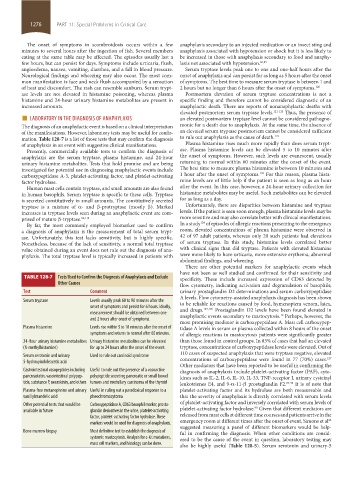
                   TABLE 128-7     Tests Used to Confirm the Diagnosis of Anaphylaxis and Exclude   specificity. These include increased expression of CD63 detected by
                              Other Causes                             flow cytometry, indicating activation and degranulation of basophils;
                  Test                   Comment                       urinary prostaglandin D2 determinations and serum carboxypeptidase
                                                                       A levels. Flow cytometry-assisted anaphylaxis diagnosis has been shown
                  Serum tryptase         Levels usually peak 60 to 90 minutes after the   to be reliable for reactions caused by food, hymenoptera venom, latex,
                                         onset of symptoms and persist for 6 hours. Ideally,   and drugs. 125,126  Prostaglandin D2 levels have been found elevated in
                                         measurement should be obtained between one   anaphylactic events secondary to mastocytosis.  Perhaps, however, the
                                                                                                         10
                                         and 2 hours after onset of symptoms.
                                                                       most promising mediator is carboxypeptidase A. Mast cell carboxypep-
                  Plasma histamine       Levels rise within 5 to 10 minutes after the onset of   tidase A levels in serum or plasma collected within 8 hours of the onset
                                         symptoms and returns to normal after 60 minutes.  of allergic reactions in mastocytosis patients were significantly greater
                  24-Hour urinary histamine metabolites  Urinary histamine metabolites can be elevated   than those found in control groups. In 83% of cases that had an elevated
                  (N-methylhistamine)    for up to 24 hours after the onset of the event.  tryptase, concentrations of carboxypeptidase levels were elevated. Out of
                                                                       110 cases of suspected anaphylaxis that were tryptase negative, elevated
                  Serum serotonin and urinary    Used to rule out carcinoid syndrome                                     127
                  5-hydroxyindoleacetic acid                           concentrations of carboxypeptidase were found in 77 (70%) cases.
                                                                       Other mediators that have been reported to be useful in confirming the
                  Gastrointestinal vasopeptides including  Useful to rule out the presence of a vasoactive    diagnosis of anaphylaxis include platelet-activating factor (PAF), cyto-
                  pancreastatin, vasointestinal polypep-  polypeptide secreting pancreatic or small bowel   kines such as IL-2, IL-6, IL-10, IL-33, TNF-receptor I, urinary cysteinyl
                  tide, substance P, neurokinin, and others tumors and medullary carcinoma of the thyroid  leukotrienes E4, and 9-α-11-β prostaglandin F2. 87-90  It is of note that
                  Plasma-free metanephrine and urinary  Useful in ruling out a paradoxical response to a    platelet-activating factor and its hydrolase are both measureable and
                  vanillylmandelic acid  pheochromocytoma              that the severity of anaphylaxis is directly correlated with serum levels
                  Other potential tests that would be    Carboxypeptidase A, CD63 basophil marker, prosta-  of platelet-activating factor and inversely correlated with serum levels of
                                                                                                 90
                  available in future    glandin derivatives in the urine, platelet-activating   platelet-activating factor hydrolase.  Given that different mediators are
                                         factor, platelet-activating factor hydrolase. These   released from mast cells at different time courses and patients arrive in the
                                                                                                                          84
                                         markers would be used for diagnosis of anaphylaxis.  emergency room at different times after the onset of event, Simons et al
                                                                       suggested measuring a panel of different biomarkers would be help-
                  Bone marrow biopsy     Most definitive test to establish the diagnosis of   ful in confirming the diagnosis. When other conditions are consid-
                                         systemic mastocytosis. Analysis for c-kit mutations,   ered to be the cause of the event in question, laboratory testing may
                                         mast cell markers, and histology can be done.   also be  highly useful  (Table 128-5). Serum serotonin  and  urinary-5


            section11.indd   1276                                                                                      1/19/2015   10:52:29 AM

