


Page 602 - Clinical Hematology_ Theory _ Procedures ( PDFDrive )
P. 602
586            PART 8  ■  Fundamentals of Hematological Analysis


                                                                                                                           tube 3 is  or gross examination, cell count, and morphol-
                                             Reasons for Performance of a


                    TABLE        29.2        Lumbar Puncture and Removal                                                   ogy. Because cells disintegrate rapidly, they must be counted
                                                                                                                           within 1 hour o  specimen collection.
                                             of an Aliquot of CSF
                                                                                                                                Caution:  All  CSF  specimens  should  be  handled  with


                   Therapeutic              Relief of increased intracranial pressure                                      extreme  care.  T ese  specimens  could  potentially  harbor
                                                                                                                           viruses or other in ectious organisms.
                   Diagnostic               Identi  cation of conditions such as sub-

                                            arachnoid hemorrhage, meningeal infec-                                         Gross Physical Exam ination

                                            tion (meningitis), multiple sclerosis, and                                     T e spinal f uid is examined visually  or turbidity (cloudi-

                                            neoplasms
                                                                                                                           ness), color, and viscosity. Normal CSF is clear and colorless.

                                                                                                                           Its appearance and viscosity are comparable to those o  water.


               Specimen Collection: Lumbar Puncture                                                                        Turbidity


               CSF is  ound inside all the ventricles, in the central canal o  the                                         I  any turbidity exists, it should be graded using a scale o  0 to 4+.

               spinal cord, and in the subarachnoid space around both the                                                  In the absence o  a set o  known standards  or comparison, the

               brain and the spinal cord. T e subarachnoid space is the area                                               rating scale is subjective. T is scale ranges  rom 1+, slight cloudi-

               between the arachnoid mater, the middle meningeal mem-                                                      ness, to 4+, in which newsprint cannot be seen through the tube.

               brane covering the brain and spinal cord, and the pia mater,                                                     Cloudiness  or  turbidity  may  be  caused  by  pleocytosis

               the  innermost  meningeal  membrane.  T e  total  maximum                                                   (increased  concentrations  o   leukocytes,  erythrocytes,  or

               volume o  CSF in adults is about 150 mL. T e maximum vol-                                                   microorganisms) or, less commonly, radiographic contrast

               ume in neonates is approximately 60 mL. T e rate o   orma-                                                  media or the presence o   at globules.

               tion in adults is approximately 500 mL/d or 20 mL/h and is                                                       Grossly bloody specimens can result  rom a traumatic tap or

               reabsorbed at the same rate, so the volume remains constant.                                                 rom conditions such as a bleeding subarachnoid hemorrhage

                    In a lumbar puncture, introducing a needle into the subarach-                                          or intracerebral hemorrhage.   raumatic taps more commonly

               noid space makes it possible to measure CSF pressure and to                                                 occur in children because o  movement during the procedure.

               obtain f uid  or analysis (  able 29.2). T is procedure is contra-                                               It is important to di  erentiate between specimens  rom a

               indicated when there is a skin in ection at the puncture site or                                            traumatic tap and those that are related to the patient’s clini-

               when the patient has septicemia or a general systemic in ection,                                            cal condition. A  reshly collected specimen should be exam-

               because o  the risk o  spreading the in ection into the meninges.                                           ined immediately. I  the reddish color diminishes between

                    Te patient is placed in a horizontal position, and the site is                                         the   rst and the last tube, the blood in the specimen is due to

               thoroughly cleansed to reduce the possibility o  contamination                                              a traumatic tap. In addition, clots may be observed in trau-

               with normal skin microbial f ora. A stylet needle is introduced                                             matically collected specimens because o  the presence o  an

               by a physician into the intervertebral space between the L4 and                                             increased concentration o  protein or blood or in a specimen

               L5 (lumbar) vertebrae. Up to 20 mL o  f uid can be removed                                                   rom a patient with a subarachnoid block or meningitis.

               i  the patient has a normal opening pressure. T e specimen

               should be placed into sterile tubes. A  er CSF collection, the                                              Color

               closing pressure is measured, the stylet replaced, and the needle                                           Any presence o  color should be noted. A yellow coloring

               removed. Specimens must be promptly delivered to the labora-                                                o  a specimen or the supernatant o  a centri uged specimen

               tory  or analysis. T e patient should be given appropriate a  er-                                           is re erred to as xanthochromia. T e release o  hemoglobin

               care because the procedure is not without risk.                                                              rom  hemolyzed  erythrocytes (red  blood  cells  [RBCs])  in

                    Indications  or spinal f uid examination are changing as                                               the CSF is a potential cause o  xanthochromia. T e lysis o

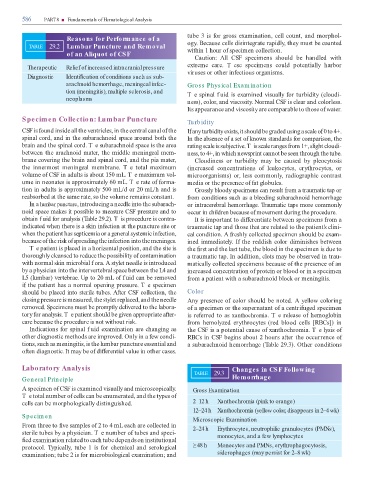
               other diagnostic methods are improved. Only in a  ew condi-                                                 RBCs in CSF begins about 2 hours a  er the occurrence o

               tions, such as meningitis, is the lumbar puncture essential and                                             a subarachnoid hemorrhage (  able 29.3). Other  conditions

               o  en diagnostic. It may be o  di  erential value in other cases.


               Laboratory Analysis                                                                                                                       Changes in CSF Follow ing

                                                                                                                                TABLE        29.3
               General Principle                                                                                                                         Hemorrhage


               A specimen o  CSF is examined visually and microscopically.                                                     Gross Examination

               T e total number o  cells can be enumerated, and the types o

               cells can be morphologically distinguished.                                                                     2–12 h          Xanthochromia (pink to orange)

                                                                                                                               12–24 h         Xanthochromia (yellow color, disappears in 2–4 wk)
               Specim en
                                                                                                                               Microscopic Examination
               From three to   ve samples o  2 to 4 mL each are collected in                                                   2–24 h          Erythrocytes, neutrophilic granulocytes (PMNs),

               sterile tubes by a physician. T e number o  tubes and speci-                                                                    monocytes, and a few lymphocytes

                 ed examination related to each tube depends on institutional

               protocol.    ypically,  tube  1  is   or  chemical  and  serological                                            ≥48 h           Monocytes and PMNs, erythrophagocytosis,

               examination; tube 2 is  or microbiological  examination; and                                                                    siderophages (may persist for 2–8 wk)

