Page 672 - Clinical Hematology_ Theory _ Procedures ( PDFDrive )
P. 672
656            PART 8  ■  Fundamentals of Hematological Analysis


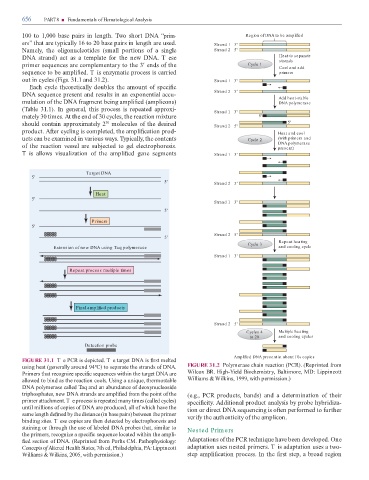
               100  to  1,000  base  pairs in  length.    wo  short  DNA  “prim-                                                                                  Region of DNA to be amplified

               ers” that are typically 16 to 20 base pairs in length are used.                                                               Strand 1     3'

               Namely,  the  oligonucleotides  (small  portions  o   a  single                                                               Strand 2     5'

               DNA  strand)  act  as  a  template   or  the  new  DNA.  T ese                                                                                                          Heat to separate
                                                                                                                                                                                       strands
               primer sequences are complementary to the 3′ ends o  the                                                                                            Cycle 1             Cool and add

               sequence to be ampli  ed. T is enzymatic process is carried                                                                                                             primers

               out in cycles (Figs. 31.1 and 31.2).                                                                                          Strand 1     3'

                    Each cycle theoretically doubles the amount o  speci  c

               DNA sequence present and results in an exponential accu-                                                                      Strand 2     5'                           Add heat-stable

               mulation o  the DNA  ragment being ampli  ed (amplicons)                                                                                                                DNA polymerase

               (  able  31.1).  In  general,  this  process  is  repeated  approxi-                                                          Strand 1     3'

               mately 30 times. At the end o  30 cycles, the reaction mixture                                                                                             5'

               should contain approximately 2  molecules o  the desired                                                                      Strand 2     5'                                 5'
                                                                      30
               product. A  er cycling is completed, the ampli  cation prod-                                                                                                            Heat and cool

               ucts can be examined in various ways.   ypically, the contents                                                                                      Cycle 2             (with primers and

               o  the reaction  vessel  are subjected to gel  electrophoresis.                                                                                                         DNA polymerase
                                                                                                                                                                                       present)
               Tis  allows  visualization  o   the  ampli  ed  gene  segments                                                                Strand 1     3'


                                                         Target DNA
                      5'
                                                                                                            5'                               Strand 2     5'


                                                                Heat
                      5'
                                                                                                                                             Strand 1     3'


                                                                                                            5'


                                                             Primers
                      5'


                                                                                                                                             Strand 2     5'
                                                                                                            5'
                                                                                                                                                                                       Repeat heating
                                                                                                                                                                   Cycle 3
                                    Extension of new DNA using Taq polymerase                                                                                                          and cooling cycle

                                                                                                                                             Strand 1     3'


                                              Repeat process multiple times


                                                   Final amplified products


                                                                                                                                             Strand 2     5'

                                                                                                                                                                  Cycles 4             Multiple heating
                                                                                                                                                                    to 20              and cooling cycles


                                                        Detection probe


                                                                                                                                                          Amplified DNA present in about 106 copies
               FIGURE 31.1  Te PCR is depicted. Te target DNA is   rst melted
               using heat (generally around 94°C) to separate the strands o  DNA.                                          FIGURE 31.2  Polymerase chain reaction (PCR). (Reprinted  rom

               Primers that recognize speci  c sequences within the target DNA are                                         Wilcox BR. High-Yield Biochemistry, Baltimore, MD: Lippincott

               allowed to bind as the reaction cools. Using a unique, thermostable                                         Williams & Wilkins, 1999, with permission.)
               DNA polymerase called   aq and an abundance o  deoxynucleoside

               triphosphates, new DNA strands are ampli  ed  rom the point o  the                                          (e.g.,  PCR  products,  bands)  and  a  determination  o   their

               primer attachment. T e process is repeated many times (called cycles)                                       speci  city. Additional product analysis by probe hybridiza-

               until millions o  copies o  DNA are produced, all o  which have the                                         tion or direct DNA sequencing is o  en per ormed to  urther

               same length de  ned by the distance (in base pairs) between the primer                                      veri y the authenticity o  the amplicon.
               binding sites. T ese copies are then detected by electrophoresis and

               staining or through the use o  labeled DNA probes that, similar to                                          Nested Prim ers

               the primers, recognize a speci  c sequence located within the ampli-
                ed section o  DNA. (Reprinted  rom Porlts CM. Pathophysiology:                                             Adaptations o  the PCR technique have been developed. One

               Concepts o  Altered Health States, 7th ed, Philadelphia, PA: Lippincott                                     adaptation uses nested primers. T is adaptation uses a two-

               Williams & Wilkins, 2005, with permission.)                                                                 step ampli  cation process. In the   rst step, a broad region
   667   668   669   670   671   672   673   674   675   676   677