


Page 677 - Clinical Hematology_ Theory _ Procedures ( PDFDrive )
P. 677
CHAPTER 31  ■  Molecular Diagnostic Techniques and Applications                                      661


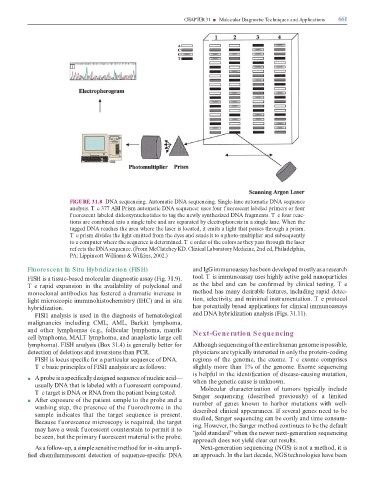
                                               FIGURE 31.8  DNA sequencing. Automatic DNA sequencing. Single-lane automatic DNA sequence

                                               analysis. T e 377 ABI Prism automatic DNA sequencer uses  our f uorescent labeled primers or  our
                                               f uorescent labeled dideoxynucleotides to tag the newly synthesized DNA  ragments. T e  our reac-

                                               tions are combined into a single tube and are separated by electrophoresis in a single lane. When the

                                               tagged DNA reaches the area where the laser is located, it emits a light that passes through a prism.

                                               T e prism divides the light emitted  rom the dyes and sends it to a photo-multiplier and subsequently
                                               to a computer where the sequence is determined. T e order o  the colors as they pass through the laser

                                               ref ects the DNA sequence. (From McClatchey KD. Clinical Laboratory Medicine, 2nd ed, Philadelphia,

                                               PA: Lippincott Williams & Wilkins, 2002.)


                   Fluorescent In Situ Hybridization (FISH)                                                                    and IgG immunoassay has been developed mostly as a research


                   FISH is a tissue-based molecular diagnostic assay (Fig. 31.9).                                              tool. T is immunoassay uses highly active gold nanoparticles

                   T e  rapid  expansion  in  the  availability  o   polyclonal  and                                           as  the  label  and  can  be  con  rmed  by  clinical  testing.  T e

                   monoclonal antibodies has  ostered a dramatic increase in                                                   method has many desirable  eatures, including rapid detec-

                   light microscopic immunohistochemistry (IHC) and in situ                                                    tion, selectivity, and minimal instrumentation. T e protocol

                   hybridization.                                                                                              has potentially broad applications  or clinical immunoassays

                        FISH analysis is used in the diagnosis o  hematological                                                and DNA hybridization analysis (Figs. 31.11).

                   malignancies  including  CML,  AML,  Burkitt  lymphoma,

                   and  other  lymphomas  (e.g.,   ollicular  lymphoma,  mantle                                                Next-Generation Sequencing

                   cell lymphoma, MAL   lymphoma, and anaplastic large cell

                   lymphoma). FISH analysis (Box 31.4) is generally better  or                                                 Although sequencing o  the entire human genome is possible,

                   detection o  deletions and inversions than PCR.                                                             physicians are typically interested in only the protein-coding

                        FISH is locus speci  c  or a particular sequence o  DNA.                                               regions  o   the  genome,  the  exome.  T e  exome  comprises

                        T e basic principles o  FISH analysis are as  ollows:                                                  slightly  more  than  1%  o   the  genome.  Exome  sequencing

                                                                                                                               is help ul in the identi  cation o  disease-causing mutation,
                   ■   A probe is a speci  cally designed sequence o  nucleic acid—                                            when the genetic cause is unknown.

                        usually DNA that is labeled with a f uorescent compound.                                                    Molecular  characterization  o   tumors  typically  include

                        Te target is DNA or RNA  rom the patient being tested.                                                 Sanger  sequencing  (described  previously)  o   a  limited

                   ■   A  er exposure o  the patient sample to the probe and a                                                 number  o   genes  known  to  harbor  mutations  with  well-

                        washing step, the presence o  the f uorochrome in the                                                  described clinical appearances. I  several genes need to be

                         sample  indicates  that  the  target  sequence  is  present.                                          studied, Sanger sequencing can be costly and time consum-

                        Because f uorescence microscopy is required, the target                                                ing. However, the Sanger method continues to be the de ault

                        may have a weak f uorescent counterstain to permit it to                                               “gold standard” when the newer next-generation sequencing

                        be seen, but the primary f uorescent material is the probe.
                                                                                                                               approach does not yield clear cut results.

                        As a  ollow-up, a simple sensitive method  or in-situ ampli-                                                Next-generation sequencing (NGS) is not a method, it is

                    ed  chemiluminescent  detection o  sequence-speci c DNA                                                    an approach. In the last decade, NGS technologies have been

