


Page 674 - Clinical Hematology_ Theory _ Procedures ( PDFDrive )
P. 674
658            PART 8  ■  Fundamentals of Hematological Analysis


               PCR assay has been run. DNA and other biomolecules can be

               separated based on charge, size, and shape (see Figs. 31.3 and

               31.4). DNA has a net negative charge and will migrate toward

               the anode (positive pole). PCR products are loaded into an aga-

               rose gel and electrophoresed. Ethidium bromide is a dye that

               intercalates into nucleic acids and will f uoresce with an orange

               color under ultraviolet (UV) irradiation. An image analyzer

               uses UV light to capture computer images o  the PCR products.

                    Melting curve analysis (MCA) is a method o  assessing

               the  dissociation  characteristics  o   double-stranded  (DS)

               DNA using a f uorophore during heating. When the tem-

               perature is raised, the DS begins to dissociate, which leads

               to a rise in the absorbance intensity, hyperchromicity. Factor

               V Leiden coagulopathies are a good example, i  a particular

               mutation is known.

                    T e principle o  MCA is that slightly mismatched DNA

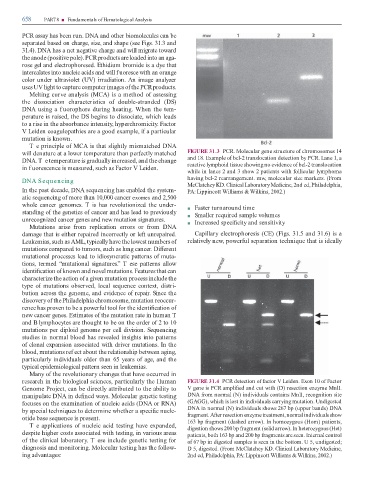
               will denature at a lower temperature than per ectly matched                                                 FIGURE 31.3  PCR. Molecular gene structure o  chromosomes 14

               DNA. T e temperature is gradually increased, and the change                                                 and 18. Example o  bcl-2 translocation detection by PCR. Lane 1, a
                                                                                                                           reactive lymphoid tissue showing no evidence o  bcl-2 translocation
               in f uorescence is measured, such as Factor V Leiden.
                                                                                                                           while in lanes 2 and 3 show 2 patients with  ollicular lymphoma


               DNA Sequencing                                                                                              having bcl-2 rearrangement. mw, molecular size markers. (From
                                                                                                                           McClatchey KD. Clinical Laboratory Medicine, 2nd ed, Philadelphia,
               In the past decade, DNA sequencing has enabled the system-                                                  PA: Lippincott Williams & Wilkins, 2002.)

               atic sequencing o  more than 10,000 cancer exomes and 2,500

               whole  cancer  genomes.  T is  has  revolutionized  the  under-                                             ■    Faster turnaround time

               standing o  the genetics o  cancer and has lead to previously                                               ■    Smaller required sample volumes

               unrecognized cancer genes and new mutation signatures.                                                      ■    Increased speci  city and sensitivity

                    Mutations  arise   rom  replication  errors  or   rom  DNA

               damage that is either repaired incorrectly or le   unrepaired.                                                   Capillary electrophoresis (CE) (Figs. 31.5 and 31.6) is a

               Leukemias, such as AML, typically have the lowest numbers o                                                 relatively new, power ul separation technique that is ideally

               mutations compared to tumors, such as lung cancer. Di  erent

               mutational processes lead to idiosyncratic patterns o  muta-

               tions,  termed  “mutational  signatures.”  T ese  patterns  allow

               identi  cation o  known and novel mutations. Features that can

               characterize the action o  a given mutation process include the

               type  o   mutations  observed,  local  sequence  context,  distri-

               bution across the genome, and evidence o  repair. Since the

               discovery o  the Philadelphia chromosome, mutation reoccur-

               rence has proven to be a power ul tool  or the identi  cation o

               new cancer genes. Estimates o  the mutation rate in human

               and B lymphocytes are thought to be on the order o  2 to 10

               mutations per diploid genome per cell division. Sequencing

               studies in normal blood has revealed insights into patterns

               o  clonal expansion associated with driver mutations. In the

               blood, mutations ref ect about the relationship between aging,

               particularly individuals older than 65 years o  age, and the

               typical epidemiological pattern seen in leukemias.

                    Many o  the revolutionary changes that have occurred in

               research in the biological sciences, particularly the Human                                                 FIGURE 31.4  PCR detection o   actor V Leiden. Exon 10 o  Factor

               Genome Project, can be directly attributed to the ability to                                                V gene is PCR ampli  ed and cut with (D) resection enzyme MnlI.

               manipulate DNA in de  ned ways. Molecular genetic testing                                                   DNA  rom normal (N) individuals contains MnlI, recognition site

                ocuses on the examination o  nucleic acids (DNA or RNA)                                                    (GAGG), which is lost in individuals carrying mutation. Undigested

               by special techniques to determine whether a speci  c nucle-                                                DNA in normal (N) individuals shows 267 bp (upper bands) DNA

               otide base sequence is present.                                                                              ragment. A  er resection enzyme treatment, normal individuals show
                                                                                                                           163 bp  ragment (dashed arrow). In homozygous (Hom) patients,
                    T e applications o  nucleic acid testing have expanded,                                                digestion shows 200 bp  ragment (solid arrow). In heterozygous (Het)

               despite higher costs associated with testing, in various areas                                              patients, both 163 bp and 200 bp  ragments are seen. Internal control

               o  the clinical laboratory. T ese include genetic testing  or                                               o  67 bp in digested samples is seen in the bottom. U 5, undigested;

               diagnosis and monitoring. Molecular testing has the  ollow-                                                 D 5, digested. (From McClatchey KD. Clinical Laboratory Medicine,

               ing advantages:                                                                                             2nd ed, Philadelphia, PA: Lippincott Williams & Wilkins, 2002.)

