


Page 676 - Clinical Hematology_ Theory _ Procedures ( PDFDrive )
P. 676
660            PART 8  ■  Fundamentals of Hematological Analysis


                                                                                                                                Tere  are  two  di  erent  pyrosequencing  strategies  that

                    BOX  31.3                                                                                              are  currently  available:  solid-phase  pyrosequencing  and

                                                                                                                             liquid-phase  pyrosequencing.  Solid-phase  pyrosequencing

                                                                                                                           utilizes immobilized DNA in a three-enzyme system. In this
                  Limitations of DNA Sequencing                                                                            system, a washing step is per ormed to remove the excess


                  ■   Large amounts o  normal tissue required                                                              substrate a  er each nucleotide addition. Using this method,

                  ■   Sensitivity—tumor mixed with normal cells                                                            the DNA to be sequenced is broken up into  ragments o

                  ■   Heterozygosity—most  mutation,  hal   o   DNA  is                                                    ~100 base pairs and denatured to  orm single-stranded DNA
                       normal                                                                                              (ssDNA).  T en  single  ssDNA  amplicons  are  immobilized
                                                                                                                           onto microscopic beads and placed into separate wells. In liq-


                  From Heriot K. Welcome to the beginning: molecular pathology  or the                                     uid-phase pyrosequencing, a nucleotide-degrading enzyme
                  community hospital pathologist and medical technologist, ASCP Annual                                     is introduced to make a  our-enzyme system. Addition o

                  Meeting,   ampa, FL, 2014.                                                                               this enzyme has eliminated the need  or solid support and

                                                                                                                           intermediate washing and enables the pyrosequencing reac-

                                                                                                                           tion to be per ormed in a single tube.


               2.  T e second step involves adding primers to the ssDNA.

                     Primers are short synthetic segments o  ssDNA that con-                                               Southern Blot Technique

                     tain a nucleotide sequence complementary to a short                                                   T e  Southern  and  Northern  blot  techniques  are  historic

                     strand  o   target  DNA.  T e  patient’s  DNA  serves  as  a                                          techniques used to detect DNA and RNA, respectively. T e

                      template to copy. DNA polymerase catalyzes the addition                                              Southern blot procedure (Figs. 31.9 and 31.10) can be used

                     o  the appropriate nucleotides to the preexisting primer.                                             in clinical laboratories, but the Northern blot technique is

                     DNA synthesis is terminated when the deoxynucleotide is                                               used in research setting.

                     incorporated into a growing DNA chain.                                                                     Specimen  DNA  is  denatured  and  treated  with  restric-


                                                                                                                           tion  enzymes  to  create  DNA   ragments;  then,  the  ssDNA
               Pyrosequencing                                                                                               ragments are separated by electrophoresis (Fig. 14.7). T e


               In attempt to   nd a  aster and less expensive way o  molecu-                                               electrophoretically separated  ragments are then blotted to

               lar sequencing, pyrosequencing has emerged as a method.                                                     a  nitrocellulose  membrane,  retaining  their  electrophoretic

               Pyrosequencing is a DNA sequencing technique that is based                                                  position  and hybridized  with radiolabeled single-stranded

               on  the  detection  o   released  pyrophosphate  (PPi)  during                                              DNA   ragments  with  sequences  complementary  to  those

               DNA synthesis. In a cascade o  enzymatic reactions, visible                                                 being sought. T e resulting dsDNA bearing the radiolabel, i

               light is generated that is proportional to the number o  incor-                                             present, is then detected by radiography.

               porated nucleotides.                                                                                             T e Southern blot procedure has clinical diagnostic appli-

                    Te  cascade  starts  with  a  nucleic  acid  polymerization                                            cations  or disorders associated with signi  cant changes in

               reaction  in  which  inorganic  PPi  is  released  as  a  result  o                                         DNA, a deletion or insertion o  at least 50 to 100 bp (e.g.,

               nucleotide incorporation by polymerase. T e released PPi is                                                  ragile  X  syndrome),  and  determination  o   clonality  in

               subsequently converted to A  P by A  P sul urylase, which                                                   lymphomas o     or B cell origin. I  a single-base mutation

               provides  the  energy  to  luci erase  to  oxidize  luci erin  and                                          changes an enzyme restriction site on the DNA, resulting in

               generate light. Because the added nucleotide is known, the                                                  an altered band or  ragment size, the Southern blot proce-

               sequence o  the template can be determined.                                                                 dure can detect these changes in DNA sequences.


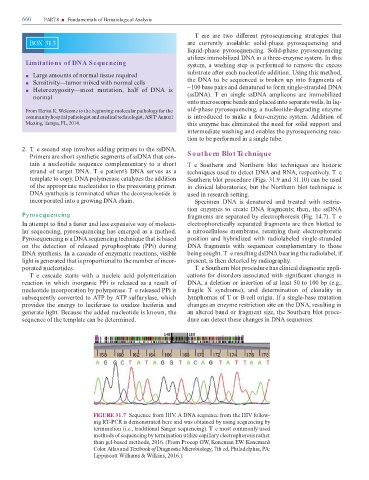
                                                              FIGURE 31.7  Sequence  rom HIV. A DNA sequence  rom the HIV  ollow-

                                                              ing R  -PCR is demonstrated here and was obtained by using sequencing by
                                                              termination (i.e., traditional Sanger sequencing). T e most commonly used

                                                              methods o  sequencing by termination utilize capillary electrophoresis rather

                                                              than gel-based methods, 2016. (From Procop GW, Koneman EW. Koneman’s

                                                              Color Atlas and   extbook o  Diagnostic Microbiology, 7th ed, Philadelphia, PA:
                                                              Lippincott Williams & Wilkins, 2016.).

