


Page 249 - Review of Medical Microbiology and Immunology ( PDFDrive )
P. 249
mebooksfree.com
                                                                                                            mebooksfree.com
 mebooksfree.com

                                                                                                            mebooksfree.com
            mebooksfree.com
                                                                            mebooksfree.com
 mebooksfree.com  mebooksfree.com           mebooksfree.com          replication begins, only the early region of the genome is            mebooksfree.com
                                            mebooksfree.com
                                                                                                                                           mebooksfree.com
                       PART III  Basic Virology
                 238
                     VIR AL  MESSENGER  RNA
                   There are four interesting aspects of viral mRNA and its
                   expression in eukaryotic cells. (1) Viral mRNAs have three
                                                                     transcribed, and therefore, only certain early proteins are
                                                                     made.  One  of  the  early  proteins  is  a  repressor  of  the  late
                   attributes in common with cellular mRNAs: on the 5´ end
                   there is a methylated GTP “cap,” which is linked by an
                   “inverted” (3´-to-5´) bond instead of the usual 5´-to-3´
                                                                     (4) Three different processes are used to generate the mono-
                                                                     cistronic mRNAs that will code for a single protein from the
                   bond; on the 3´ end there is a tail of 100–200 adenosine resi-  genes; this prevents transcription until the appropriate time.
                                                                                                            mebooksfree.com
                                                                            mebooksfree.com
 mebooksfree.com  mebooksfree.com           mebooksfree.com          specific initiation points along the genome, which is the             mebooksfree.com
                                                                     polycistronic viral genome:
                   dues [poly(A)]; and the mRNA is generated by splicing from
                                                                        (1) Individual mRNAs are transcribed by starting at many
                   a larger transcript of the genome. In fact, these three modifi-
                   cations were first observed in studies on viral mRNAs and
                   then extended to cellular mRNAs. (2) Some viruses use their
                                                                     same mechanism used by eukaryotic cells and by herpesvi-
                   genetic material to the fullest extent by making more than
                                                                     ruses, adenoviruses, and the DNA and RNA tumor viruses.
                   one type of mRNA from the same piece of DNA by “shifting
                                                                        (2) In the reoviruses and influenza viruses, the genome is
                                                                     segmented into multiple pieces, each of which codes for a
                   the reading frame.” This is done by starting transcription one
                                                                     single mRNA.
                   or two bases downstream from the original initiation site.
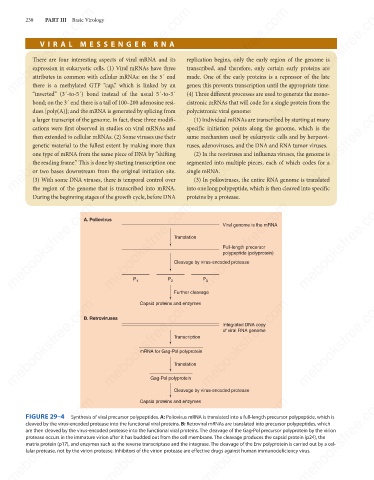
                                                                        (3) In polioviruses, the entire RNA genome is translated
                   (3) With some DNA viruses, there is temporal control over
                   the  region  of  the  genome  that  is  transcribed  into  mRNA.
                                                                     proteins by a protease.
                   During the beginning stages of the growth cycle, before DNA   into one long polypeptide, which is then cleaved into specific
 mebooksfree.com  mebooksfree.com           mebooksfree.com                 mebooksfree.com                 mebooksfree.com                mebooksfree.com
                                    A. Poliovirus
                                                                                 Viral genome is the mRNA
                                                                 Translation
                                                                                 Full-length precursor
                                                                                 polypeptide (polyprotein)
                                                                 Cleavage by virus-encoded protease


                                                    P
                                                               P
                                                                           P
                                                                            3
                                                                2
                                                     1
                                                                 Further cleavage
 mebooksfree.com  mebooksfree.com           mebooksfree.com                 mebooksfree.com                 mebooksfree.com                mebooksfree.com
                                                      Capsid proteins and enzymes
                                    B. Retroviruses
                                                                                 Integrated DNA copy
                                                                                 of viral RNA genome
                                                                 Transcription

                                                      mRNA for Gag-Pol polyprotein
                                                                 Translation

                                                         Gag-Pol polyprotein

                                                                 Cleavage by virus-encoded protease
 mebooksfree.com  mebooksfree.com           mebooksfree.com                 mebooksfree.com                 mebooksfree.com                mebooksfree.com
                                                      Capsid proteins and enzymes
                 FIGURE 29–4
                               Synthesis of viral precursor polypeptides. A: Poliovirus mRNA is translated into a full-length precursor polypeptide, which is
                 cleaved by the virus-encoded protease into the functional viral proteins. B: Retroviral mRNAs are translated into precursor polypeptides, which
                 are then cleaved by the virus-encoded protease into the functional viral proteins. The cleavage of the Gag-Pol precursor polyprotein by the virion
                 protease occurs in the immature virion after it has budded out from the cell membrane. The cleavage produces the capsid protein (p24), the
                 matrix protein (p17), and enzymes such as the reverse transcriptase and the integrase. The cleavage of the Env polyprotein is carried out by a cel-
                 lular protease, not by the virion protease. Inhibitors of the virion protease are effective drugs against human immunodeficiency virus.


 mebooksfree.com  mebooksfree.com           mebooksfree.com                 mebooksfree.com                 mebooksfree.com                mebooksfree.com

