


Page 248 - Review of Medical Microbiology and Immunology ( PDFDrive )
P. 248
mebooksfree.com
mebooksfree.com
mebooksfree.com
mebooksfree.com
mebooksfree.com
mebooksfree.com
mebooksfree.com
mebooksfree.com mebooksfree.com mebooksfree.com DNA Product of Reverse Phase of Replication When Reverse 237 mebooksfree.com
mebooksfree.com
CHAPTER 29 Replication
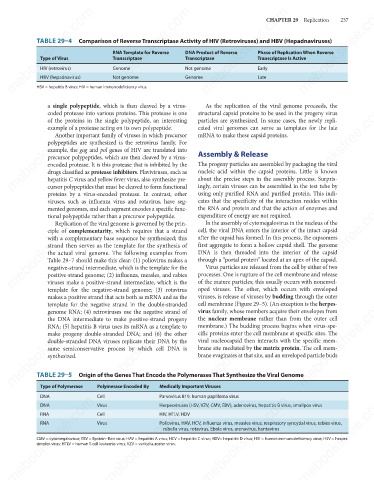
TABLE 29–4 Comparison of Reverse Transcriptase Activity of HIV (Retroviruses) and HBV (Hepadnaviruses)
RNA Template for Reverse
Transcriptase Is Active
Transcriptase
Transcriptase
Type of Virus
Not genome
Genome
HIV (retrovirus)
Early
Late
Not genome
Genome
HBV (hepadnavirus)
HBV = hepatitis B virus; HIV = human immunodeficiency virus.
As the replication of the viral genome proceeds, the
a single polypeptide, which is then cleaved by a virus-
mebooksfree.com mebooksfree.com mebooksfree.com structural capsid proteins to be used in the progeny virus mebooksfree.com
mebooksfree.com
mebooksfree.com
coded protease into various proteins. This protease is one
particles are synthesized. In some cases, the newly repli-
of the proteins in the single polypeptide, an interesting
example of a protease acting on its own polypeptide.
cated viral genomes can serve as templates for the late
Another important family of viruses in which precursor
mRNA to make these capsid proteins.
polypeptides are synthesized is the retrovirus family. For
example, the gag and pol genes of HIV are translated into
Assembly & Release
precursor polypeptides, which are then cleaved by a virus-
The progeny particles are assembled by packaging the viral
encoded protease. It is this protease that is inhibited by the
nucleic acid within the capsid proteins. Little is known
drugs classified as protease inhibitors. Flaviviruses, such as
hepatitis C virus and yellow fever virus, also synthesize pre-
ingly, certain viruses can be assembled in the test tube by
cursor polypeptides that must be cleaved to form functional
using only purified RNA and purified protein. This indi-
proteins by a virus-encoded protease. In contrast, other about the precise steps in the assembly process. Surpris-
cates that the specificity of the interaction resides within
viruses, such as influenza virus and rotavirus, have seg-
mebooksfree.com mebooksfree.com mebooksfree.com cell, the viral DNA enters the interior of the intact capsid mebooksfree.com
mebooksfree.com
mebooksfree.com
the RNA and protein and that the action of enzymes and
mented genomes, and each segment encodes a specific func-
expenditure of energy are not required.
tional polypeptide rather than a precursor polypeptide.
In the assembly of cytomegalovirus in the nucleus of the
Replication of the viral genome is governed by the prin-
ciple of complementarity, which requires that a strand
after the capsid has formed. In this process, the capsomers
with a complementary base sequence be synthesized; this
first aggregate to form a hollow capsid shell. The genome
strand then serves as the template for the synthesis of
DNA is then threaded into the interior of the capsid
the actual viral genome. The following examples from
through a “portal protein” located at an apex of the capsid.
Table 29–7 should make this clear: (1) poliovirus makes a
Virus particles are released from the cell by either of two
negative-strand intermediate, which is the template for the
positive-strand genome; (2) influenza, measles, and rabies
of the mature particles; this usually occurs with nonenvel-
viruses make a positive-strand intermediate, which is the
oped viruses. The other, which occurs with enveloped
template for the negative-strand genome; (3) rotavirus
viruses, is release of viruses by budding through the outer
makes a positive strand that acts both as mRNA and as the processes. One is rupture of the cell membrane and release
mebooksfree.com
mebooksfree.com mebooksfree.com Polymerase Encoded By Medically Important Viruses mebooksfree.com mebooksfree.com mebooksfree.com
cell membrane (Figure 29–5). (An exception is the herpes-
template for the negative strand in the double-stranded
virus family, whose members acquire their envelopes from
genome RNA; (4) retroviruses use the negative strand of
the nuclear membrane rather than from the outer cell
the DNA intermediate to make positive-strand progeny
membrane.) The budding process begins when virus-spe-
RNA; (5) hepatitis B virus uses its mRNA as a template to
cific proteins enter the cell membrane at specific sites. The
make progeny double-stranded DNA; and (6) the other
viral nucleocapsid then interacts with the specific mem-
double-stranded DNA viruses replicate their DNA by the
brane site mediated by the matrix protein. The cell mem-
same semiconservative process by which cell DNA is
brane evaginates at that site, and an enveloped particle buds
synthesized.
TABLE 29–5 Origin of the Genes That Encode the Polymerases That Synthesize the Viral Genome
Type of Polymerase
DNA
Parvovirus B19, human papilloma virus
mebooksfree.com mebooksfree.com Cell mebooksfree.com mebooksfree.com mebooksfree.com mebooksfree.com
Virus
Herpesviruses (HSV, VZV, CMV, EBV), adenovirus, hepatitis B virus, smallpox virus
DNA
Cell
RNA
HIV, HTLV, HDV
RNA
Poliovirus, HAV, HCV, influenza virus, measles virus, respiratory syncytial virus, rabies virus,
Virus
rubella virus, rotavirus, Ebola virus, arenavirus, hantavirus
CMV = cytomegalovirus; EBV = Epstein–Barr virus; HAV = hepatitis A virus; HCV = hepatitis C virus; HDV= hepatitis D virus; HIV = human immunodeficiency virus; HSV = herpes
simplex virus; HTLV = human T-cell leukemia virus; VZV = varicella-zoster virus.
mebooksfree.com mebooksfree.com mebooksfree.com mebooksfree.com mebooksfree.com mebooksfree.com

