Page 44 - Review of Medical Microbiology and Immunology ( PDFDrive )
P. 44
mebooksfree.com
                                                                            mebooksfree.com
 mebooksfree.com

                                            mebooksfree.com
            mebooksfree.com
                                                                                                            mebooksfree.com
 mebooksfree.com  mebooksfree.com           mebooksfree.com              external sources. Pathogens exit the infected patient most   33   mebooksfree.com
                                                                            mebooksfree.com
                                                                                                                                           mebooksfree.com
                                                                                                CHAPTER 7  Pathogenesis
                        members of the normal flora and, as such, are not transmit-
                        ted directly prior to the onset of infection.
                                                                         frequently from the respiratory and gastrointestinal tracts;
                                                                         hence transmission to the new host usually occurs via air-
                          A generalized sequence of the stages of infection is as
                        follows:
                                                                         borne respiratory droplets or fecal contamination of food
                                                                         and water. Organisms can also be  transmitted by sexual
                          (1) Transmission from an external source into the portal
                        of entry.
                                                                         nated needles, or biting insects. The transfer of blood,
                          (2) Evasion of primary host defenses such as skin or
                                                                         either by transfusion or by sharing needles during intrave-
                        stomach acid.
                                                                         nous drug use, can transmit various bacterial and viral
                          (3) Adherence to mucous membranes, usually by bacte-  contact, urine, skin contact, blood transfusions, contami-
                                                                                                            mebooksfree.com
 mebooksfree.com  mebooksfree.com           mebooksfree.com              virus, and West Nile virus has greatly reduced the risk of        mebooksfree.com
                                                                         pathogens. The screening of donated blood for Treponema
                                                                            mebooksfree.com
                        rial pili.
                                                                         pallidum, human immunodeficiency virus (HIV), human
                          (4) Colonization by growth of the bacteria at the site of
                                                                         T-cell lymphotropic virus, hepatitis B virus, hepatitis C
                        adherence.
                          (5) Disease symptoms caused by toxin production or
                                                                         infection by these organisms.
                        invasion accompanied by inflammation.
                                                                           The major bacterial diseases transmitted by ticks in the
                          (6) Host  responses,  both  nonspecific  and  specific
                                                                         United States are Lyme disease, Rocky Mountain spotted
                        (immunity), during steps 3, 4, and 5.
                                                                         fever, ehrlichiosis, relapsing fever, and tularemia. Of these
                          (7) Progression or resolution of the disease.
                                                                         five diseases, Lyme disease is by far the most common. Ticks
                                                                         of the genus Ixodes transmit three infectious diseases: Lyme
                        DETERMINANTS OF BACTERIAL
                        PATHOGENESIS
                                                                           Bacteria, viruses, and other microbes can also be trans-
                                                                         mitted from mother to offspring, a process called vertical
                        1. Transmission                                  disease, ehrlichiosis, and babesiosis, a protozoan disease.
                                                                         transmission. The three modes by which organisms are
                                                                            mebooksfree.com
 mebooksfree.com  mebooksfree.com           mebooksfree.com              describes some medically important organisms that are             mebooksfree.com
                                                                                                            mebooksfree.com
                                                                         transmitted vertically are across the placenta, within the
                        An understanding of the mode of transmission of bacteria
                        and other infectious agents is extremely important from a
                                                                         birth canal during birth, and via breast milk. Table 7–2
                        public health perspective, because interrupting the chain of
                                                                         transmitted vertically. (Horizontal transmission, by con-
                        transmission is an excellent way to prevent infectious
                                                                         trast, is person-to-person transmission that is not from
                        diseases. The mode of transmission of many infectious
                                                                         mother to offspring.)
                        diseases is “human-to-human,” but infectious diseases are
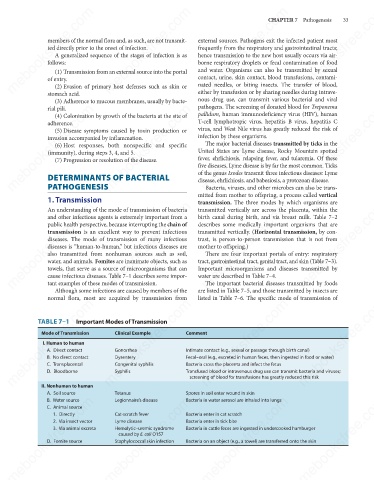
                        also transmitted from nonhuman sources such as soil,
                                                                           There are four important portals of entry: respiratory
                        water, and animals. Fomites are inanimate objects, such as
                                                                         tract, gastrointestinal tract, genital tract, and skin (Table 7–3).
                                                                         Important microorganisms and diseases transmitted by
                        towels, that serve as a source of microorganisms that can
                        cause infectious diseases. Table 7–1 describes some impor-
                                                                           The important bacterial diseases transmitted by foods
                        tant examples of these modes of transmission.
                          Although some infections are caused by members of the
                                                                         are listed in Table 7–5, and those transmitted by insects are
                        normal flora, most are acquired by transmission from   water are described in Table 7–4.
                                                                         listed in Table 7–6. The specific mode of transmission of
 mebooksfree.com  mebooksfree.com               mebooksfree.com      Comment mebooksfree.com                mebooksfree.com                mebooksfree.com
                     TABLE 7–1  Important Modes of Transmission
                                              Clinical Example
                      Mode of Transmission
                       I. Human to human
                                               
                                                                      
                        A.  Direct contact
                                              Gonorrhea
                                                                     Intimate contact (e.g., sexual or passage through birth canal)
                                              Dysentery
                                                                     Fecal–oral (e.g., excreted in human feces, then ingested in food or water)
                        B.  No direct contact
                        C.  Transplacental
                                              Congenital syphilis
                                                                     Bacteria cross the placenta and infect the fetus
                        D.  Bloodborne
                                                                      screening of blood for transfusions has greatly reduced this risk
                      II. Nonhuman to human
                                                                      
                                              Tetanus
                        A.  Soil source       Syphilis               Transfused blood or intravenous drug use can transmit bacteria and viruses;
                                                                     Spores in soil enter wound in skin
 mebooksfree.com  mebooksfree.com           mebooksfree.com          Bacteria enter in tick bite            mebooksfree.com                mebooksfree.com
                                                                            mebooksfree.com
                                              Legionnaire’s disease
                        B.  Water source
                                                                     Bacteria in water aerosol are inhaled into lungs
                        C.  Animal source
                                                                      
                                               
                          1.  Directly
                                              Cat-scratch fever
                                                                     Bacteria enter in cat scratch
                                              Lyme disease
                          2.  Via insect vector
                          3.  Via animal excreta
                                              Hemolytic–uremic syndrome
                                                                     Bacteria in cattle feces are ingested in undercooked hamburger
                                               caused by E. coli O157
                                                                     Bacteria on an object (e.g., a towel) are transferred onto the skin
                        D.  Fomite source
                                              Staphylococcal skin infection
 mebooksfree.com  mebooksfree.com           mebooksfree.com                 mebooksfree.com                 mebooksfree.com                mebooksfree.com
   39   40   41   42   43   44   45   46   47   48   49