


Page 49 - Review of Medical Microbiology and Immunology ( PDFDrive )
P. 49
mebooksfree.com
mebooksfree.com
mebooksfree.com
mebooksfree.com
mebooksfree.com
mebooksfree.com mebooksfree.com Virulence Factor Used in Vaccine mebooksfree.com mebooksfree.com mebooksfree.com
mebooksfree.com
mebooksfree.com
38
PART I Basic Bacteriology
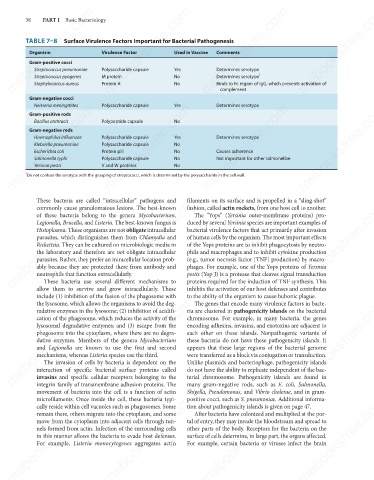
TABLE 7–8 Surface Virulence Factors Important for Bacterial Pathogenesis
Organism
Comments
Gram-positive cocci
Polysaccharide capsule
Yes
Determines serotype
Streptococcus pneumoniae
Streptococcus pyogenes
No
Binds to Fc region of IgG, which prevents activation of
Protein A
Staphylococcus aureus
complement
Gram-negative cocci M protein No Determines serotype 1
Yes
mebooksfree.com
Polysaccharide capsule
Neisseria meningitides
Determines serotype
mebooksfree.com mebooksfree.com Polysaccharide capsule Yes mebooksfree.com mebooksfree.com mebooksfree.com
Gram-positive rods
Polypeptide capsule
Bacillus anthracis
No
Gram-negative rods
Haemophilus influenzae
Determines serotype
Polysaccharide capsule
No
Klebsiella pneumoniae
Causes adherence
Escherichia coli
Protein pili
No
No
Polysaccharide capsule
Salmonella typhi
Not important for other salmonellae
No
V and W proteins
Yersinia pestis
1
Do not confuse the serotype with the grouping of streptococci, which is determined by the polysaccharide in the cell wall.
These bacteria are called “intracellular” pathogens and filaments on its surface and is propelled in a “sling-shot”
mebooksfree.com mebooksfree.com mebooksfree.com bacterial virulence factors that act primarily after invasion mebooksfree.com
mebooksfree.com
mebooksfree.com
commonly cause granulomatous lesions. The best-known
fashion, called actin rockets, from one host cell to another.
The “Yops” (Yersinia outer-membrane proteins) pro-
of these bacteria belong to the genera Mycobacterium,
duced by several Yersinia species are important examples of
Legionella, Brucella, and Listeria. The best-known fungus is
Histoplasma. These organisms are not obligate intracellular
parasites, which distinguishes them from Chlamydia and
of human cells by the organism. The most important effects
Rickettsia. They can be cultured on microbiologic media in
of the Yops proteins are to inhibit phagocytosis by neutro-
phils and macrophages and to inhibit cytokine production
the laboratory and therefore are not obligate intracellular
(e.g., tumor necrosis factor [TNF] production) by macro-
parasites. Rather, they prefer an intracellular location prob-
ably because they are protected there from antibody and
phages. For example, one of the Yops proteins of Yersinia
neutrophils that function extracellularly.
These bacteria use several different mechanisms to
proteins required for the induction of TNF synthesis. This
inhibits the activation of our host defenses and contributes
allow them to survive and grow intracellularly. These
to the ability of the organism to cause bubonic plague.
include (1) inhibition of the fusion of the phagosome with pestis (Yop J) is a protease that cleaves signal transduction
mebooksfree.com
mebooksfree.com
mebooksfree.com mebooksfree.com mebooksfree.com encoding adhesins, invasins, and exotoxins are adjacent to mebooksfree.com
the lysosome, which allows the organisms to avoid the deg-
The genes that encode many virulence factors in bacte-
radative enzymes in the lysosome; (2) inhibition of acidifi-
ria are clustered in pathogenicity islands on the bacterial
cation of the phagosome, which reduces the activity of the
chromosome. For example, in many bacteria, the genes
lysosomal degradative enzymes; and (3) escape from the
phagosome into the cytoplasm, where there are no degra-
each other on these islands. Nonpathogenic variants of
dative enzymes. Members of the genera Mycobacterium
these bacteria do not have these pathogenicity islands. It
appears that these large regions of the bacterial genome
and Legionella are known to use the first and second
were transferred as a block via conjugation or transduction.
mechanisms, whereas Listeria species use the third.
The invasion of cells by bacteria is dependent on the
Unlike plasmids and bacteriophage, pathogenicity islands
interaction of specific bacterial surface proteins called
invasins and specific cellular receptors belonging to the
terial chromosome. Pathogenicity islands are found in
integrin family of transmembrane adhesion proteins. The
many gram-negative rods, such as E. coli, Salmonella,
Shigella, Pseudomonas, and Vibrio cholerae, and in gram-
movement of bacteria into the cell is a function of actin do not have the ability to replicate independent of the bac-
mebooksfree.com
mebooksfree.com
mebooksfree.com mebooksfree.com mebooksfree.com tal of entry, they may invade the bloodstream and spread to mebooksfree.com
positive cocci, such as S. pneumoniae. Additional informa-
microfilaments. Once inside the cell, these bacteria typi-
cally reside within cell vacuoles such as phagosomes. Some
tion about pathogenicity islands is given on page 47.
remain there, others migrate into the cytoplasm, and some
After bacteria have colonized and multiplied at the por-
move from the cytoplasm into adjacent cells through tun-
other parts of the body. Receptors for the bacteria on the
nels formed from actin. Infection of the surrounding cells
surface of cells determine, in large part, the organs affected.
in this manner allows the bacteria to evade host defenses.
For example, certain bacteria or viruses infect the brain
For example, Listeria monocytogenes aggregates actin
mebooksfree.com mebooksfree.com mebooksfree.com mebooksfree.com mebooksfree.com mebooksfree.com

