


Page 53 - Review of Medical Microbiology and Immunology ( PDFDrive )
P. 53
mebooksfree.com
                                                                            mebooksfree.com
 mebooksfree.com

            mebooksfree.com
                                            mebooksfree.com
                                                                                                            mebooksfree.com
                                                                                                                                           mebooksfree.com
                                                                            mebooksfree.com
 mebooksfree.com  mebooksfree.com      Organism                       Mode of Action Exotoxin               mebooksfree.com                mebooksfree.com
                 42
                      PART I  Basic Bacteriology
                TABLE 7–13  Main Location of Symptoms of Disease Caused by Bacterial Exotoxins
                  Main Location of
                  Symptoms

                  Gastrointestinal tract

                                                                      Inactivates GTPases in enterocytes
                                       Clostridium difficile
                    2.  Gram-positive rods
                                                                      Superantigen
                                       Clostridium perfringens

                                                                      Superantigen
                                       Bacillus cereus
                      1.  Gram-positive cocci  Staphylococcus aureus  Enterotoxin is a superantigen
                                                                      Stimulates adenylate cyclase
                                       Vibrio cholerae
                    3.  Gram-negative rods
                                            mebooksfree.com
 mebooksfree.com  mebooksfree.com        Clostridium tetani             Inhibits glycine release            mebooksfree.com                mebooksfree.com
                                                                            mebooksfree.com
                                       Toxigenic Escherichia coli
                                                                      Stimulates adenylate cyclase

                                       Escherichia coli O157
                                                                      Inactivates protein synthesis

                  Nervous system
                    1.  Gram-positive rods
                                                                      Inhibits acetylcholine release

                                       Clostridium botulinum


                  Respiratory tract
                                                                      Inactivates protein synthesis
                    1.  Gram-positive rods
                                       Corynebacterium diphtheriae
                                                                      Stimulates adenylate cyclase; inhibits chemokine receptor
                    2.  Gram-negative rods
                                       Bordetella pertussis
                    1.  Gram-positive cocci
                                       S. aureus (MRSA strains)

                                                                      PV leukocidin is a pore-forming toxin that disrupts cell membrane
                    Skin, soft tissue, or muscle    S. aureus (scalded skin syndrome)    Protease cleaves desmosome in skin
                                       Streptococcus pyogenes (scarlet fever)
                                                                      Erythrogenic toxin is a superantigen
                                                                      Lecithinase cleaves cell membranes
                    2.  Gram-positive rods
                                       C. perfringens
 mebooksfree.com  mebooksfree.com      S. aureus                     is a protease that degrades the protein(s) responsible for the        mebooksfree.com
                                                                                                            mebooksfree.com
                                                                            mebooksfree.com
                                            mebooksfree.com
                                       Bacillus anthracis

                                                                      Edema factor is an adenylate cyclase; lethal factor is a protease
                  Systemic


                                                                      Toxic shock syndrome toxin is a superantigen
                    1.  Gram-positive cocci
                MRSA = methicillin-resistant Staphylococcus aureus; PV = Panton-Valentine.
                    may travel either by retrograde axonal transport or in the
                    bloodstream to the anterior horn and interstitial neurons of
                                                                     release of acetylcholine. There are six serotypes of botuli-
                    the spinal cord. Blockage of release of the inhibitory trans-
                                                                     plasmid, some on a temperate bacteriophage, and some on
                    mitter leads to convulsive contractions of the voluntary
                                                                     the bacterial chromosome.
                    muscles, best exemplified by spasm of the jaw and neck
                    muscles (“lockjaw”).                             num toxin (A–F). Some serotypes are encoded on a
                                                                        (4) Two exotoxins are produced by Clostridium difficile,
                       (3) Botulinum toxin, produced by Clostridium botulinum,
                                                                     both of which are involved in the pathogenesis of pseudo-
                                                                                                            mebooksfree.com
 mebooksfree.com  mebooksfree.com           mebooksfree.com          ages the colonic mucosa and causes pseudomembranes to                 mebooksfree.com
                                                                            mebooksfree.com
                                                                     membranous colitis. Exotoxin A is an enterotoxin that
                    is a neurotoxin that blocks the release of acetylcholine at
                                                                     causes watery diarrhea. Exotoxin B is a cytotoxin that dam-
                    the synapse, producing a flaccid paralysis. Approximately 1
                    μg is lethal for humans; it is one of the most toxic com-
                                                                     form. Exotoxins A and B are glucosyltransferases that glu-
                    pounds known. The toxin is composed of two polypeptide
                    subunits held together by disulfide bonds. One of the sub-
                                                                     cosylate signal transduction proteins called Rho GTPases—
                                                                     a process that inhibits these GTPases from performing
                    units binds to a receptor on the neuron; the other subunit
                                                 –
                                   S
                                              COO
                                S
                                                                             3
                                    NH 3 +       S       Protease     S    + H N  COO –  Fragment A   C O 3 O + –
                                                 S
                                                                                                      NH
 mebooksfree.com  mebooksfree.com           mebooksfree.com                 mebooksfree.com                 mebooksfree.com                mebooksfree.com
                                                                      S
                                                                                  Fragment B
                                   Intact toxin
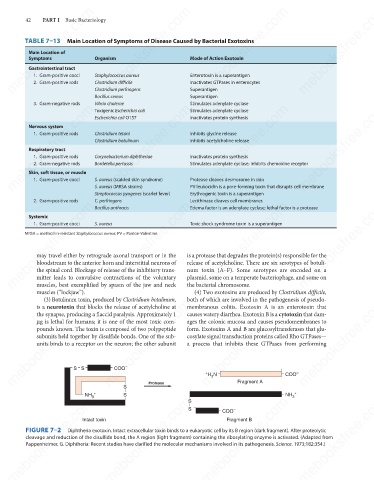
                 FIGURE 7–2
                              Diphtheria exotoxin. Intact extracellular toxin binds to a eukaryotic cell by its B region (dark fragment). After proteolytic
                 cleavage and reduction of the disulfide bond, the A region (light fragment) containing the ribosylating enzyme is activated. (Adapted from
                 Pappenheimer, G. Diphtheria: Recent studies have clarified the molecular mechanisms involved in its pathogenesis. Science. 1973;182:354.)
 mebooksfree.com  mebooksfree.com           mebooksfree.com                 mebooksfree.com                 mebooksfree.com                mebooksfree.com

