


Page 187 - Textbook of Pathology, 6th Edition
P. 187
2. Poor blood supply to wound slows healing e.g. injuries to  Fracture Healing                           171
           face heal quickly due to rich blood supply while injury to  Healing of fracture by callus formation depends upon some
           leg with varicose ulcers having poor blood supply heals  clinical considerations whether the fracture is:
           slowly.                                                traumatic (in previously normal bone), or pathological (in
           3. Foreign bodies including sutures interfere with healing and  previously diseased bone);
           cause intense inflammatory reaction and infection.     complete or incomplete like green-stick fracture; and  CHAPTER 6
           4. Movement delays wound healing.                      simple (closed),  comminuted  (splintering of bone), or
           5. Exposure to ionising radiation delays granulation tissue  compound (communicating to skin surface).
                                                                  However, basic events in healing of any type of fracture
           formation.                                          are similar and resemble healing of skin wound to some
           6. Exposure to ultraviolet light facilitates healing.  extent.
           7. Type, size and location of injury determines whether  Primary union of fractures occurs in a few special
           healing takes place by resolution or organisation.  situations when the ends of fracture are approximated as is
           B. SYSTEMIC FACTORS:                                done by application of compression clamps. In these cases,
           1. Age. Wound healing is rapid in young and somewhat  bony union takes place with formation of medullary callus
           slow in aged and debilitated people due to poor blood supply  without periosteal callus formation. The patient can be made
           to the injured area in the latter.                  ambulatory early but there is more extensive bone necrosis  Inflammation and Healing
           2. Nutrition. Deficiency of constituents like protein, vitamin  and slow healing.
           C (scurvy) and zinc delays the wound healing.          Secondary union is the more common process of fracture
           3. Systemic infection delays wound healing.         healing. Though it is a continuous process, secondary bone
                                                               union is described under the following 3 headings:
           4. Administration of glucocorticoids has anti-inflammatory  i) Procallus formation
           effect.                                             ii) Osseous callus formation
           5. Uncontrolled diabetics are more prone to develop infections  iii) Remodelling
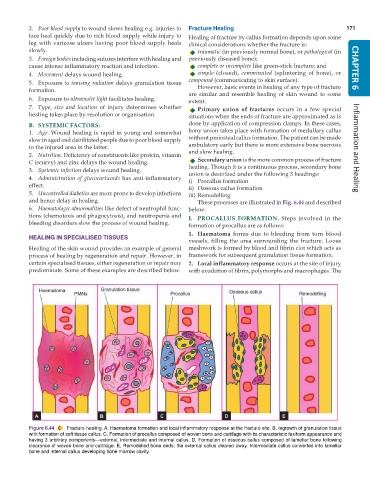
           and hence delay in healing.                            These processes are illustrated in Fig. 6.44 and described
           6. Haematologic abnormalities like defect of neutrophil func-  below:
           tions (chemotaxis and phagocytosis), and neutropenia and  I. PROCALLUS FORMATION.  Steps involved in the
           bleeding disorders slow the process of wound healing.  formation of procallus are as follows:

                                                               1. Haematoma forms due to bleeding from torn blood
           HEALING IN SPECIALISED TISSUES
                                                               vessels, filling the area surrounding the fracture. Loose
           Healing of the skin wound provides an example of general  meshwork is formed by blood and fibrin clot which acts as
           process of healing by regeneration and repair. However, in  framework for subsequent granulation tissue formation.
           certain specialised tissues, either regeneration or repair may  2. Local inflammatory response occurs at the site of injury
           predominate. Some of these examples are described below.  with exudation of fibrin, polymorphs and macrophages. The


           Figure 6.44  Fracture healing. A, Haematoma formation and local inflammatory response at the fracture site. B, Ingrowth of granulation tissue
           with formation of soft tissue callus. C, Formation of procallus composed of woven bone and cartilage with its characteristic fusiform appearance and
           having 3 arbitrary components—external, intermediate and internal callus. D, Formation of osseous callus composed of lamellar bone following
           clearance of woven bone and cartilage. E, Remodelled bone ends; the external callus cleared away. Intermediate callus converted into lamellar
           bone and internal callus developing bone marrow cavity.

