


Page 203 - Textbook of Pathology, 6th Edition
P. 203
DISEASES CAUSED BY PARASITES 187
Diseases caused by parasites (protozoa and helminths) are
quite common and comprise a very large group of
infestations and infections in human beings. Parasites may
cause disease due to their presence in the lumen of the
intestine, due to infiltration into the blood stream, or due to CHAPTER 7
their presence inside the cells. A short list of parasitic diseases
is given in Table 7.5. These diseases form a distinct subject
of study called Parasitology; only a few conditions are briefly
considered below.
AMOEBIASIS
Amoebiasis is caused by Entamoeba histolytica, named for its
lytic action on tissues. It is the most important intestinal
infection of man. The condition is particularly more common
in tropical and subtropical areas with poor sanitation.
The parasite occurs in 2 forms: a trophozoite form which is
active adult form seen in the tissues and diarrhoeal stools, Infectious and Parasitic Diseases
and a cystic form seen in formed stools but not in the tissues.
The trophozoite form can be stained positively with PAS stain
in tissue sections while amoebic cysts having four nuclei can
be identified in stools. The cysts are the infective stage of the
parasite and are found in contaminated water or food. The
trophozoites are formed from the cyst stage in the intestine
and colonise in the caecum and large bowel. The trophozoites
as well as cysts are passed in stools but the trophozoites fail
to survive outside or are destroyed by gastric secretions.
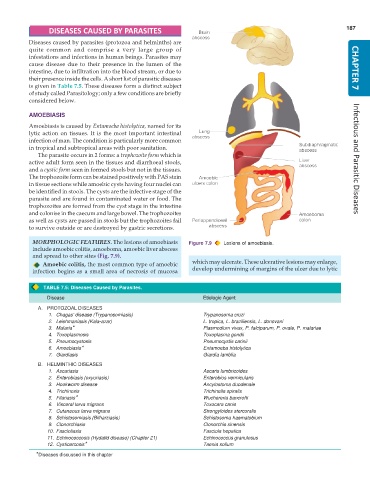
MORPHOLOGIC FEATURES. The lesions of amoebiasis Figure 7.9 Lesions of amoebiasis.
include amoebic colitis, amoeboma, amoebic liver abscess
and spread to other sites (Fig. 7.9).
Amoebic colitis, the most common type of amoebic which may ulcerate. These ulcerative lesions may enlarge,
infection begins as a small area of necrosis of mucosa develop undermining of margins of the ulcer due to lytic
TABLE 7.5: Diseases Caused by Parasites.
Disease Etiologic Agent
A. PROTOZOAL DISEASES
1. Chagas’ disease (Trypanosomiasis) Trypanosoma cruzi
2. Leishmaniasis (Kala-azar) L. tropica, L. braziliensis, L. donovani
3. Malaria* Plasmodium vivax, P. falciparum, P. ovale, P. malariae
4. Toxoplasmosis Toxoplasma gondii
5. Pneumocystosis Pneumocystis carinii
6. Amoebiasis* Entamoeba histolytica
7. Giardiasis Giardia lamblia
B. HELMINTHIC DISEASES
1. Ascariasis Ascaris lumbricoides
2. Enterobiasis (oxyuriasis) Enterobius vermicularis
3. Hookworm disease Ancylostoma duodenale
4. Trichinosis Trichinella spiralis
5. Filariasis* Wuchereria bancrofti
6. Visceral larva migrans Toxocara canis
7. Cutaneous larva migrans Strongyloides stercoralis
8. Schistosomiasis (Bilharziasis) Schistosoma haematobium
9. Clonorchiasis Clonorchis sinensis
10. Fascioliasis Fasciola hepatica
11. Echinococcosis (Hydatid disease) (Chapter 21) Echinococcus granulosus
12. Cysticercosis* Taenia solium
*Diseases discussed in this chapter

