


Page 26 - Textbook of Pathology, 6th Edition
P. 26
10 SURGICAL PATHOLOGY PROTOCOL
           REQUEST FORMS.  The first and foremost task of the
           clinician requesting tissue diagnosis is to send a completed
           request form containing patient’s identification data (ID)
           matching with that on accompanying specimen container. The
           body of the request form must contain the entire relevant infor-
           mation about the case and the disease (history, physical and
           operative findings, results of other relevant biochemical/
           haematological/radiological investigations, and clinical and
     SECTION I
           differential diagnosis) and reference to any preceding cytology
           or biopsy examination done in the pathology services.
           TISSUE ACCESSION.  The laboratory staff receiving the
           biopsy specimen must always match the ID of the patient
           on the request form with that on the specimen container.
           For routine tissue processing by paraffin-embedding
           technique, the tissue must be put in either appropriate
           fixative solution (most commonly 10% formol-saline or 10%
           buffered formalin) or received fresh-unfixed. For frozen
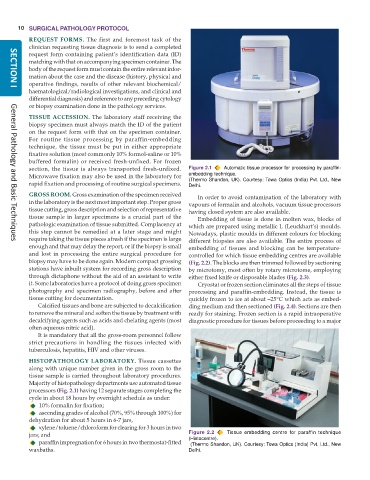
           section, the tissue is always transported fresh-unfixed.  Figure 2.1  Automatic tissue processor for processing by paraffin-
           Microwave fixation may also be used in the laboratory for  embedding technique.
           rapid fixation and processing of routine surgical specimens.  (Thermo Shandon, UK). Courtesy: Towa Optics (India) Pvt. Ltd., New
                                                               Delhi.
           GROSS ROOM. Gross examination of the specimen received  In order to avoid contamination of the laboratory with
           in the laboratory is the next most important step. Proper gross  vapours of formalin and alcohols, vacuum tissue processors
           tissue cutting, gross description and selection of representative  having closed system are also available.
           tissue sample in larger specimens is a crucial part of the  Embedding of tissue is done in molten wax, blocks of
           pathologic examination of tissue submitted. Complacency at  which are prepared using metallic L (Leuckhart’s) moulds.
           this step cannot be remedied at a later stage and might  Nowadays, plastic moulds in different colours for blocking
           require taking the tissue pieces afresh if the specimen is large  different biopsies are also available. The entire process of
     General Pathology and Basic Techniques
           enough and that may delay the report, or if the biopsy is small  embedding of tissues and blocking can be temperature-
           and lost in processing the entire surgical procedure for  controlled for which tissue embedding centres are available
           biopsy may have to be done again. Modern compact grossing  (Fig. 2.2). The blocks are then trimmed followed by sectioning
           stations have inbuilt system for recording gross description  by microtomy, most often by rotary microtome, employing
           through dictaphone without the aid of an assistant to write  either fixed knife or disposable blades (Fig. 2.3).
           it. Some laboratories have a protocol of doing gross specimen  Cryostat or frozen section eliminates all the steps of tissue
           photography and specimen radiography, before and after  processing and paraffin-embedding. Instead, the tissue is
           tissue cutting for documentation.                   quickly frozen to ice at about –25°C which acts as embed-
              Calcified tissues and bone are subjected to decalcification  ding medium and then sectioned (Fig. 2.4). Sections are then
           to remove the mineral and soften the tissue by treatment with  ready for staining. Frozen section is a rapid intraoperative
           decalcifying agents such as acids and chelating agents (most  diagnostic procedure for tissues before proceeding to a major
           often aqueous nitric acid).
              It is mandatory that all the gross-room personnel follow
           strict precautions in handling the tissues infected with
           tuberculosis, hepatitis, HIV and other viruses.

           HISTOPATHOLOGY LABORATORY.  Tissue cassettes
           along with unique number given in the gross room to the
           tissue sample is carried throughout laboratory procedures.
           Majority of histopathology departments use automated tissue
           processors (Fig. 2.1) having 12 separate stages completing the
           cycle in about 18 hours by overnight schedule as under:
              10% formalin for fixation;
              ascending grades of alcohol (70%, 95% through 100%) for
           dehydration for about 5 hours in 6-7 jars,
              xylene/toluene/chloroform for clearing for 3 hours in two
           jars; and                                           Figure 2.2   Tissue embedding centre for paraffin technique
              paraffin impregnation for 6 hours in two thermostat-fitted  (Histocentre).
                                                                (Thermo Shandon, UK). Courtesy: Towa Optics (India) Pvt. Ltd., New
           waxbaths.                                           Delhi.

