


Page 275 - Textbook of Pathology, 6th Edition
P. 275
259


                                                                                                                      CHAPTER 10


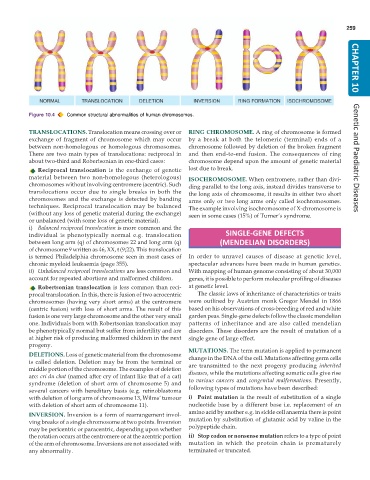
           Figure 10.4  Common structural abnormalities of human chromosomes.

           TRANSLOCATIONS. Translocation means crossing over or  RING CHROMOSOME. A ring of chromosome is formed
           exchange of fragment of chromosome which may occur  by a break at both the telomeric (terminal) ends of a
           between non-homologous or homologous chromosomes.   chromosome followed by deletion of the broken fragment
           There are two main types of translocations: reciprocal in  and then end-to-end fusion. The consequences of ring
           about two-third and Robertsonian in one-third cases:  chromosome depend upon the amount of genetic material  Genetic and Paediatric Diseases
              Reciprocal translocation is the exchange of genetic  lost due to break.
           material between two non-homologous (heterologous)  ISOCHROMOSOME. When centromere, rather than divi-
           chromosomes without involving centromere (acentric). Such  ding parallel to the long axis, instead divides transverse to
           translocations occur due to single breaks in both the  the long axis of chromosome, it results in either two short
           chromosomes and the exchange is detected by banding  arms only or two long arms only called isochromosomes.
           techniques. Reciprocal translocation may be balanced  The example involving isochromosome of X-chromosome is
           (without any loss of genetic material during the exchange)  seen in some cases (15%) of Turner’s syndrome.
           or unbalanced (with some loss of genetic material).
           i) Balanced reciprocal translocation is more common and the
           individual is phenotypically normal e.g. translocation           SINGLE-GENE DEFECTS
           between long arm (q) of chromosomes 22 and long arm (q)        (MENDELIAN DISORDERS)
           of chromosome 9 written as 46, XX, t (9;22). This translocation
           is termed Philadelphia chromosome seen in most cases of  In  order to unravel causes of disease at genetic level,
           chronic myeloid leukaemia (page 355).               spectacular advances have been made in human genetics.
           ii) Unbalanced reciprocal translocations are less common and  With mapping of human genome consisting of about 30,000
           account for repeated abortions and malformed children.  genes, it is possible to perform molecular profiling of diseases
              Robertsonian translocation is less common than reci-  at genetic level.
           procal translocation. In this, there is fusion of two acrocentric  The classic laws of inheritance of characteristics or traits
           chromosomes (having very short arms) at the centromere  were outlined by Austrian monk Gregor Mendel in 1866
           (centric fusion) with loss of short arms. The result of this  based on his observations of cross-breeding of red and white
           fusion is one very large chromosome and the other very small  garden peas. Single-gene defects follow the classic mendelian
           one. Individuals born with Robertsonian translocation may  patterns of inheritance and are also called mendelian
           be phenotypically normal but suffer from infertility and are  disorders. These disorders are the result of mutation of a
           at higher risk of producing malformed children in the next  single gene of large effect.
           progeny.
                                                               MUTATIONS. The term mutation is applied to permanent
           DELETIONS. Loss of genetic material from the chromosome  change in the DNA of the cell. Mutations affecting germ cells
           is called deletion. Deletion may be from the terminal or
           middle portion of the chromosome. The examples of deletion  are transmitted to the next progeny producing  inherited
                                                               diseases, while the mutations affecting somatic cells give rise
           are: cri du chat (named after cry of infant like that of a cat)
           syndrome (deletion of short arm of chromosome 5) and  to various cancers and  congenital malformations. Presently,
           several cancers with hereditary basis (e.g. retinoblastoma  following types of mutations have been described:
           with deletion of long arm of chromosome 13, Wilms’ tumour  i) Point mutation is the result of substitution of a single
           with deletion of short arm of chromosome 11).       nucleotide base by a different base i.e. replacement of an
           INVERSION. Inversion is a form of rearrangement invol-  amino acid by another e.g. in sickle cell anaemia there is point
           ving breaks of a single chromosome at two points. Inversion  mutation by substitution of glutamic acid by valine in the
           may be pericentric or paracentric, depending upon whether  polypeptide chain.
           the rotation occurs at the centromere or at the acentric portion  ii) Stop codon or nonsense mutation refers to a type of point
           of the arm of chromosome. Inversions are not associated with  mutation in which the protein chain is prematurely
           any abnormality.                                    terminated or truncated.

