


Page 280 - Textbook of Pathology, 6th Edition
P. 280
264 Some tumours have probably evolved in utero and are 1. Hamartomas. Hamartomas are focal accumulations of
apparent at birth or in immediate postnatal period. Such cells normally present in that tissue but are arranged in an
tumours are termed developmental tumours. abnormal manner i.e. though present at normal site they do
Many other tumours originate in abnormally developed not reproduce normal architecture identical to adjacent
organs and organ rests; they become apparent subsequently tissues (page 193).
and are termed embryonic tumours. 2. Choristoma (heterotopia). Choristoma or heterotopia is
In embryonic tumours, proliferation of embryonic cells collection of normal cells and tissues at aberrant locations
occurs which have not reached the differentiation stage essential e.g. heterotopic pancreatic tissue in the wall of small bowel
for specialised functions i.e. the cells proliferate as or stomach.
SECTION I
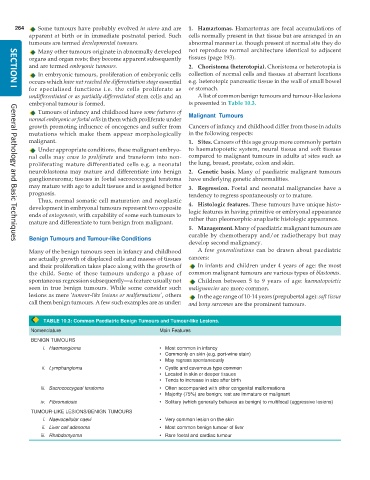
undifferentiated or as partially differentiated stem cells and an A list of common benign tumours and tumour-like lesions
embryonal tumour is formed. is presented in Table 10.3.
Tumours of infancy and childhood have some features of Malignant Tumours
normal embryonic or foetal cells in them which proliferate under
growth promoting influence of oncogenes and suffer from Cancers of infancy and childhood differ from those in adults
mutations which make them appear morphologically in the following respects:
malignant. 1. Sites. Cancers of this age group more commonly pertain
Under appropriate conditions, these malignant embryo- to haematopoietic system, neural tissue and soft tissues
nal cells may cease to proliferate and transform into non- compared to malignant tumours in adults at sites such as
proliferating mature differentiated cells e.g. a neonatal the lung, breast, prostate, colon and skin.
neuroblastoma may mature and differentiate into benign 2. Genetic basis. Many of paediatric malignant tumours
ganglioneuroma; tissues in foetal sacrococcygeal teratoma have underlying genetic abnormalities.
may mature with age to adult tissues and is assigned better 3. Regression. Foetal and neonatal malignancies have a
prognosis. tendency to regress spontaneously or to mature.
Thus, normal somatic cell maturation and neoplastic
development in embryonal tumours represent two opposite 4. Histologic features. These tumours have unique histo-
logic features in having primitive or embryonal appearance
ends of ontogenesis, with capability of some such tumours to rather than pleomorphic-anaplastic histologic appearance.
mature and differentiate to turn benign from malignant.
5. Management. Many of paediatric malignant tumours are
curable by chemotherapy and/or radiotherapy but may
Benign Tumours and Tumour-like Conditions
develop second malignancy.
General Pathology and Basic Techniques
Many of the benign tumours seen in infancy and childhood A few generalisations can be drawn about paediatric
are actually growth of displaced cells and masses of tissues cancers:
and their proliferation takes place along with the growth of In infants and children under 4 years of age: the most
the child. Some of these tumours undergo a phase of common malignant tumours are various types of blastomas.
spontaneous regression subsequently—a feature usually not Children between 5 to 9 years of age: haematopoietic
seen in true benign tumours. While some consider such malignancies are more common.
lesions as mere ‘tumour-like lesions or malformations’, others In the age range of 10-14 years (prepubertal age): soft tissue
call them benign tumours. A few such examples are as under: and bony sarcomas are the prominent tumours.
TABLE 10.3: Common Paediatric Benign Tumours and Tumour-like Lesions.
Nomenclature Main Features
BENIGN TUMOURS
i. Haemangioma • Most common in infancy
• Commonly on skin (e.g. port-wine stain)
• May regress spontaneously
ii. Lymphangioma • Cystic and cavernous type common
• Located in skin or deeper tissues
• Tends to increase in size after birth
iii. Sacrococcygeal teratoma • Often accompanied with other congenital malformations
• Majority (75%) are benign; rest are immature or malignant
iv. Fibromatosis • Solitary (which generally behaves as benign) to multifocal (aggressive lesions)
TUMOUR-LIKE LESIONS/BENIGN TUMOURS
i. Naevocellular naevi • Very common lesion on the skin
ii. Liver cell adenoma • Most common benign tumour of liver
iii. Rhabdomyoma • Rare foetal and cardiac tumour

