


Page 276 - Textbook of Pathology, 6th Edition
P. 276
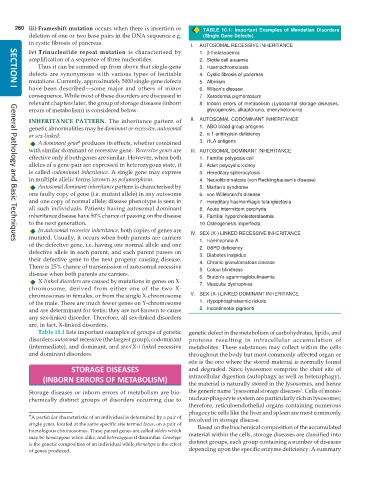
260 iii) Frameshift mutation occurs when there is insertion or TABLE 10.1: Important Examples of Mendelian Disorders
deletion of one or two base pairs in the DNA sequence e.g. (Single Gene Defects).
in cystic fibrosis of pancreas. I. AUTOSOMAL RECESSIVE INHERITANCE
iv) Trinucleotide repeat mutation is characterised by 1. β-thalassaemia
amplification of a sequence of three nucleotides. 2. Sickle cell anaemia
Thus it can be summed up from above that single-gene 3. Haemochromatosis
defects are synonymous with various types of heritable 4. Cystic fibrosis of pancreas
mutations. Currently, approximately 5000 single-gene defects 5. Albinism
have been described—some major and others of minor 6. Wilson’s disease
SECTION I
consequence. While most of these disorders are discussed in 7. Xeroderma pigmentosum
relevant chapters later, the group of storage diseases (inborn 8. Inborn errors of metabolism (Lysosomal storage diseases,
errors of metabolism) is considered below. glycogenosis, alkaptonuria, phenylketonuria)
INHERITANCE PATTERN. The inheritance pattern of II. AUTOSOMAL CODOMINANT INHERITANCE
1. ABO blood group antigens
genetic abnormalities may be dominant or recessive, autosomal
2. α 1-antitrypsin deficiency
or sex-linked:
A dominant gene* produces its effects, whether combined 3. HLA antigens
with similar dominant or recessive gene. Recessive genes are III. AUTOSOMAL DOMINANT INHERITANCE
effective only if both genes are similar. However, when both 1. Familial polyposis coli
alleles of a gene pair are expressed in heterozygous state, it 2. Adult polycystic kidney
is called codominant inheritance. A single gene may express 3. Hereditary spherocytosis
in multiple allelic forms known as polymorphism. 4. Neurofibromatosis (von Recklinghausen’s disease)
Autosomal dominant inheritance pattern is characterised by 5. Marfan’s syndrome
one faulty copy of gene (i.e. mutant allele) in any autosome 6. von Willebrand’s disease
and one copy of normal allele; disease phenotype is seen in 7. Hereditary haemorrhagic telangiectasia
all such individuals. Patients having autosomal dominant 8. Acute intermittent porphyria
inheritance disease have 50% chance of passing on the disease 9. Familial hypercholesterolaemia
to the next generation. 10.Osteogenesis imperfecta
In autosomal recessive inheritance, both copies of genes are
mutated. Usually, it occurs when both parents are carriers IV. SEX-(X-) LINKED RECESSIVE INHERITANCE
1. Haemophilia A
General Pathology and Basic Techniques
of the defective gene, i.e. having one normal allele and one 2. G6PD deficiency
defective allele in each parent, and each parent passes on 3. Diabetes insipidus
their defective gene to the next progeny causing disease. 4. Chronic granulomatous disease
There is 25% chance of transmission of autosomal recessive 5. Colour blindness
disease when both parents are carriers. 6. Bruton’s agammaglobulinaemia
X-linked disorders are caused by mutations in genes on X-
chromosome, derived from either one of the two X- 7. Muscular dystrophies
chromosomes in females, or from the single X-chromosome V. SEX-(X-) LINKED DOMINANT INHERITANCE
of the male. There are much fewer genes on Y-chromosome 1. Hypophosphataemic rickets
and are determinant for testis; they are not known to cause 2. Incontinentia pigmenti
any sex-linked disorder. Therefore, all sex-linked disorders
are, in fact, X-linked disorders.
Table 10.1 lists important examples of groups of genetic genetic defect in the metabolism of carbohydrates, lipids, and
disorders: autosomal recessive (the largest group), codominant proteins resulting in intracellular accumulation of
(intermediate), and dominant, and sex-(X-) linked recessive metabolites. These substances may collect within the cells
and dominant disorders. throughout the body but most commonly affected organ or
site is the one where the stored material is normally found
STORAGE DISEASES and degraded. Since lysosomes comprise the chief site of
intracellular digestion (autophagy as well as heterophagy),
(INBORN ERRORS OF METABOLISM)
the material is naturally stored in the lysosomes, and hence
Storage diseases or inborn errors of metabolism are bio- the generic name ‘lysosomal storage diseases’. Cells of mono-
chemically distinct groups of disorders occurring due to nuclear-phagocyte system are particularly rich in lysosomes;
therefore, reticuloendothelial organs containing numerous
phagocytic cells like the liver and spleen are most commonly
*A particular characteristic of an individual is determined by a pair of involved in storage disease.
single genes, located at the same specific site termed locus, on a pair of Based on the biochemical composition of the accumulated
homologous chromosomes. These paired genes are called alleles which material within the cells, storage diseases are classified into
may be homozygous when alike, and heterozygous if dissimilar. Genotype
is the genetic composition of an individual while phenotype is the effect distinct groups, each group containing a number of diseases
of genes produced. depending upon the specific enzyme deficiency. A summary

