


Page 277 - Textbook of Pathology, 6th Edition
P. 277
261
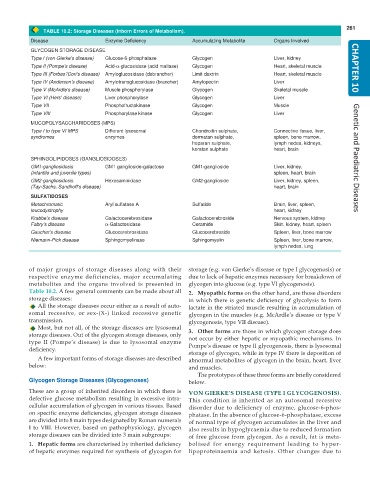
TABLE 10.2: Storage Diseases (Inborn Errors of Metabolism).
Disease Enzyme Deficiency Accumulating Metabolite Organs Involved
GLYCOGEN STORAGE DISEASE
Type I (von Gierke’s disease) Glucose-6-phosphatase Glycogen Liver, kidney
Type II (Pompe’s disease) Acid-α-glucosidase (acid maltase) Glycogen Heart, skeletal muscle CHAPTER 10
Type III (Forbes’/Cori’s disease) Amyloglucosidase (debrancher) Limit dextrin Heart, skeletal muscle
Type IV (Anderson’s disease) Amylotransglucosidase (brancher) Amylopectin Liver
Type V (McArdle’s disease) Muscle phosphorylase Glycogen Skeletal muscle
Type VI (Hers’ disease) Liver phosphorylase Glycogen Liver
Type VII Phosphofructokinase Glycogen Muscle
Type VIII Phosphorylase kinase Glycogen Liver
MUCOPOLYSACCHARIDOSES (MPS)
Type I to type VI MPS Different lysosomal Chondroitin sulphate, Connective tissue, liver,
syndromes enzymes dermatan sulphate, spleen, bone marrow,
heparan sulphate, lymph nodes, kidneys,
keratan sulphate heart, brain
SPHINGOLIPIDOSES (GANGLIOSIDOSES) Genetic and Paediatric Diseases
GM1-gangliosidosis GM1 ganglioside-galactose GM1-ganglioside Liver, kidney,
(infantile and juvenile types) spleen, heart, brain
GM2-gangliosidosis Hexosaminidase GM2-ganglioside Liver, kidney, spleen,
(Tay-Sachs, Sandhoff’s disease) heart, brain
SULFATIDOSES
Metachromatic Aryl sulfatase A Sulfatide Brain, liver, spleen,
leucodystrophy heart, kidney
Krabbe’s disease Galactocerebrosidase Galactocerebroside Nervous system, kidney
Fabry’s disease α-Galactosidase Ceramide Skin, kidney, heart, spleen
Gaucher’s disease Glucocerebrosidase Glucocerebroside Spleen, liver, bone marrow
Niemann-Pick disease Sphingomyelinase Sphingomyelin Spleen, liver, bone marrow,
lymph nodes, lung
of major groups of storage diseases along with their storage (e.g. von Gierke’s disease or type I glycogenosis) or
respective enzyme deficiencies, major accumulating due to lack of hepatic enzymes necessary for breakdown of
metabolites and the organs involved is presented in glycogen into glucose (e.g. type VI glycogenosis).
Table 10.2. A few general comments can be made about all 2. Myopathic forms on the other hand, are those disorders
storage diseases: in which there is genetic deficiency of glycolysis to form
All the storage diseases occur either as a result of auto- lactate in the striated muscle resulting in accumulation of
somal recessive, or sex-(X-) linked recessive genetic glycogen in the muscles (e.g. McArdle’s disease or type V
transmission. glycogenosis, type VII disease).
Most, but not all, of the storage diseases are lysosomal
storage diseases. Out of the glycogen storage diseases, only 3. Other forms are those in which glycogen storage does
not occur by either hepatic or myopathic mechanisms. In
type II (Pompe’s disease) is due to lysosomal enzyme Pompe’s disease or type II glycogenosis, there is lysosomal
deficiency. storage of glycogen, while in type IV there is deposition of
A few important forms of storage diseases are described abnormal metabolites of glycogen in the brain, heart, liver
below: and muscles.
The prototypes of these three forms are briefly considered
Glycogen Storage Diseases (Glycogenoses) below.
These are a group of inherited disorders in which there is VON GIERKE’S DISEASE (TYPE I GLYCOGENOSIS).
defective glucose metabolism resulting in excessive intra- This condition is inherited as an autosomal recessive
cellular accumulation of glycogen in various tissues. Based disorder due to deficiency of enzyme, glucose-6-phos-
on specific enzyme deficiencies, glycogen storage diseases phatase. In the absence of glucose-6-phosphatase, excess
are divided into 8 main types designated by Roman numerals of normal type of glycogen accumulates in the liver and
I to VIII. However, based on pathophysiology, glycogen also results in hypoglycaemia due to reduced formation
storage diseases can be divided into 3 main subgroups: of free glucose from glycogen. As a result, fat is meta-
1. Hepatic forms are characterised by inherited deficiency bolised for energy requirement leading to hyper-
of hepatic enzymes required for synthesis of glycogen for lipoproteinaemia and ketosis. Other changes due to

