


Page 294 - Textbook of Pathology, 6th Edition
P. 294
278


     SECTION I


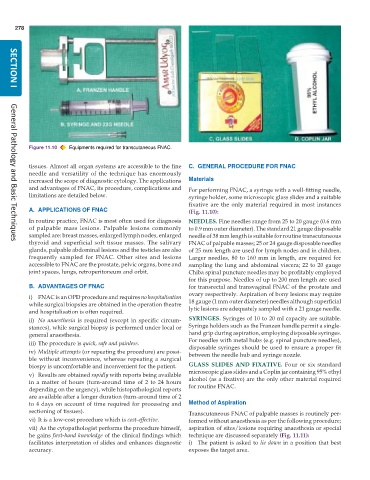
           Figure 11.10  Equipments required for transcutaneous FNAC.


           tissues. Almost all organ systems are accessible to the fine  C. GENERAL PROCEDURE FOR FNAC
           needle and versatility of the technique has enormously
           increased the scope of diagnostic cytology. The applications  Materials
           and advantages of FNAC, its procedure, complications and  For performing FNAC, a syringe with a well-fitting needle,
           limitations are detailed below.                     syringe holder, some microscopic glass slides and a suitable
                                                               fixative are the only material required in most instances
           A. APPLICATIONS OF FNAC                             (Fig. 11.10):
           In routine practice, FNAC is most often used for diagnosis  NEEDLES. Fine needles range from 25 to 20 gauge (0.6 mm
           of palpable mass lesions. Palpable lesions commonly  to 0.9 mm outer diameter). The standard 21 gauge disposable
           sampled are: breast masses, enlarged lymph nodes, enlarged  needle of 38 mm length is suitable for routine transcutaneous
           thyroid and superficial soft tissue masses. The salivary  FNAC of palpable masses; 25 or 24 gauge disposable needles
     General Pathology and Basic Techniques
           glands, palpable abdominal lesions and the testicles are also  of 25 mm length are used for lymph nodes and in children.
           frequently sampled for FNAC. Other sites and lesions  Larger needles, 80 to 160 mm in length, are required for
           accessible to FNAC are the prostate, pelvic organs, bone and  sampling the lung and abdominal viscera; 22 to 20 gauge
           joint spaces, lungs, retroperitoneum and orbit.     Chiba spinal puncture needles may be profitably employed
                                                               for this purpose. Needles of up to 200 mm length are used
           B. ADVANTAGES OF FNAC                               for transrectal and transvaginal FNAC of the prostate and
                                                               ovary respectively. Aspiration of bony lesions may require
           i) FNAC is an OPD procedure and requires no hospitalisation  18 gauge (1 mm outer diameter) needles although superficial
           while surgical biopsies are obtained in the operation theatre
           and hospitalisation is often required.              lytic lesions are adequately sampled with a 21 gauge needle.
           ii) No anaesthesia  is required (except in specific circum-  SYRINGES. Syringes of 10 to 20 ml capacity are suitable.
           stances), while surgical biopsy is performed under local or  Syringe holders such as the Franzen handle permit a single-
           general anaesthesia.                                hand grip during aspiration, employing disposable syringes.
           iii) The procedure is quick, safe and painless.     For needles with metal hubs (e.g. spinal puncture needles),
                                                               disposable syringes should be used to ensure a proper fit
           iv) Multiple attempts (or repeating the procedure) are possi-  between the needle hub and syringe nozzle.
           ble without inconvenience, whereas repeating a surgical
           biospy is uncomfortable and inconvenient for the patient.  GLASS SLIDES AND FIXATIVE.  Four or six standard
                                                               microscopic glass slides and a Coplin jar containing 95% ethyl
           v) Results are obtained rapidly with reports being available
           in a matter of hours (turn-around time of 2 to 24 hours  alcohol (as a fixative) are the only other material required
           depending on the urgency), while histopathological reports  for routine FNAC.
           are available after a longer duration (turn-around time of 2
           to 4 days on account of time required for processing and  Method of Aspiration
           sectioning of tissues).                             Transcutaneous FNAC of palpable masses is routinely per-
           vi) It is a low-cost procedure which is cost-effective.  formed without anaesthesia as per the following procedure;
           vii) As the cytopathologist performs the procedure himself,  aspiration of sites/lesions requiring anaesthesia or special
           he gains first-hand knowledge of the clinical findings which  technique are discussed separately (Fig. 11.11):
           facilitates interpretation of slides and enhances diagnostic  i) The patient is asked to lie down in a position that best
           accuracy.                                           exposes the target area.

