


Page 296 - Textbook of Pathology, 6th Edition
P. 296
280
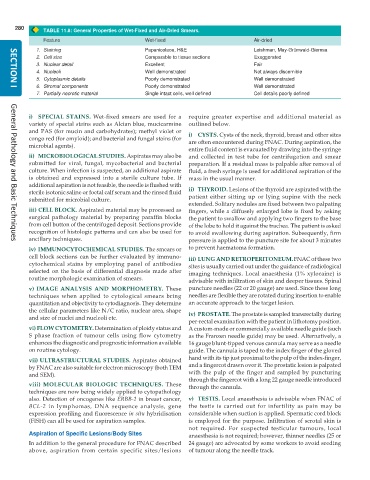
TABLE 11.8: General Properties of Wet-Fixed and Air-Dried Smears.
Feature Wet-fixed Air-dried
1. Staining Papanicolaou, H&E Leishman, May-Grünwald-Giemsa
2. Cell size Comparable to tissue sections Exaggerated
3. Nuclear detail Excellent Fair
4. Nucleoli Well demonstrated Not always discernible
5. Cytoplasmic details Poorly demonstrated Well demonstrated
6. Stromal components Poorly demonstrated Well demonstrated
SECTION I
7. Partially necrotic material Single intact cells, well defined Cell details poorly defined
i) SPECIAL STAINS. Wet-fixed smears are used for a require greater expertise and additional material as
variety of special stains such as Alcian blue, mucicarmine outlined below.
and PAS (for mucin and carbohydrates); methyl violet or i) CYSTS. Cysts of the neck, thyroid, breast and other sites
congo red (for amyloid); and bacterial and fungal stains (for are often encountered during FNAC. During aspiration, the
microbial agents).
entire fluid content is evacuated by drawing into the syringe
ii) MICROBIOLOGICAL STUDIES. Aspirates may also be and collected in test tube for centrifugation and smear
submitted for viral, fungal, mycobacterial and bacterial preparation. If a residual mass is palpable after removal of
culture. When infection is suspected, an additional aspirate fluid, a fresh syringe is used for additional aspiration of the
is obtained and expressed into a sterile culture tube. If mass in the usual manner.
additional aspiration is not feasible, the needle is flushed with
sterile isotonic saline or foetal calf serum and the rinsed fluid ii) THYROID. Lesions of the thyroid are aspirated with the
submitted for microbial culture. patient either sitting up or lying supine with the neck
extended. Solitary nodules are fixed between two palpating
iii) CELL BLOCK. Aspirated material may be processed as fingers, while a diffusely enlarged lobe is fixed by asking
surgical pathology material by preparing paraffin blocks the patient to swallow and applying two fingers to the base
from cell button of the centrifuged deposit. Sections provide of the lobe to hold it against the trachea. The patient is asked
recognition of histologic patterns and can also be used for to avoid swallowing during aspiration. Subsequently, firm
ancillary techniques. pressure is applied to the puncture site for about 3 minutes
General Pathology and Basic Techniques
iv) IMMUNOCYTOCHEMICAL STUDIES. The smears or to prevent haematoma formation.
cell block sections can be further evaluated by immuno- iii) LUNG AND RETROPERITONEUM. FNAC of these two
cytochemical stains by employing panel of antibodies sites is usually carried out under the guidance of radiological
selected on the basis of differential diagnosis made after imaging techniques. Local anaesthesia (1% xylocaine) is
routine morphologic examination of smears. advisable with infiltration of skin and deeper tissues. Spinal
v) IMAGE ANALYSIS AND MORPHOMETRY. These puncture needles (22 or 20 gauge) are used. Since these long
techniques when applied to cytological smears bring needles are flexible they are rotated during insertion to enable
quantitation and objectivity to cytodiagnosis. They determine an accurate approach to the target lesion.
the cellular parameters like N/C ratio, nuclear area, shape iv) PROSTATE. The prostate is sampled transrectally during
and size of nuclei and nucleoli etc.
per-rectal examination with the patient in lithotomy position.
vi) FLOW CYTOMETRY. Determination of ploidy status and A custom-made or commercially available needle guide (such
S phase fraction of tumour cells using flow cytometry as the Franzen needle guide) may be used. Alternatively, a
enhances the diagnostic and prognostic information available 16 gauge blunt-tipped venous cannula may serve as a needle
on routine cytology. guide. The cannula is taped to the index finger of the gloved
hand with its tip just proximal to the pulp of the index-finger,
vii) ULTRASTRUCTURAL STUDIES. Aspirates obtained
by FNAC are also suitable for electron microscopy (both TEM and a fingercot drawn over it. The prostatic lesion is palpated
and SEM). with the pulp of the finger and sampled by puncturing
through the fingercot with a long 22 gauge needle introduced
viii) MOLECULAR BIOLOGIC TECHNIQUES. These through the cannula.
techniques are now being widely applied to cytopathology
also. Detection of oncogenes like ERBB-2 in breast cancer, v) TESTIS. Local anaesthesia is advisable when FNAC of
BCL-2 in lymphomas, DNA sequence analysis, gene the testis is carried out for infertility as pain may be
expression profiling and fluorescence in situ hybridisation considerable when suction is applied. Spermatic cord block
(FISH) can all be used for aspiration samples. is employed for the purpose. Infiltration of scrotal skin is
not required. For suspected testicular tumours, local
Aspiration of Specific Lesions/Body Sites anaesthesia is not required; however, thinner needles (25 or
In addition to the general procedure for FNAC described 24 gauge) are advocated by some workers to avoid seeding
above, aspiration from certain specific sites/lesions of tumour along the needle track.

