


Page 301 - Textbook of Pathology, 6th Edition
P. 301
285


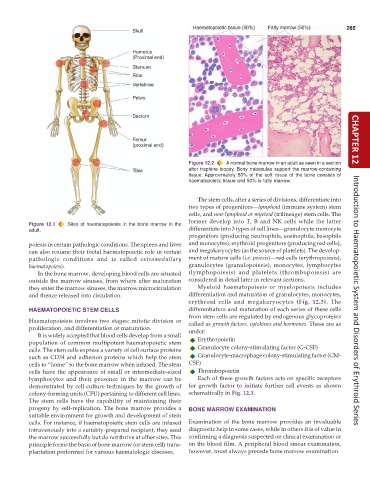
                                                               Figure 12.2  A normal bone marrow in an adult as seen in a section  CHAPTER 12
                                                               after trephine biopsy. Bony trabeculae support the marrow-containing
                                                               tissue. Approximately 50% of the soft tissue of the bone consists of
                                                               haematopoietic tissue and 50% is fatty marrow.

                                                                  The stem cells, after a series of divisions, differentiate into
                                                               two types of progenitors—lymphoid (immune system) stem
                                                               cells, and non-lymphoid or myeloid (trilineage) stem cells. The
                                                               former develop into T, B and NK cells while the latter
           Figure 12.1  Sites of haematopoiesis in the bone marrow in the
           adult.                                              differentiate into 3 types of cell lines—granulocyte-monocyte
                                                               progenitors (producing neutrophils, eosinophils, basophils
           poiesis in certain pathologic conditions. The spleen and liver  and monocytes), erythroid progenitors (producing red cells),
           can also resume their foetal haematopoietic role in certain  and megakaryocytes (as the source of platelets). The develop-
           pathologic conditions and is called  extramedullary  ment of mature cells (i.e. poiesis)—red cells (erythropoiesis),
           haematopoiesis.                                     granulocytes (granulopoiesis), monocytes, lymphocytes
              In the bone marrow, developing blood cells are situated  (lymphopoiesis) and platelets (thrombopoiesis) are
           outside the marrow sinuses, from where after maturation  considered in detail later in relevant sections.
           they enter the marrow sinuses, the marrow microcirculation  Myeloid haematopoiesis or myelopoiesis includes
           and thence released into circulation.               differentiation and maturation of granulocytes, monocytes,
                                                               erythroid cells and megakaryocytes  (Fig.  12.3).  The  Introduction to Haematopoietic System and Disorders of Erythroid Series
           HAEMATOPOIETIC STEM CELLS                           differentiation and maturation of each series of these cells
                                                               from stem cells are regulated by endogenous glycoproteins
           Haematopoieisis involves two stages: mitotic division or  called as growth factors, cytokines and hormones. These are as
           proliferation, and differentiation or maturation.   under:
              It is widely accepted that blood cells develop from a small
           population of common multipotent haematopoietic stem   Erythropoietin
           cells. The stem cells express a variety of cell surface proteins  Granulocyte colony-stimulating factor (G-CSF)
           such as CD34 and adhesion proteins which help the stem  Granulocyte-macrophage colony-stimulating factor (GM-
           cells to “home” to the bone marrow when infused. The stem  CSF)
           cells have the appearance of small or intermediate-sized  Thrombopoietin
           lymphocytes and their presence in the marrow can be    Each of these growth factors acts on specific receptors
           demonstrated by cell culture techniques by the growth of  for growth factor to initiate further cell events as shown
           colony-forming units (CFU) pertaining to different cell lines.  schematically in Fig. 12.3.
           The stem cells have the capability of maintaining their
           progeny by self-replication. The bone marrow provides a  BONE MARROW EXAMINATION
           suitable environment for growth and development of stem
           cells. For instance, if haematopoietic stem cells are infused  Examination of the bone marrow provides an invaluable
           intravenously into a suitably-prepared recipient, they seed  diagnostic help in some cases, while in others it is of value in
           the marrow successfully but do not thrive at other sites. This  confirming a diagnosis suspected on clinical examination or
           principle forms the basis of bone marrow (or stem cell) trans-  on the blood film. A peripheral blood smear examination,
           plantation performed for various haematologic diseases.  however, must always precede bone marrow examination.

