


Page 302 - Textbook of Pathology, 6th Edition
P. 302
286


     SECTION II


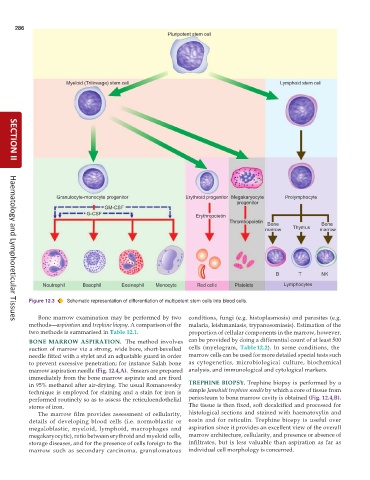
           Figure 12.3  Schematic representation of differentiation of multipotent stem cells into blood cells.

              Bone marrow examination may be performed by two  conditions, fungi (e.g. histoplasmosis) and parasites (e.g.
     Haematology and Lymphoreticular Tissues
           methods—aspiration and trephine biopsy. A comparison of the  malaria, leishmaniasis, trypanosomiasis). Estimation of the
           two methods is summarised in Table 12.1.            proportion of cellular components in the marrow, however,
           BONE MARROW ASPIRATION.  The method involves        can be provided by doing a differential count of at least 500
           suction of marrow via a strong, wide bore, short-bevelled  cells (myelogram,  Table 12.2). In some conditions, the
           needle fitted with a stylet and an adjustable guard in order  marrow cells can be used for more detailed special tests such
           to prevent excessive penetration; for instance Salah bone  as cytogenetics, microbiological culture, biochemical
           marrow aspiration needle (Fig. 12.4,A).  Smears are prepared  analysis, and immunological and cytological markers.
           immediately from the bone marrow aspirate and are fixed
           in 95% methanol after air-drying. The usual Romanowsky  TREPHINE BIOPSY. Trephine biopsy is performed by a
           technique is employed for staining and a stain for iron is  simple Jamshidi trephine needle by which a core of tissue from
           performed routinely so as to assess the reticuloendothelial  periosteum to bone marrow cavity is obtained (Fig. 12.4,B).
           stores of iron.                                     The tissue is then fixed, soft decalcified and processed for
              The marrow film provides assessment of cellularity,  histological sections and stained with haematoxylin and
           details of developing blood cells (i.e. normoblastic or  eosin and for reticulin. Trephine biospy is useful over
           megaloblastic, myeloid, lymphoid, macrophages and   aspiration since it provides an excellent view of the overall
           megakaryocytic), ratio between erythroid and myeloid cells,  marrow architecture, cellularity, and presence or absence of
           storage diseases, and for the presence of cells foreign to the  infiltrates, but is less valuable than aspiration as far as
           marrow such as secondary carcinoma, granulomatous   individual cell morphology is concerned.

