


Page 306 - Textbook of Pathology, 6th Edition
P. 306
290


     SECTION II
           Figure 12.7  Schematic diagram of haemoglobin synthesis in the developing red cell.

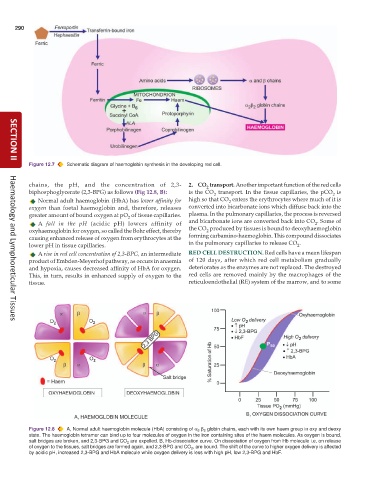
           chains, the pH, and the concentration of 2,3-       2. CO  transport. Another important function of the red cells
                                                                     2
           biphosphoglycerate (2,3-BPG) as follows (Fig 12.8, B):  is the CO  transport. In the tissue capillaries, the pCO  is
                                                                                                               2
                                                                        2
              Normal adult haemoglobin (HbA) has lower affinity for  high so that CO  enters the erythrocytes where much of it is
                                                                             2
           oxygen than foetal haemoglobin and, therefore, releases  converted into bicarbonate ions which diffuse back into the
           greater amount of bound oxygen at pO  of tissue capillaries.  plasma. In the pulmonary capillaries, the process is reversed
                                           2
              A  fall in the pH (acidic pH) lowers affinity of  and bicarbonate ions are converted back into CO . Some of
                                                                                                         2
           oxyhaemoglobin for oxygen, so called the Bohr effect, thereby  the CO  produced by tissues is bound to deoxyhaemoglobin
                                                                     2
           causing enhanced release of oxygen from erythrocytes at the  forming carbamino-haemoglobin. This compound dissociates
           lower pH in tissue capillaries.                     in the pulmonary capillaries to release CO .
                                                                                                   2
              A rise in red cell concentration of 2,3-BPG, an intermediate  RED CELL DESTRUCTION. Red cells have a mean lifespan
           product of Embden-Meyerhof pathway, as occurs in anaemia  of 120 days, after which red cell metabolism gradually
           and hypoxia, causes decreased affinity of HbA for oxygen.  deteriorates as the enzymes are not replaced. The destroyed
           This, in turn, results in enhanced supply of oxygen to the  red cells are removed mainly by the macrophages of the
           tissue.                                             reticuloendothelial (RE) system of the marrow, and to some


     Haematology and Lymphoreticular Tissues


           Figure 12.8  A, Normal adult haemoglobin molecule (HbA) consisting of α 2  β 2  globin chains, each with its own haem group in oxy and deoxy
           state. The haemoglobin tetramer can bind up to four molecules of oxygen in the iron containing sites of the haem molecules. As oxygen is bound,
           salt bridges are broken, and 2,3-BPG and CO 2  are expelled. B, Hb-dissociation curve. On dissociation of oxygen from Hb molecule i.e. on release
           of oxygen to the tissues, salt bridges are formed again, and 2,3-BPG and CO 2 , are bound. The shift of the curve to higher oxygen delivery is affected
           by acidic pH, increased 2,3-BPG and HbA molecule while oxygen delivery is less with high pH, low 2,3-BPG and HbF.

