


Page 307 - Textbook of Pathology, 6th Edition
P. 307
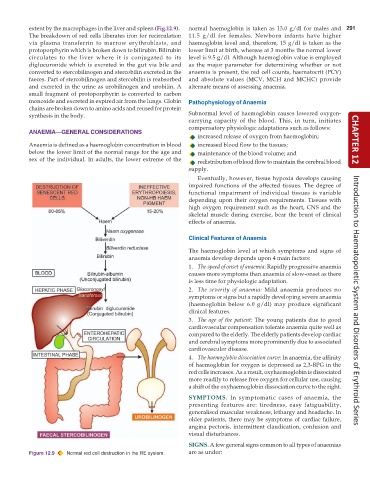
extent by the macrophages in the liver and spleen (Fig.12.9).  normal haemoglobin is taken as 13.0 g/dl for males and  291
           The breakdown of red cells liberates iron for recirculation  11.5 g/dl for females. Newborn infants have higher
           via plasma transferrin to marrow erythroblasts, and  haemoglobin level and, therefore, 15 g/dl is taken as the
           protoporphyrin which is broken down to bilirubin. Bilirubin  lower limit at birth, whereas at 3 months the normal lower
           circulates to the liver where it is conjugated to its  level is 9.5 g/dl. Although haemoglobin value is employed
           diglucuronide which is excreted in the gut via bile and  as the major parameter for determining whether or not
           converted to stercobilinogen and stercobilin excreted in the  anaemia is present, the red cell counts, haematocrit (PCV)
           faeces. Part of stercobilinogen and stercobilin is reabsorbed  and absolute values (MCV, MCH and MCHC) provide
           and excreted in the urine as urobilinogen and urobilin. A  alternate means of assessing anaemia.
           small fragment of protoporphyrin is converted to carbon
           monoxide and excreted in expired air from the lungs. Globin  Pathophysiology of Anaemia
           chains are broken down to amino acids and reused for protein
           synthesis in the body.                              Subnormal level of haemoglobin causes lowered oxygen-
                                                               carrying capacity of the blood. This, in turn, initiates
                                                               compensatory physiologic adaptations such as follows:
           ANAEMIA—GENERAL CONSIDERATIONS
                                                                  increased release of oxygen from haemoglobin;
           Anaemia is defined as a haemoglobin concentration in blood  increased blood flow to the tissues;           CHAPTER 12
           below the lower limit of the normal range for the age and  maintenance of the blood volume; and
           sex of the individual. In adults, the lower extreme of the  redistribution of blood flow to maintain the cerebral blood
                                                               supply.
                                                                  Eventually, however, tissue hypoxia develops causing
                                                               impaired functions of the affected tissues. The degree of
                                                               functional impairment of individual tissues is variable
                                                               depending upon their oxygen requirements. Tissues with
                                                               high oxygen requirement such as the heart, CNS and the
                                                               skeletal muscle during exercise, bear the brunt of clinical
                                                               effects of anaemia.

                                                               Clinical Features of Anaemia

                                                               The haemoglobin level at which symptoms and signs of
                                                               anaemia develop depends upon 4 main factors:
                                                               1. The speed of onset of anaemia: Rapidly progressive anaemia
                                                               causes more symptoms than anaemia of slow-onset as there
                                                               is less time for physiologic adaptation.
                                                               2. The severity of anaemia: Mild anaemia produces no
                                                               symptoms or signs but a rapidly developing severe anaemia
                                                               (haemoglobin below 6.0 g/dl) may produce significant   Introduction to Haematopoietic System and Disorders of Erythroid Series
                                                               clinical features.
                                                               3. The age of the patient: The young patients due to good
                                                               cardiovascular compensation tolerate anaemia quite well as
                                                               compared to the elderly. The elderly patients develop cardiac
                                                               and cerebral symptoms more prominently due to associated
                                                               cardiovascular disease.
                                                               4. The haemoglobin dissociation curve: In anaemia, the affinity
                                                               of haemoglobin for oxygen is depressed as 2,3-BPG in the
                                                               red cells increases. As a result, oxyhaemoglobin is dissociated
                                                               more readily to release free oxygen for cellular use, causing
                                                               a shift of the oxyhaemoglobin dissociation curve to the right.
                                                               SYMPTOMS.  In symptomatic cases of anaemia, the
                                                               presenting features are: tiredness, easy fatiguability,
                                                               generalised muscular weakness, lethargy and headache. In
                                                               older patients, there may be symptoms of cardiac failure,
                                                               angina pectoris, intermittent claudication, confusion and
                                                               visual disturbances.
                                                               SIGNS. A few general signs common to all types of anaemias
           Figure 12.9  Normal red cell destruction in the RE system.  are as under:

