


Page 346 - Textbook of Pathology, 6th Edition
P. 346
330


     SECTION II


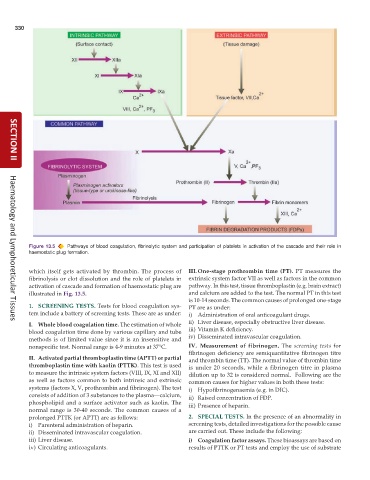
           Figure 13.5  Pathways of blood coagulation, fibrinolytic system and participation of platelets in activation of the cascade and their role in
           haemostatic plug formation.

           which itself gets activated by thrombin. The process of  III. One-stage prothrombin time (PT). PT measures the
           fibrinolysis or clot dissolution and the role of platelets in  extrinsic system factor VII as well as factors in the common
           activation of cascade and formation of haemostatic plug are  pathway. In this test, tissue thromboplastin (e.g. brain extract)
           illustrated in Fig. 13.5.                           and calcium are added to the test. The normal PT in this test
                                                               is 10-14 seconds. The common causes of prolonged one-stage
           1. SCREENING TESTS. Tests for blood coagulation sys-  PT are as under:
           tem include a battery of screening tests. These are as under:  i) Administration of oral anticoagulant drugs.
                                                               ii) Liver disease, especially obstructive liver disease.
     Haematology and Lymphoreticular Tissues
           I. Whole blood coagulation time. The estimation of whole
           blood coagulation time done by various capillary and tube  iii) Vitamin K deficiency.
           methods is of limited value since it is an insensitive and  iv) Disseminated intravascular coagulation.
           nonspecific test. Normal range is 4-9 minutes at 37°C.  IV.  Measurement of fibrinogen. The  screening tests for
                                                               fibrinogen deficiency are semiquantitative fibrinogen titre
           II. Activated partial thromboplastin time (APTT) or partial  and thrombin time (TT). The normal value of thrombin time
           thromboplastin time with kaolin (PTTK). This test is used  is under 20 seconds, while a fibrinogen titre in plasma
           to measure the intrinsic system factors (VIII, IX, XI and XII)  dilution up to 32 is considered normal.  Following are the
           as well as factors common to both intrinsic and extrinsic  common causes for higher values in both these tests:
           systems (factors X, V, prothrombin and fibrinogen). The test  i) Hypofibrinogenaemia (e.g. in DIC).
           consists of addition of 3 substances to the plasma—calcium,  ii) Raised concentration of FDP.
           phospholipid and a surface activator such as kaolin. The  iii) Presence of heparin.
           normal range is 30-40 seconds. The common causes of a
           prolonged PTTK (or APTT) are as follows:            2. SPECIAL TESTS. In the presence of an abnormality in
           i) Parenteral administration of heparin.            screening tests, detailed investigations for the possible cause
           ii) Disseminated intravascular coagulation.         are carried out. These include the following:
           iii) Liver disease.                                 i) Coagulation factor assays. These bioassays are based on
           iv) Circulating anticoagulants.                     results of PTTK or PT tests and employ the use of substrate

