


Page 344 - Textbook of Pathology, 6th Edition
P. 344
328


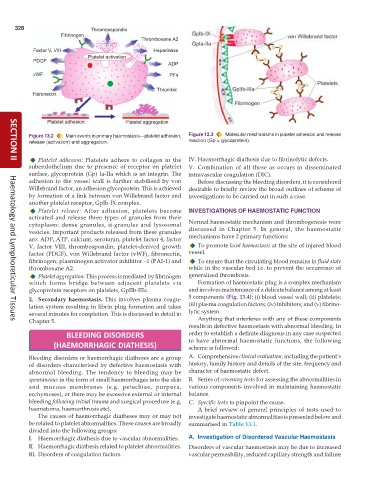
           Figure 13.2  Main events in primary haemostasis—platelet adhesion,  Figure 13.3  Molecular mechanisms in platelet adhesion and release
           release (activation) and aggregation.               reaction (Gp = glycoprotein).

              Platelet adhesion: Platelets adhere to collagen in the  IV. Haemorrhagic diathesis due to fibrinolytic defects.
     SECTION II
           subendothelium due to presence of receptor on platelet  V. Combination of all these as occurs in disseminated
           surface, glycoprotein (Gp) Ia-IIa which is an integrin. The  intravascular coagulation (DIC).
           adhesion to the vessel wall is further stabilised by von  Before discussing the bleeding disorders, it is considered
           Willebrand factor, an adhesion glycoprotein. This is achieved  desirable to briefly review the broad outlines of scheme of
           by formation of a link between von Willebrand factor and  investigations to be carried out in such a case.
           another platelet receptor, GpIb-IX complex.
              Platelet release: After adhesion, platelets become  INVESTIGATIONS OF HAEMOSTATIC FUNCTION
           activated and release three types of granules from their
           cytoplasm: dense granules,  α-granules and lysosomal  Normal haemostatic mechanism and thrombogenesis were
           vesicles. Important products released from these granules  discussed in Chapter 5. In general, the haemostatic
           are: ADP, ATP, calcium, serotonin, platelet factor 4, factor  mechanisms have 2 primary functions:
           V, factor VIII, thrombospondin, platelet-derived growth  To promote local haemostasis at the site of injured blood
           factor (PDGF), von Willebrand factor (vWF), fibronectin,  vessel.
           fibrinogen, plasminogen activator inhibitor –1 (PAI-1) and  To ensure that the circulating blood remains in fluid state
           thromboxane A2.                                     while in the vascular bed i.e. to prevent the occurrence of
              Platelet aggregation: This process is mediated by fibrinogen  generalised thrombosis.
           which forms bridge between adjacent platelets via      Formation of haemostatic plug is a complex mechanism
           glycoprotein receptors on platelets, GpIIb-IIIa.    and involves maintenance of a delicate balance among at least
           2. Secondary haemostasis. This involves plasma coagu-  5 components (Fig. 13.4): (i) blood vessel wall; (ii) platelets;
           lation system resulting in fibrin plug formation and takes  (iii) plasma coagulation factors; (iv) inhibitors; and (v) fibrino-
           several minutes for completion. This is discussed in detail in  lytic system.
           Chapter 5.                                             Anything that interferes with any of these components
     Haematology and Lymphoreticular Tissues
                                                               results in defective haemostasis with abnormal bleeding. In
                       BLEEDING DISORDERS                      order to establish a definite diagnosis in any case suspected
                                                               to have abnormal haemostatic functions, the following
                   (HAEMORRHAGIC DIATHESIS)                    scheme is followed:
           Bleeding disorders or haemorrhagic diatheses are a group  A. Comprehensive clinical evaluation, including the patient’s
           of disorders characterised by defective haemostasis with  history, family history and details of the site, frequency and
           abnormal bleeding. The tendency to bleeding may be  character of haemostatic defect.
           spontaneous in the form of small haemorrhages into the skin  B. Series of screening tests for assessing the abnormalities in
           and mucous membranes (e.g. petechiae, purpura,      various components involved in maintaining haemostatic
           ecchymoses), or there may be excessive external or internal  balance.
           bleeding following trivial trauma and surgical procedure (e.g.  C. Specific tests to pinpoint the cause.
           haematoma, haemarthrosis etc).                         A brief review of general principles of tests used to
              The causes of haemorrhagic diatheses may or may not  investigate haemostatic abnormalities is presented below and
           be related to platelet abnormalities. These causes are broadly  summarised in Table 13.1.
           divided into the following groups:
           I. Haemorrhagic diathesis due to vascular abnormalities.  A. Investigation of Disordered Vascular Haemostasis
           II. Haemorrhagic diathesis related to platelet abnormalities.  Disorders of vascular haemostasis may be due to increased
           III. Disorders of coagulation factors.              vascular permeability, reduced capillary strength and failure

