


Page 362 - Textbook of Pathology, 6th Edition
P. 362
346


     SECTION II


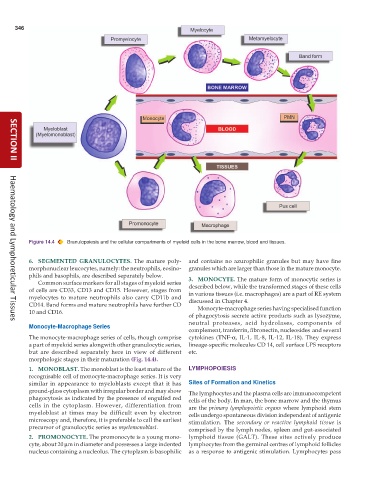
           Figure 14.4  Granulopoiesis and the cellular compartments of myeloid cells in the bone marrow, blood and tissues.


           6. SEGMENTED GRANULOCYTES. The mature poly-         and contains no azurophilic granules but may have fine
           morphonuclear leucocytes, namely: the neutrophils, eosino-  granules which are larger than those in the mature monocyte.
           phils and basophils, are described separately below.  3. MONOCYTE. The mature form of monocytic series is
              Common surface markers for all stages of myeloid series
           of cells are CD33, CD13 and CD15. However, stages from  described below, while the transformed stages of these cells
                                                               in various tissues (i.e. macrophages) are a part of RE system
           myelocytes to mature neutrophils also carry CD11b and  discussed in Chapter 4.
           CD14. Band forms and mature neutrophils have further CD  Monocyte-macrophage series having specialised function
           10 and CD16.
                                                               of phagocytosis secrete active products such as lysozyme,
                                                               neutral proteases, acid hydrolases, components of
     Haematology and Lymphoreticular Tissues
           Monocyte-Macrophage Series
                                                               complement, tranferrin, fibronectin, nucleosides  and several
           The monocyte-macrophage series of cells, though comprise  cytokines (TNF-α, IL-1, IL-8, IL-12, IL-18). They express
           a part of myeloid series alongwith other granulocytic series,  lineage-specific molecules CD 14, cell surface LPS receptors
           but are described separately here in view of different  etc.
           morphologic stages in their maturation (Fig. 14.4).
           1. MONOBLAST. The monoblast is the least mature of the  LYMPHOPOIESIS
           recognisable cell of monocyte-macrophage series. It is very
           similar in appearance to myeloblasts except that it has  Sites of Formation and Kinetics
           ground-glass cytoplasm with irregular border and may show  The lymphocytes and the plasma cells are immunocompetent
           phagocytosis as indicated by the presence of engulfed red  cells of the body. In man, the bone marrow and the thymus
           cells in the cytoplasm. However, differentiation from  are the primary lymphopoietic organs where lymphoid stem
           myeloblast at times may be difficult even by electron  cells undergo spontaneous division independent of antigenic
           microscopy and, therefore, it is preferable to call the earliest  stimulation. The  secondary or reactive lymphoid tissue is
           precursor of granulocytic series as myelomonoblast.  comprised by the lymph nodes, spleen and gut-associated
           2. PROMONOCYTE. The promonocyte is a young mono-    lymphoid tissue (GALT). These sites actively produce
           cyte, about 20 μm in diameter and possesses a large indented  lymphocytes from the germinal centres of lymphoid follicles
           nucleus containing a nucleolus. The cytoplasm is basophilic  as a response to antigenic stimulation. Lymphocytes pass

