


Page 383 - Textbook of Pathology, 6th Edition
P. 383
367


                                                                                                                      CHAPTER 14


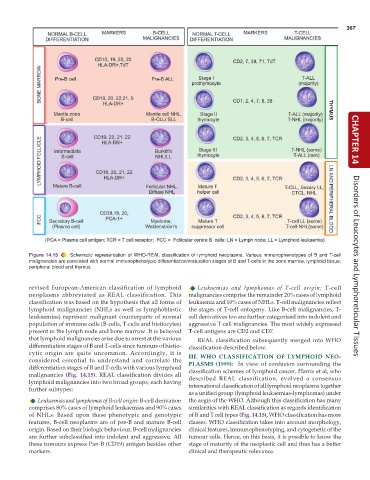
           Figure 14.15  Schematic representation of WHO-REAL classification of lymphoid neoplasms. Various immunophenotypes of B and T-cell
           malignancies are correlated with normal immunophenotypic differentiation/maturation stages of B and T-cells in the bone marrow, lymphoid tissue,
           peripheral blood and thymus.                                                                               Disorders of Leucocytes and Lymphoreticular Tissues


           revised  European-American classification of  lymphoid  Leukaemias and lymphomas of T-cell origin: T-cell
           neoplasms abbreviated as REAL classification. This  malignancies comprise the remainder 20% cases of lymphoid
           classification was based on the hypothesis that all forms of  leukaemia and 10% cases of NHLs. T-cell malignancies reflect
           lymphoid malignancies (NHLs as well as lymphoblastic  the stages of T-cell ontogeny. Like B-cell malignancies, T-
           leukaemias) represent malignant counterparts of normal  cell derivatives too are further categorised into indolent and
           population of immune cells (B-cells, T-cells and histiocytes)  aggressive T-cell malignancies. The most widely expressed
           present in the lymph node and bone marrow. It is believed  T-cell antigens are CD2 and CD7.
           that lymphoid malignancies arise due to arrest at the various  REAL classification subsequently merged into WHO
           differentiation stages of B and T-cells since tumours of histio-  classification described below.
           cytic origin are quite uncommon. Accordingly, it is  III. WHO CLASSIFICATION OF LYMPHOID NEO-
           considered essential to understand and correlate the  PLASMS (1999):   In view of confusion surrounding the
           differentiation stages of B and T-cells with various lymphoid  classification schemes of lymphoid cancer, Harris et al, who
           malignancies (Fig. 14.15). REAL classification divides all  described REAL classification, evolved a consensus
           lymphoid malignancies into two broad groups, each having  international classification of all lymphoid neoplasms together
           further subtypes:
                                                               as a unified group (lymphoid leukaemias-lymphomas) under
              Leukaemias and lymphomas of B-cell origin: B-cell derivation  the aegis of the WHO. Although this classification has many
           comprises 80% cases of lymphoid leukaemias and 90% cases  similarities with REAL classification as regards identification
           of NHLs. Based upon these phenotypic and genotypic  of B and T cell types (Fig. 14.15), WHO classification has more
           features, B-cell neoplasms are of pre-B and mature B-cell  classes. WHO classification takes into account morphology,
           origin. Based on their biologic behaviour, B-cell malignancies  clinical features, immunophenotyping, and cytogenetic of the
           are further subclassified into indolent and aggressive. All  tumour cells. Hence, on this basis, it is possible to know the
           these tumours express Pan-B (CD19) antigen besides other  stage of maturity of the neoplastic cell and thus has a better
           markers.                                            clinical and therapeutic relevance.

