


Page 403 - Textbook of Pathology, 6th Edition
P. 403
forms of normal splenic function. Splenic enlargement may TABLE 14.13: Causes of Splenomegaly. 387
occur as a result of one of the following pathophysiologic
mechanisms: I. INFECTIONS
I. Infections 1. Malaria
2. Leishmaniasis
II. Disordered immunoregulation 3. Typhoid
III. Altered splenic blood flow 4. Infectious mononucleosis
5. Bacterial septicaemia
IV. Lymphohaematogenous malignancies 6. Bacterial endocarditis
V. Diseases with abnormal erythrocytes 7. Tuberculosis
VI. Storage diseases 8. Syphilis
9. Viral hepatitis
VII. Miscellaneous causes. 10. AIDS
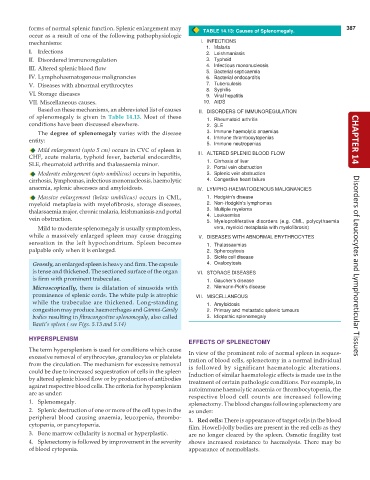
Based on these mechanisms, an abbreviated list of causes II. DISORDERS OF IMMUNOREGULATION
of splenomegaly is given in Table 14.13. Most of these 1. Rheumatoid arthritis
conditions have been discussed elsewhere. 2. SLE
The degree of splenomegaly varies with the disease 3. Immune haemolytic anaemias
entity: 4. Immune thrombocytopenias CHAPTER 14
5. Immune neutropenias
Mild enlargement (upto 5 cm) occurs in CVC of spleen in
CHF, acute malaria, typhoid fever, bacterial endocarditis, III. ALTERED SPLENIC BLOOD FLOW
SLE, rheumatoid arthritis and thalassaemia minor. 1. Cirrhosis of liver
2. Portal vein obstruction
Moderate enlargement (upto umbilicus) occurs in hepatitis, 3. Splenic vein obstruction
cirrhosis, lymphomas, infectious mononucleosis, haemolytic 4. Congestive heart failure
anaemia, splenic abscesses and amyloidosis. IV. LYMPHO-HAEMATOGENOUS MALIGNANCIES
Massive enlargement (below umbilicus) occurs in CML, 1. Hodgkin’s disease
myeloid metaplasia with myelofibrosis, storage diseases, 2. Non-Hodgkin’s lymphomas
thalassaemia major, chronic malaria, leishmaniasis and portal 3. Multiple myeloma
vein obstruction. 4. Leukaemias
5. Myeloproliferative disorders (e.g. CML, polycythaemia
Mild to moderate splenomegaly is usually symptomless, vera, myeloid metaplasia with myelofibrosis)
while a massively enlarged spleen may cause dragging V. DISEASES WITH ABNORMAL ERYTHROCYTES
sensation in the left hypochondrium. Spleen becomes 1. Thalassaemias
palpable only when it is enlarged. 2. Spherocytosis
3. Sickle cell disease
Grossly, an enlarged spleen is heavy and firm. The capsule 4. Ovalocytosis Disorders of Leucocytes and Lymphoreticular Tissues
is tense and thickened. The sectioned surface of the organ VI. STORAGE DISEASES
is firm with prominent trabeculae. 1. Gaucher’s disease
Microscopically, there is dilatation of sinusoids with 2. Niemann-Pick’s disease
prominence of splenic cords. The white pulp is atrophic VII. MISCELLANEOUS
while the trabeculae are thickened. Long-standing 1. Amyloidosis
congestion may produce haemorrhages and Gamna-Gandy 2. Primary and metastatic splenic tumours
bodies resulting in fibrocongestive splenomegaly, also called 3. Idiopathic splenomegaly
Banti’s spleen ( see Figs. 5.13 and 5.14)
HYPERSPLENISM
EFFECTS OF SPLENECTOMY
The term hypersplenism is used for conditions which cause In view of the prominent role of normal spleen in seques-
excessive removal of erythrocytes, granulocytes or platelets tration of blood cells, splenectomy in a normal individual
from the circulation. The mechanism for excessive removal is followed by significant haematologic alterations.
could be due to increased sequestration of cells in the spleen Induction of similar haematologic effects is made use in the
by altered splenic blood flow or by production of antibodies treatment of certain pathologic conditions. For example, in
against respective blood cells. The criteria for hypersplenism autoimmune haemolytic anaemia or thrombocytopenia, the
are as under: respective blood cell counts are increased following
1. Splenomegaly. splenectomy. The blood changes following splenectomy are
2. Splenic destruction of one or more of the cell types in the as under:
peripheral blood causing anaemia, leucopenia, thrombo- 1. Red cells: There is appearance of target cells in the blood
cytopenia, or pancytopenia. film. Howell-Jolly bodies are present in the red cells as they
3. Bone marrow cellularity is normal or hyperplastic. are no longer cleared by the spleen. Osmotic fragility test
4. Splenectomy is followed by improvement in the severity shows increased resistance to haemolysis. There may be
of blood cytopenia. appearance of normoblasts.

