


Page 399 - Textbook of Pathology, 6th Edition
P. 399
5. Liver, spleen involvement. Involvement of the liver  iii) increased β-2 microglobulins and other globulins in urine  383
            and spleen by myeloma cells sufficient to cause    and serum.
            hepatomegaly, and splenomegaly occurs in a small   9. POEMS syndrome is seen in about 1% cases of myeloma
            percentage of cases.                               and includes simultaneous manifestations of polyneuro-
                                                               pathy,  organomegaly,  endocrinopathy, multiple myeloma
           Clinical Features                                   and skin changes.
           The clinical manifestations of myeloma result from the effects
           of infiltration of the bones and other organs by neoplastic  Diagnosis
           plasma cells and from immunoglobulin synthesis. The  The diagnosis of myeloma is made by classic triad of features:
           principal clinical features are as under:           1. Marrow plasmacytosis of more than 10%
           1. Bone pain is the most common symptom. The pain usually  2. Radiologic evidence of lytic bony lesions
           involves the back and ribs. Pathological fractures may occur  3. Demonstration of serum and/or urine M component.
           causing persistent localised pain. Bone pain results from the  There is rise in the total serum protein concentration due
           proliferation of tumour cells in the marrow and activation of  to paraproteinaemia but normal serum immunoglobulins (IgG,
           osteoclasts which destroy the bones.                IgA and IgM) and albumin are depressed. Paraproteins are
           2. Susceptibility to infections is the next most common clinical  abnormal immunoglobulins or their parts circulating in  CHAPTER 14
           feature. Particularly common are bacterial infections such  plasma and excreted in urine. About two-third cases of
           as pneumonias and pyelonephritis. Increased susceptibility  myeloma excrete Bence Jones (light chain) proteins in the
           to infection is related mainly to hypogammaglobulinaemia,  urine, consisting of either kappa (κ) or lambda (λ) light chains,
           and partly to granulocyte dysfunction and neutropenia.  along with presence of Bence Jones paraproteins in the serum.
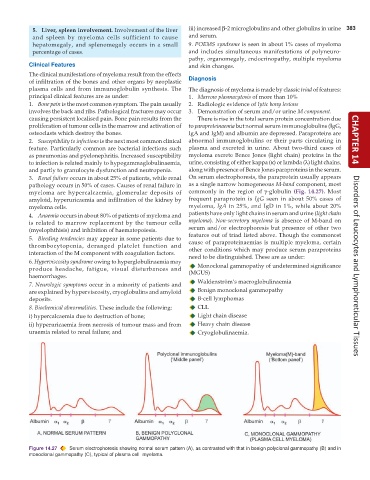
           3. Renal failure occurs in about 25% of patients, while renal  On serum electrophoresis, the paraprotein usually appears
           pathology occurs in 50% of cases. Causes of renal failure in  as a single narrow homogeneous M-band component, most
           myeloma are hypercalcaemia, glomerular deposits of  commonly in the region of  γ-globulin (Fig. 14.27). Most
           amyloid, hyperuricaemia and infiltration of the kidney by  frequent paraprotein is  IgG seen in about 50% cases of
           myeloma cells.                                      myeloma,  IgA in 25%, and IgD in 1%, while about 20%
           4. Anaemia occurs in about 80% of patients of myeloma and  patients have only light chains in serum and urine (light chain
           is related to marrow replacement by the tumour cells  myeloma). Non-secretory myeloma is absence of M-band on
           (myelophthisis) and inhibition of haematopoiesis.   serum and/or electrophoresis but presence of other two
           5. Bleeding tendencies may appear in some patients due to  features out of triad listed above. Though the commonest
                                                               cause of paraproteinaemias is multiple myeloma, certain
           thrombocytopenia, deranged platelet function and    other conditions which may produce serum paraproteins
           interaction of the M component with coagulation factors.  need to be distinguished. These are as under:
           6. Hyperviscosity syndrome owing to hyperglobulinaemia may
                                                                  Monoclonal gammopathy of undetermined significance
           produce headache, fatigue, visual disturbances and  (MGUS)                                                 Disorders of Leucocytes and Lymphoreticular Tissues
           haemorrhages.
           7. Neurologic symptoms occur in a minority of patients and  Waldenström’s macroglobulinaemia
           are explained by hyperviscosity, cryoglobulins and amyloid  Benign monoclonal gammopathy
           deposits.                                              B-cell lymphomas
           8. Biochemical abnormalities. These include the following:  CLL
           i) hypercalcaemia due to destruction of bone;          Light chain disease
           ii) hyperuricaemia from necrosis of tumour mass and from  Heavy chain disease
           uraemia related to renal failure; and                  Cryoglobulinaemia.


           Figure 14.27  Serum electrophoresis showing normal serum pattern (A), as contrasted with that in benign polyclonal gammopathy (B) and in
           monoclonal gammopathy (C), typical of plasma cell  myeloma.

