


Page 408 - Textbook of Pathology, 6th Edition
P. 408
392


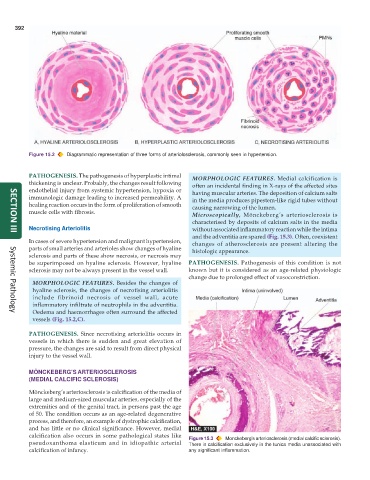
           Figure 15.2  Diagrammatic representation of three forms of arteriolosclerosis, commonly seen in hypertension.


           PATHOGENESIS. The pathogenesis of hyperplastic intimal  MORPHOLOGIC FEATURES. Medial calcification is
           thickening is unclear. Probably, the changes result following  often an incidental finding in X-rays of the affected sites
           endothelial injury from systemic hypertension, hypoxia or  having muscular arteries. The deposition of calcium salts
           immunologic damage leading to increased permeability. A  in the media produces pipestem-like rigid tubes without
           healing reaction occurs in the form of proliferation of smooth  causing narrowing of the lumen.
           muscle cells with fibrosis.
                                                                 Microscopically, Mönckeberg’s arteriosclerosis is
                                                                 characterised by deposits of calcium salts in the media
           Necrotising Arteriolitis                              without associated inflammatory reaction while the intima
     SECTION III
                                                                 and the adventitia are spared (Fig. 15.3). Often, coexistent
           In cases of severe hypertension and malignant hypertension,  changes of atherosclerosis are present altering the
           parts of small arteries and arterioles show changes of hyaline  histologic appearance.
           sclerosis and parts of these show necrosis, or necrosis may
           be superimposed on hyaline sclerosis. However, hyaline  PATHOGENESIS.  Pathogenesis of this condition is not
           sclerosis may not be always present in the vessel wall.  known but it is considered as an age-related physiologic
                                                               change due to prolonged effect of vasoconstriction.
            MORPHOLOGIC FEATURES. Besides the changes of
            hyaline sclerosis, the changes of necrotising arteriolitis
            include fibrinoid necrosis of vessel wall, acute
            inflammatory infiltrate of neutrophils in the adventitia.
            Oedema and haemorrhages often surround the affected
     Systemic Pathology
            vessels (Fig. 15.2,C).
           PATHOGENESIS.  Since necrotising arteriolitis occurs in
           vessels in which there is sudden and great elevation of
           pressure, the changes are said to result from direct physical
           injury to the vessel wall.

           MÖNCKEBERG’S ARTERIOSCLEROSIS
           (MEDIAL CALCIFIC SCLEROSIS)
           Mönckeberg’s arteriosclerosis is calcification of the media of
           large and medium-sized muscular arteries, especially of the
           extremities and of the genital tract, in persons past the age
           of 50. The condition occurs as an age-related degenerative
           process, and therefore, an example of dystrophic calcification,
           and has little or no clinical significance. However, medial
           calcification also occurs in some pathological states like  Figure 15.3  Monckeberg’s arteriosclerosis (medial calcific sclerosis).
           pseudoxanthoma elasticum and in idiopathic arterial  There is calcification exclusively in the tunica media unassociated with
           calcification of infancy.                           any significant inflammation.

