


Page 398 - Textbook of Pathology, 6th Edition
P. 398
382                                                        cells but usually lacks the cart-wheel chromatin pattern
                                                                 seen in classical plasma cells. Nucleoli are frequently
                                                                 present. The cytoplasm of these cells is abundant and
                                                                 basophilic with perinuclear halo, vacuolisation and
                                                                 contains Russell bodies consisting of hyaline globules
                                                                 composed of synthesised immunoglobulin (Fig. 14.26).
                                                                    In addition to neoplastic proliferation of plasma cells
                                                                 in multiple myeloma, reactive plasmacytosis in the bone
                                                                 marrow can occur in some other disorders; these include:
                                                                 aplastic anaemia, rheumatoid arthritis, SLE, cirrhosis of
                                                                 liver, metastatic cancer and chronic inflammation and
                                                                 infections such as tuberculosis. However, in all these
                                                                 conditions the plasma cells are mature and they do not
                                                                 exceed 10% of the total marrow cells.
                                                                 B. EXTRAOSSEOUS LESIONS. Late in the course of
                                                                 disease, lesions at several extraosseous sites become
                                                                 evident. Some of the commonly involved sites are as
                                                                 under:
                                                                 1. Blood. Approximately 50% of patients with multiple
     SECTION II
                                                                 myeloma have a few atypical plasma cells in the blood.
                                                                 Other changes in the blood in myeloma are the presence
                                                                 of anaemia (usually normocytic normochromic type),
                                                                 marked red cell rouleaux formation due to hypervisco-
                                                                 sity of blood, and an elevated ESR.
                                                                 2. Myeloma kidney. Renal involvement in myeloma
                                                                 called myeloma nephrosis occurs in many cases (Chapter
                                                                 22). The main mechanism of myeloma kidney is by
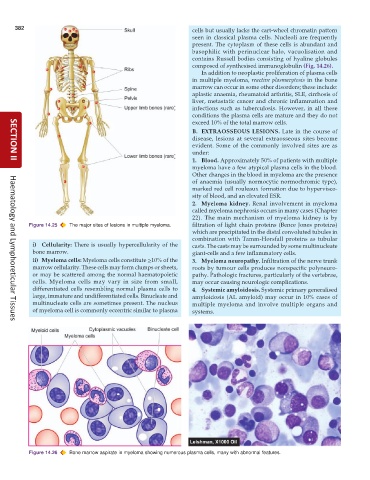
           Figure 14.25  The major sites of lesions in multiple myeloma.  filtration of light chain proteins (Bence Jones proteins)
                                                                 which are precipitated in the distal convoluted tubules in
                                                                 combination with Tamm-Horsfall proteins as tubular
            i) Cellularity: There is usually hypercellularity of the  casts. The casts may be surrounded by some multinucleate
            bone marrow.                                         giant-cells and a few inflammatory cells.
            ii) Myeloma cells: Myeloma cells constitute >10% of the  3. Myeloma neuropathy. Infiltration of the nerve trunk
            marrow cellularity. These cells may form clumps or sheets,  roots by tumour cells produces nonspecific polyneuro-
            or may be scattered among the normal haematopoietic  pathy. Pathologic fractures, particularly of the vertebrae,
            cells. Myeloma cells may vary in size from small,    may occur causing neurologic complications.
            differentiated cells resembling normal plasma cells to  4. Systemic amyloidosis. Systemic primary generalised
            large, immature and undifferentiated cells. Binucleate and  amyloidosis (AL amyloid) may occur in 10% cases of
            multinucleate cells are sometimes present. The nucleus  multiple myeloma and involve multiple organs and
            of myeloma cell is commonly eccentric similar to plasma  systems.

     Haematology and Lymphoreticular Tissues


           Figure 14.26  Bone marrow aspirate in myeloma showing numerous plasma cells, many with abnormal features.

