


Page 409 - Textbook of Pathology, 6th Edition
P. 409
ATHEROSCLEROSIS I. Major risk factors. These are further considered under 2 393
headings:
Definition
A) Major risk factors modifiable by life style and/or therapy: This
Atherosclerosis is a specific form of arteriosclerosis affecting includes major risk factors which can be controlled by
primarily the intima of large and medium-sized muscular modifying life style and/or by pharmacotherapy and
arteries and is characterised by fibrofatty plaques or includes: dyslipidaemias, hypertension, diabetes mellitus
atheromas. The term atherosclerosis is derived from athero- and smoking.
(meaning porridge) referring to the soft lipid-rich material B) Constitutional risk factors: These are non-modifiable major
in the centre of atheroma, and sclerosis (scarring) referring to risk factors that include: increasing age, male sex, genetic
connective tissue in the plaques. Atherosclerosis is the abnormalities, and familial and racial predisposition.
commonest and the most important of the arterial diseases.
Though any large and medium-sized artery may be involved II. Non-traditional emerging risk factors. This includes a
in atherosclerosis, the most commonly affected are the aorta, host of factors whose role in atherosclerosis is minimal, and
the coronary and the cerebral arterial systems. Therefore, the in some cases, even uncertain.
major clinical syndromes resulting from ischaemia due to Apparently, a combination of etiologic risk factors have
atherosclerosis pertain to the heart (angina and myocardial additive effect in producing the lesions of atherosclerosis.
infarcts or heart attacks), and the brain (transient cerebral
ischaemia and cerebral infarcts or strokes); other sequelae are MAJOR RISK FACTORS MODIFIABLE BY LIFE STYLE
peripheral vascular disease, aneurysmal dilatation due to AND/OR THERAPY
weakened arterial wall, chronic ischaemic heart disease, There are four major risk factors in atherogenesis—lipid
ischaemic encephalopathy and mesenteric arterial occlusion. disorders, hypertension, cigarette smoking and diabetes
mellitus.
Etiology
1. DYSLIPIDAEMIAS. Virchow in 19th century first
Atherosclerosis is widely prevalent in industrialised coun- identified cholesterol crystals in the atherosclerotic lesions.
tries. However, majority of the data on etiology are based Since then, extensive information on lipoproteins and their CHAPTER 15
on the animal experimental work and epidemiological role in atherosclerotic lesions has been gathered.
studies. The incidences for atherosclerosis quoted in the Abnormalities in plasma lipoproteins have been firmly
literature are based on the major clinical syndromes established as the most important major risk factor for
produced by it, the most important interpretation being that atherosclerosis. It has been firmly established that hyper-
death from myocardial infarction is related to underlying cholesterolaemia has directly proportionate relationship with
atherosclerosis. Cardiovascular disease, mostly related to atherosclerosis and IHD. The following evidences are cited
atherosclerotic coronary heart disease or ischaemic heart in support of this:
disease (IHD) is the most common cause of premature death i) The atherosclerotic plaques contain cholesterol and
in the developed countries of the world. It is estimated that cholesterol esters, largely derived from the lipoproteins in
by the year 2020, cardiovascular disease, mainly the blood.
atherosclerosis, will become the leading cause of total global
disease burden. ii) The lesions of atherosclerosis can be induced in
Systematic large scale studies of investigations on living experimental animals by feeding them with diet rich in The Blood Vessels and Lymphatics
populations have revealed a number of risk factors which are cholesterol.
associated with increased risk of developing clinical iii) Individuals with hypercholesterolaemia due to various
atherosclerosis. Often, they are acting in combination rather causes such as in diabetes mellitus, myxoedema, nephrotic
than singly. These risk factors are divided into two groups syndrome, von Gierke’s disease, xanthomatosis and familial
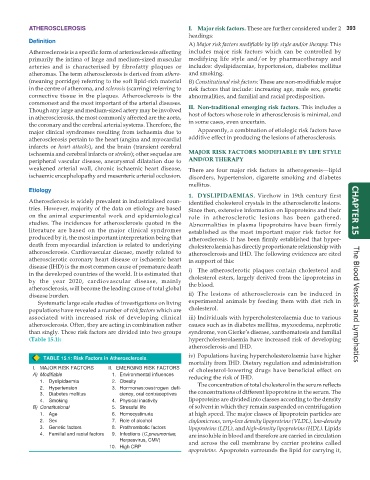
(Table 15.1): hypercholesterolaemia have increased risk of developing
atherosclerosis and IHD.
iv) Populations having hypercholesterolaemia have higher
TABLE 15.1: Risk Factors in Atherosclerosis.
mortality from IHD. Dietary regulation and administration
I. MAJOR RISK FACTORS II. EMERGING RISK FACTORS of cholesterol-lowering drugs have beneficial effect on
A) Modifiable 1. Environmental influences reducing the risk of IHD.
1. Dyslipidaemia 2. Obesity The concentration of total cholesterol in the serum reflects
2. Hypertension 3. Hormones:oestrogen defi-
3. Diabetes mellitus ciency, oral contraceptives the concentrations of different lipoproteins in the serum. The
4. Smoking 4. Physical inactivity lipoproteins are divided into classes according to the density
B) Constitutional 5. Stressful life of solvent in which they remain suspended on centrifugation
1. Age 6. Homocystinuria at high speed. The major classes of lipoprotein particles are
2. Sex 7. Role of alcohol chylomicrons, very-low density lipoproteins (VLDL), low-density
3. Genetic factors 8. Prothrombotic factors lipoproteins (LDL), and high-density lipoproteins (HDL). Lipids
4. Familial and racial factors 9. Infections (C.pneumoniae, are insoluble in blood and therefore are carried in circulation
Herpesvirus, CMV) and across the cell membrane by carrier proteins called
10. High CRP
apoproteins. Apoprotein surrounds the lipid for carrying it,

