


Page 43 - Textbook of Pathology, 6th Edition
P. 43
27  CHAPTER 3


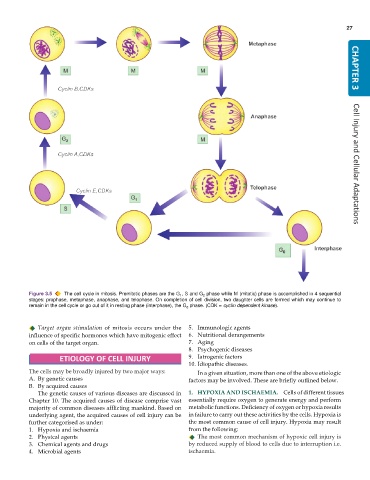
           Figure 3.5  The cell cycle in mitosis. Premitotic phases are the G 1 , S and G 2  phase while M (mitotic) phase is accomplished in 4 sequential  Cell Injury and Cellular Adaptations
           stages: prophase, metaphase, anaphase, and telophase. On completion of cell division, two daughter cells are formed which may continue to
           remain in the cell cycle or go out of it in resting phase (interphase), the G  phase. (CDK = cyclin dependent kinase).
                                                               0


              Target organ stimulation of mitosis occurs under the  5. Immunologic agents
           influence of specific hormones which have mitogenic effect  6. Nutritional derangements
           on cells of the target organ.                       7. Aging
                                                               8. Psychogenic diseases
                     ETIOLOGY OF CELL INJURY                   9. Iatrogenic factors
                                                               10. Idiopathic diseases.
           The cells may be broadly injured by two major ways:    In a given situation, more than one of the above etiologic
           A. By genetic causes                                factors may be involved. These are briefly outlined below.
           B. By acquired causes
              The genetic causes of various diseases are discussed in  1. HYPOXIA AND ISCHAEMIA.   Cells of different tissues
           Chapter 10. The acquired causes of disease comprise vast  essentially require oxygen to generate energy and perform
           majority of common diseases afflicting mankind. Based on  metabolic functions. Deficiency of oxygen or hypoxia results
           underlying agent, the acquired causes of cell injury can be  in failure to carry out these activities by the cells. Hypoxia is
           further categorised as under:                       the most common cause of cell injury. Hypoxia may result
           1. Hypoxia and ischaemia                            from the following:
           2. Physical agents                                     The most common mechanism of hypoxic cell injury is
           3. Chemical agents and drugs                        by reduced supply of blood to cells due to interruption i.e.
           4. Microbial agents                                 ischaemia.

