


Page 45 - Textbook of Pathology, 6th Edition
P. 45
genesis of hypoxic and ischaemic cell injury is, therefore, membrane transport, protein synthesis, lipid synthesis and 29
described in detail below followed by brief discussion on phospholipid metabolism). ATP in human cell is derived
pathogenesis of chemical and physical (ionising radiation) from 2 sources:
agents. firstly, by aerobic respiration or oxidative phosphorylation
(which requires oxygen) in the mitochondria, and
PATHOGENESIS OF ISCHAEMIC AND HYPOXIC INJURY
secondly, cells may switch over to anaerobic glycolytic CHAPTER 3
Ischaemia and hypoxia are the most common forms of cell oxidation to maintain constant supply of ATP (in which ATP
injury. Although underlying intracellular mechanisms and is generated from glucose/glycogen in the absence of
ultrastructural changes involved in reversible and oxygen).
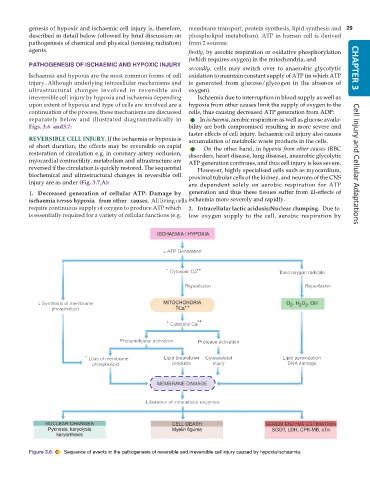
irreversible cell injury by hypoxia and ischaemia depending Ischaemia due to interruption in blood supply as well as
upon extent of hypoxia and type of cells are involved are a hypoxia from other causes limit the supply of oxygen to the
continuation of the process, these mechanisms are discussed cells, thus causing decreased ATP generation from ADP:
separately below and illustrated diagrammatically in In ischaemia, aerobic respiration as well as glucose availa-
Figs. 3.6 and 3.7: bility are both compromised resulting in more severe and
faster effects of cell injury. Ischaemic cell injury also causes
REVERSIBLE CELL INJURY. If the ischaemia or hypoxia is accumulation of metabolic waste products in the cells.
of short duration, the effects may be reversible on rapid On the other hand, in hypoxia from other causes (RBC
restoration of circulation e.g. in coronary artery occlusion, disorders, heart disease, lung disease), anaerobic glycolytic
myocardial contractility, metabolism and ultrastructure are ATP generation continues, and thus cell injury is less severe.
reversed if the circulation is quickly restored. The sequential However, highly specialised cells such as myocardium, Cell Injury and Cellular Adaptations
biochemical and ultrastructural changes in reversible cell proximal tubular cells of the kidney, and neurons of the CNS
injury are as under (Fig. 3.7,A): are dependent solely on aerobic respiration for ATP
1. Decreased generation of cellular ATP: Damage by generation and thus these tissues suffer from ill-effects of
ischaemia versus hypoxia from other causes.All living cells ischaemia more severely and rapidly.
require continuous supply of oxygen to produce ATP which 2. Intracellular lactic acidosis:Nuclear clumping. Due to
is essentially required for a variety of cellular functions (e.g. low oxygen supply to the cell, aerobic respiration by
Figure 3.6 Sequence of events in the pathogenesis of reversible and irreversible cell injury caused by hypoxia/ischaemia.

