


Page 464 - Textbook of Pathology, 6th Edition
P. 464
448


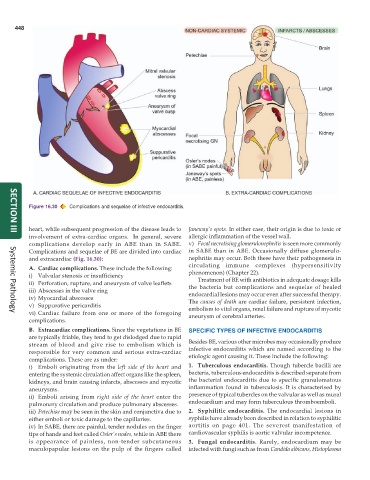
           Figure 16.30  Complications and sequelae of infective endocarditis.


           heart, while subsequent progression of the disease leads to  Janeway’s spots. In either case, their origin is due to toxic or
     SECTION III
           involvement of extra-cardiac organs.  In general, severe  allergic inflammation of the vessel wall.
           complications develop early in ABE than in SABE.    v) Focal necrotising glomerulonephritis is seen more commonly
           Complications and sequelae of BE are divided into cardiac  in SABE than in ABE. Occasionally diffuse glomerulo-
           and extracardiac (Fig. 16.30):                      nephritis may occur. Both these have their pathogenesis in
                                                               circulating immune complexes (hypersensitivity
           A. Cardiac complications. These include the following:
           i) Valvular stenosis or insufficiency               phenomenon) (Chapter 22).
           ii) Perforation, rupture, and aneurysm of valve leaflets  Treatment of BE with antibiotics in adequate dosage kills
           iii) Abscesses in the valve ring                    the bacteria but complications and sequelae of healed
                                                               endocardial lesions may occur even after successful therapy.
           iv) Myocardial abscesses                            The causes of death are cardiac failure, persistent infection,
           v) Suppurative pericarditis                         embolism to vital organs, renal failure and rupture of mycotic
           vi) Cardiac failure from one or more of the foregoing  aneurysm of cerebral arteries.
     Systemic Pathology
           complications.
           B. Extracardiac complications. Since the vegetations in BE  SPECIFIC TYPES OF INFECTIVE ENDOCARDITIS
           are typically friable, they tend to get dislodged due to rapid
           stream of blood and give rise to embolism which is  Besides BE, various other microbes may occasionally produce
           responsible for very common and serious extra-cardiac  infective endocarditis which are named according to the
           complications. These are as under:                  etiologic agent causing it. These include the following:
           i) Emboli originating from the  left side of the heart and  1. Tuberculous endocarditis. Though tubercle bacilli are
           entering the systemic circulation affect organs like the spleen,  bacteria, tuberculous endocarditis is described separate from
           kidneys, and brain causing infarcts, abscesses and mycotic  the bacterial endocarditis due to specific granulomatous
           aneurysms.                                          inflammation found in tuberculosis. It is characterised by
           ii) Emboli arising from  right side of the heart enter the  presence of typical tubercles on the valvular as well as mural
           pulmonary circulation and produce pulmonary abscesses.  endocardium and may form tuberculous thromboemboli.
           iii) Petechiae may be seen in the skin and conjunctiva due to  2. Syphilitic endocarditis. The endocardial lesions in
           either emboli or toxic damage to the capillaries.   syphilis have already been described in relation to syphilitic
           iv) In SABE, there are painful, tender nodules on the finger  aortitis on page 401. The severest manifestation of
           tips of hands and feet called Osler’s nodes, while in ABE there  cardiovascular syphilis is aortic valvular incompetence.
           is appearance of painless, non-tender subcutaneous  3. Fungal endocarditis. Rarely, endocardium may be
           maculopapular lesions on the pulp of the fingers called  infected with fungi such as from Candida albicans, Histoplasma

