


Page 508 - Textbook of Pathology, 6th Edition
P. 508
492 Asbestos Disease
           Asbestos as a mineral is known to mankind for more than
           4000 years but its harmful effects have come to light during
           the last few decades. Asbestos is a Greek word meaning
           ‘unquenchable’. In general, if coal is lot of dust and little fibrosis,
           asbestos is little dust and a lot of fibrosis. Prolonged exposure
           for a number of years to asbestos dust produces three types
           of severe diseases:  asbestosis of lungs, pleural disease and
           tumours. In nature, asbestos exists as long thin fibrils which
           are fire-resistant and can be spun into yarns and fabrics
           suitable for thermal and electrical insulation and has many
           applications in industries. Particularly at risk are workers
           engaged in mining, fabrication and manufacture of a number
           of products from asbestos such as asbestos pipes, tiles, roofs,
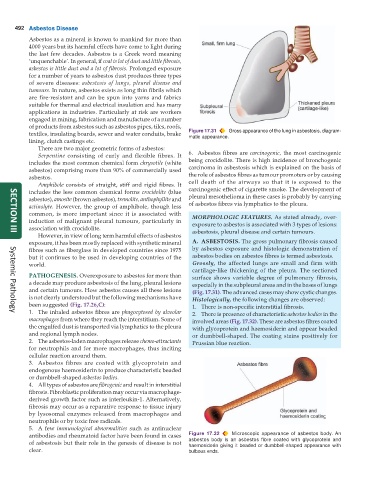
           textiles, insulating boards, sewer and water conduits, brake  Figure 17.31  Gross appearance of the lung in asbestosis, diagram-
                                                               matic appearance.
           lining, clutch castings etc.
              There are two major geometric forms of asbestos:
              Serpentine consisting of curly and flexible fibres. It  6. Asbestos fibres are  carcinogenic, the most carcinogenic
           includes the most common chemical form chrysotile (white  being crocidolite. There is high incidence of bronchogenic
           asbestos) comprising more than 90% of commercially used  carcinoma in asbestosis which is explained on the basis of
           asbestos.                                           the role of asbestos fibres as tumour promoters or by causing
              Amphibole consists of straight, stiff and rigid fibres. It  cell death of the airways so that it is exposed to the
           includes the less common chemical forms crocidolite (blue  carcinogenic effect of cigarette smoke. The development of
           asbestos), amosite (brown asbestos), tremolite, anthophyllite and  pleural mesothelioma in these cases is probably by carrying
           actinolyte. However, the group of amphibole, though less  of asbestos fibres via lymphatics to the pleura.
           common, is more important since it is associated with  MORPHOLOGIC FEATURES. As stated already, over-
           induction of malignant pleural tumours, particularly in  exposure to asbestos is associated with 3 types of lesions:
           association with crocidolite.                         asbestosis, pleural disease and certain tumours.
              However, in view of long term harmful effects of asbestos
     SECTION III
           exposure, it has been mostly replaced with synthetic mineral  A. ASBESTOSIS. The gross pulmonary fibrosis caused
           fibres such as fiberglass in developed countries since 1975  by asbestos exposure and histologic demonstration of
           but it continues to be used in developing countries of the  asbestos bodies on asbestos fibres is termed asbestosis.
           world.                                                Grossly, the affected lungs are small and firm with
                                                                 cartilage-like thickening of the pleura. The sectioned
           PATHOGENESIS. Overexposure to asbestos for more than  surface shows variable degree of pulmonary fibrosis,
           a decade may produce asbestosis of the lung, pleural lesions  especially in the subpleural areas and in the bases of lungs
           and certain tumours. How asbestos causes all these lesions  (Fig. 17.31). The advanced cases may show cystic changes.
           is not clearly understood but the following mechanisms have  Histologically, the following changes are observed:
           been suggested (Fig. 17.26,C):                        1. There is non-specific interstitial fibrosis.
           1. The inhaled asbestos fibres are phagocytosed by alveolar  2. There is presence of characteristic asbestos bodies in the
     Systemic Pathology
           macrophages from where they reach the interstitium. Some of  involved areas (Fig. 17.32). These are asbestos fibres coated
           the engulfed dust is transported via lymphatics to the pleura  with glycoprotein and haemosiderin and appear beaded
           and regional lymph nodes.                             or dumbbell-shaped. The coating stains positively for
           2. The asbestos-laden macrophages release chemo-attractants  Prussian blue reaction.
           for neutrophils and for more macrophages, thus inciting
           cellular reaction around them.
           3. Asbestos fibres are coated with glycoprotein and
           endogenous haemosiderin to produce characteristic beaded
           or dumbbell-shaped asbestos bodies.
           4. All types of asbestos are fibrogenic and result in interstitial
           fibrosis. Fibroblastic proliferation may occur via macrophage-
           derived growth factor such as interleukin-1. Alternatively,
           fibrosis may occur as a reparative response to tissue injury
           by lysosomal enzymes released from macrophages and
           neutrophils or by toxic free radicals.
           5. A few immunological abnormalities such as antinuclear
           antibodies and rheumatoid factor have been found in cases  Figure 17.32  Microscopic appearance of asbestos body. An
           of asbestosis but their role in the genesis of disease is not  asbestos body is an asbestos fibre coated with glycoprotein and
                                                               haemosiderin giving it beaded or dumbbell-shaped appearance with
           clear.                                              bulbous ends.

