


Page 506 - Textbook of Pathology, 6th Edition
P. 506
490                                                      probably due to swallowing of coal dust containing
                                                               carcinogens. But bronchogenic carcinoma does not appear
                                                               to be more common in coal-miners than in other groups.

                                                               Silicosis

                                                               Historically, silicosis used to be called ‘knife grinders’ lung.
                                                               Silicosis is caused by prolonged inhalation of silicon dioxide,
                                                               commonly called silica. Silica constitutes about one-fourth
                                                               of earth’s crust. Therefore, a number of occupations engaged
                                                               in silceous rocks or sand and products manufactured from
                                                               them are at increased risk. These include miners (e.g. of
                                                               granite, sandstone, slate, coal, gold, tin and copper), quarry
                                                               workers, tunnellers, sandblasters, grinders, ceramic workers,
                                                               foundry workers and those involved in the manufacture of
                                                               abrasives containing silica. Peculiar to India are the occu-
                                                               pational exposure to pencil, slate and agate-grinding industry
                                                               carrying high risk of silicosis (agate = very hard stone
                                                               containing silica). According to an Indian Council of Medical
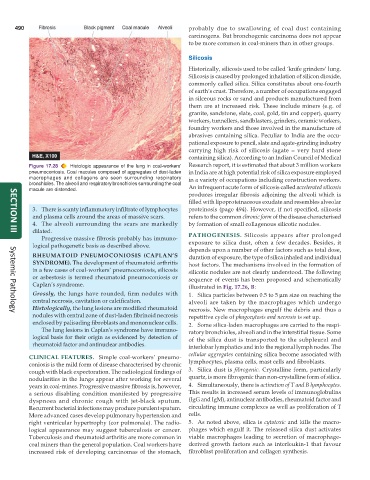
           Figure 17.28  Histologic appearance of the lung in coal-workers’  Research report, it is estimated that about 3 million workers
           pneumoconiosis. Coal macules composed of aggregates of dust-laden  in India are at high potential risk of silica exposure employed
           macrophages and collagens are seen surrounding respiratory  in a variety of occupations including construction workers.
           bronchioles. The alveoli and respiratory bronchioles surrounding the coal
           macule are distended.                               An infrequent acute form of silicosis called accelerated silicosis
                                                               produces irregular fibrosis adjoining the alveoli which is
                                                               filled with lipoproteinaceous exudate and resembles alveolar
            3. There is scanty inflammatory infiltrate of lymphocytes  proteinosis (page 494). However, if not specified, silicosis
            and plasma cells around the areas of massive scars.  refers to the common chronic form of the disease characterised
            4. The alveoli surrounding the scars are markedly  by formation of small collagenous silicotic nodules.
            dilated.
     SECTION III
               Progressive massive fibrosis probably has immuno-  PATHOGENESIS.  Silicosis appears after prolonged
            logical pathogenetic basis as described above.     exposure to silica dust, often a few decades. Besides, it
                                                               depends upon a number of other factors such as total dose,
            RHEUMATOID PNEUMOCONIOSIS (CAPLAN’S                duration of exposure, the type of silica inhaled and individual
            SYNDROME). The development of rheumatoid arthritis  host factors. The mechanisms involved in the formation of
            in a few cases of coal-workers’ pneumoconiosis, silicosis  silicotic nodules are not clearly understood. The following
            or asbestosis is termed rheumatoid pneumoconiosis or  sequence of events has been proposed and schematically
            Caplan’s syndrome.                                 illustrated in Fig. 17.26, B:
            Grossly, the lungs have rounded, firm nodules with  1. Silica particles between 0.5 to 5 μm size on reaching the
            central necrosis, cavitation or calcification.     alveoli are taken by the macrophages which undergo
            Histologically, the lung lesions are modified rheumatoid  necrosis. New macrophages engulf the debris and thus a
            nodules with central zone of dust-laden fibrinoid necrosis  repetitive cycle of phagocytosis and necrosis is set up.
     Systemic Pathology
            enclosed by palisading fibroblasts and mononuclear cells.  2. Some silica-laden macrophages are carried to the respi-
               The lung lesions in Caplan’s syndrome have immuno-  ratory bronchioles, alveoli and in the interstitial tissue. Some
            logical basis for their origin as evidenced by detection of  of the silica dust is transported to the subpleural and
            rheumatoid factor and antinuclear antibodies.      interlobar lymphatics and into the regional lymph nodes. The
                                                               cellular aggregates containing silica become associated with
           CLINICAL FEATURES.   Simple coal-workers’ pneumo-
           coniosis is the mild form of disease characterised by chronic  lymphocytes, plasma cells, mast cells and fibroblasts.
           cough with black expectoration. The radiological findings of  3. Silica dust is  fibrogenic. Crystalline form, particularly
           nodularities in the lungs appear after working for several  quartz, is more fibrogenic than non-crystalline form of silica.
           years in coal-mines. Progressive massive fibrosis is, however,  4. Simultaneously, there is activation of T and B lymphocytes.
           a serious disabling condition manifested by progressive  This results in increased serum levels of immunoglobulins
           dyspnoea and chronic cough with jet-black sputum.   (IgG and IgM), antinuclear antibodies, rheumatoid factor and
           Recurrent bacterial infections may produce purulent sputum.  circulating immune complexes as well as proliferation of T
           More advanced cases develop pulmonary hypertension and  cells.
           right ventricular hypertrophy (cor pulmonale). The radio-  5. As noted above, silica is cytotoxic and kills the macro-
           logical appearance may suggest tuberculosis or cancer.  phages which engulf it. The released silica dust activates
           Tuberculosis and rheumatoid arthritis are more common in  viable macrophages leading to secretion of macrophage-
           coal miners than the general population. Coal workers have  derived growth factors such as interleukin-1 that favour
           increased risk of developing carcinomas of the stomach,  fibroblast proliferation and collagen synthesis.

