


Page 514 - Textbook of Pathology, 6th Edition
P. 514
498


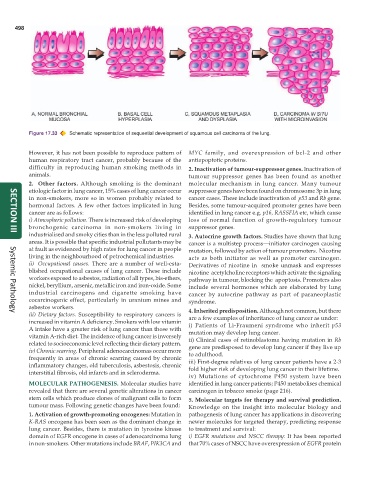
           Figure 17.33  Schematic representation of sequential development of squamous cell carcinoma of the lung.


           However, it has not been possible to reproduce pattern of  MYC family, and overexpression of bcl-2 and other
           human respiratory tract cancer, probably because of the  antiapoptotic proteins.
           difficulty in reproducing human smoking methods in  2. Inactivation of tumour-suppressor genes. Inactivation of
           animals.                                            tumour suppressor genes has been found as another
           2. Other factors.  Although smoking is the dominant  molecular mechanism in lung cancer. Many tumour
           etiologic factor in lung cancer, 15% cases of lung cancer occur  suppressor genes have been found on chromosome 3p in lung
           in non-smokers, more so in women probably related to  cancer cases. These include inactivation of  p53 and Rb gene.
           hormonal factors. A few other factors implicated in lung  Besides, some tumour-acquired promoter genes have been
           cancer are as follows:                              identified in lung cancer e.g. p16, RASSFIA etc, which cause
           i) Atmospheric pollution. There is increased risk of developing  loss of normal function of growth-regulatory tumour
           bronchogenic carcinoma in non-smokers living in     suppressor genes.
           industrialised and smoky cities than in the less polluted rural  3. Autocrine growth factors. Studies have shown that lung
     SECTION III
           areas. It is possible that specific industrial pollutants may be  cancer is a multistep process—initiator carcinogen causing
           at fault as evidenced by high rates for lung cancer in people  mutation, followed by action of tumour promoters.  Nicotine
           living in the neighbourhood of petrochemical industries.  acts as both initiator as well as promoter carcinogen.
           ii) Occupational causes. There are a number of well-esta-  Derivatives of nicotine in  smoke unmask and expresses
           blished occupational causes of lung cancer. These include  nicotine  acetylcholine receptors which activate the signaling
           workers exposed to asbestos, radiation of all types, bis-ethers,  pathway in tumour, blocking the  apoptosis. Promoters also
           nickel, beryllium, arsenic, metallic iron and iron-oxide. Some  include several hormones which are elaborated by lung
           industrial carcinogens and cigarette smoking have   cancer by autocrine pathway as part of paraneoplastic
           cocarcinogenic effect, particularly in uranium mines and  syndrome.
           asbestos workers.                                   4. Inherited predisposition. Although not common, but there
           iii) Dietary factors. Susceptibility to respiratory cancers is  are a few examples of inheritance of lung cancer as under:
     Systemic Pathology
           increased in vitamin A deficiency. Smokers with low vitamin
           A intake have a greater risk of lung cancer than those with  i) Patients of Li-Fraumeni syndrome who inherit  p53
                                                               mutation may develop lung cancer.
           vitamin A-rich diet. The incidence of lung cancer is inversely
           related to socioeconomic level reflecting their dietary pattern.  ii) Clinical cases of retinoblastoma having mutation in Rb
                                                               gene are predisposed to develop lung cancer if they live up
           iv) Chronic scarring. Peripheral adenocarcinomas occur more  to adulthood.
           frequently in areas of chronic scarring caused by chronic  iii) First-degree relatives of lung cancer patients have a 2-3
           inflammatory changes, old tuberculosis, asbestosis, chronic  fold higher risk of developing lung cancer in their lifetime.
           interstitial fibrosis, old infarcts and in scleroderma.
                                                               iv) Mutations of cytochrome P450 system have been
           MOLECULAR PATHOGENESIS. Molecular studies have      identified in lung cancer patients; P450 metabolises chemical
           revealed that there are several genetic alterations in cancer  carcinogen in tobacco smoke (page 216).
           stem cells which produce clones of malignant cells to form  5. Molecular targets for therapy and survival prediction.
           tumour mass. Following genetic changes have been found:  Knowledge on the insight into molecular biology and
           1. Activation of growth-promoting oncogenes: Mutation in  pathogenesis of lung cancer has applications in discovering
           K-RAS oncogene has been seen as the dominant change in  newer molecules for targeted therapy, predicting response
           lung cancer. Besides, there is mutation in tyrosine kinase  to treatment and survival:
           domain of EGFR oncogene in cases of adenocarcinoma lung  i) EGFR mutations and NSCC therapy: It has been reported
           in non-smokers. Other mutations include BRAF, PIK3CA and  that 70% cases of NSCC have overexpression of EGFR protein

