


Page 660 - Textbook of Pathology, 6th Edition
P. 660
644                                                        Histologically, the following patterns are observed:
                                                                 1. Most gallbladder cancers are adenocarcinomas (90%).
                                                                 They may be papillary or infiltrative, well-differentiated
                                                                 or poorly-differentiated. Most are non-mucin secreting but
                                                                 some are colloid carcinomas forming mucus pools.
                                                                 2. About 5% of gallbladder cancers are squamous cell
                                                                 carcinomas arising from squamous metaplastic epithelium.
                                                                 3. A few cases show both squamous and adeno-
                                                                 carcinoma pattern of growth called  adenosquamous
                                                                 carcinoma.
                                                               CLINICAL FEATURES.  Carcinoma of the gallbadder is
                                                               slow-growing and causes symptoms late in the course of
                                                               disease. Quite often, the diagnosis is made when gallbladder
                                                               is removed for cholelithiasis. The symptomatic cases have
                                                               pain, jaundice, noticeable mass, anorexia and weight loss.
                                                               In such case, the growth has usually invaded the liver and
                                                               other adjacent organs and has metastasised to regional lymph
                                                               nodes and more distant sites such as the lung, peritoneum
                                                               and gastrointestinal tract.

                                                               Carcinoma of Extrahepatic Bile Ducts and
                                                               Ampulla of Vater
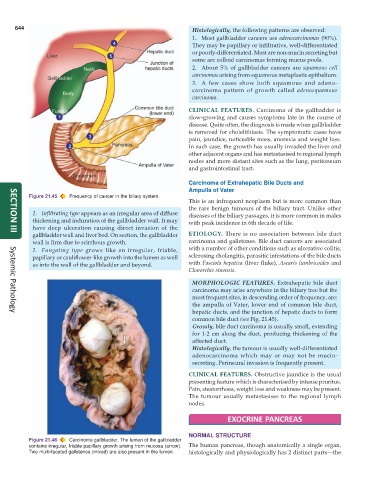
           Figure 21.45  Frequency of cancer in the biliary system.
                                                               This is an infrequent neoplasm but is more common than
                                                               the rare benign tumours of the biliary tract. Unlike other
            1. Infiltrating type appears as an irregular area of diffuse  diseases of the biliary passages, it is more common in males
            thickening and induration of the gallbladder wall. It may  with peak incidence in 6th decade of life.
            have deep ulceration causing direct invasion of the
            gallbladder wall and liver bed. On section, the gallbladder  ETIOLOGY.  There is no association between bile duct
     SECTION III
            wall is firm due to scirrhous growth.              carcinoma and gallstones. Bile duct cancers are associated
            2. Fungating type grows like an irregular, friable,  with a number of other conditions such as ulcerative colitis,
            papillary or cauliflower-like growth into the lumen as well  sclerosing cholangitis, parasitic infestations of the bile ducts
            as into the wall of the gallbladder and beyond.    with Fasciola hepatica (liver fluke), Ascaris lumbricoides and
                                                               Clonorchis sinensis.

                                                                 MORPHOLOGIC FEATURES. Extrahepatic bile duct
                                                                 carcinoma may arise anywhere in the biliary tree but the
                                                                 most frequent sites, in descending order of frequency, are:
                                                                 the ampulla of Vater, lower end of common bile duct,
                                                                 hepatic ducts, and the junction of hepatic ducts to form
     Systemic Pathology
                                                                 common bile duct (see Fig. 21.45).
                                                                 Grossly, bile duct carcinoma is usually small, extending
                                                                 for 1-2 cm along the duct, producing thickening of the
                                                                 affected duct.
                                                                 Histologically, the tumour is usually well-differentiated
                                                                 adenocarcinoma which may or may not be mucin-
                                                                 secreting. Perineural invasion is frequently present.
                                                               CLINICAL FEATURES. Obstructive jaundice is the usual
                                                               presenting feature which is characterised by intense pruritus.
                                                               Pain, steatorrhoea, weight loss and weakness may be present.
                                                               The tumour usually metastasises to the regional lymph
                                                               nodes.


                                                                            EXOCRINE PANCREAS

                                                               NORMAL STRUCTURE
           Figure 21.46  Carcinoma gallbladder. The lumen of the gallbladder
           contains irregular, friable papillary growth arising from mucosa (arrow).  The human pancreas, though anatomically a single organ,
           Two multi-faceted gallstones (mixed) are also present in the lumen.  histologically and physiologically has 2 distinct parts—the

